
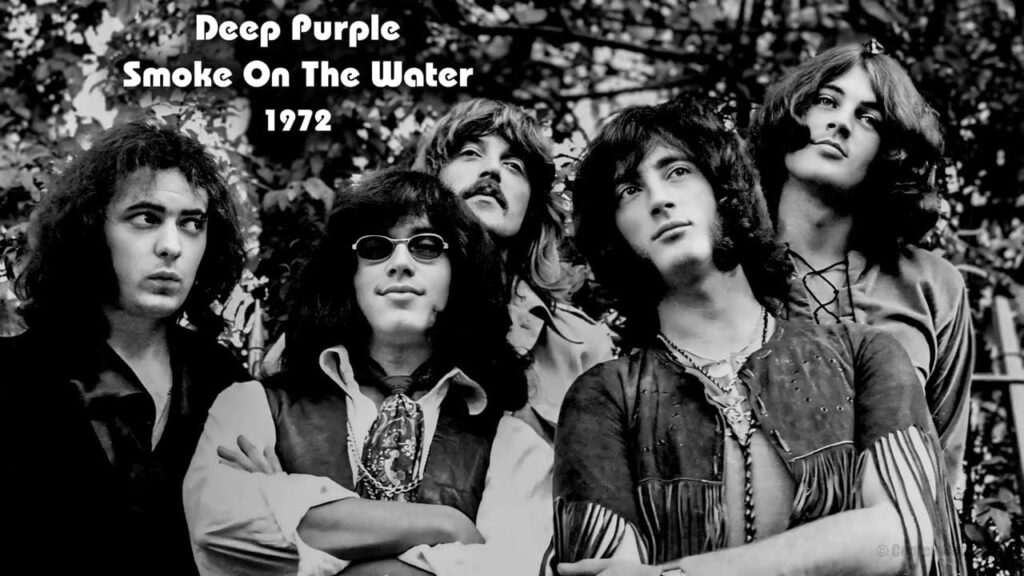
A Fiery Birth from Lake Geneva’s Ashes: Smoke on the Water Chronicles a Moment in Rock History.
Ah, Deep Purple. The very name conjures images of powerful riffs, soaring vocals, and a raw energy that defined a generation. And among their formidable catalog, one song stands out, instantly recognizable from its iconic opening chords: “Smoke on the Water”. Released in late 1972 as part of their seminal album, Machine Head, this track wasn’t just a hit; it became a cultural touchstone, a narrative etched in the annals of rock and roll. Climbing to the respectable position of number four on the Billboard Hot 100 chart in the United States in 1973, its impact transcended mere chart success, embedding itself deeply into the collective consciousness of music lovers worldwide.
The story behind “Smoke on the Water” is as compelling as the riff itself, a real-life drama unfolding against the picturesque backdrop of Lake Geneva, Switzerland. The band had traveled there in December 1971 to record their next album in the tranquility of the Montreux Casino, a venue that also housed a concert hall. Fate, however, had other plans. Just before a Frank Zappa and The Mothers of Invention concert, a fire erupted during the show, sparked by a stray flare gun. The ensuing blaze engulfed the casino, sending thick plumes of smoke billowing over Lake Geneva – a दृश्य that guitarist Ritchie Blackmore witnessed from his hotel window and immortalized in that unforgettable guitar phrase.
Imagine the scene: the cold Swiss air, the serene lake reflecting the ominous smoke, the frantic activity as the fire raged. This wasn’t some abstract rock and roll fantasy; this was reality intruding on their creative process. Bassist Roger Glover, recalling the event, remarked on the almost poetic image of the smoke drifting across the water, a phrase that would ultimately become the song’s evocative title. The lyrics, penned by vocalist Ian Gillan, paint a vivid picture of the chaos and displacement they experienced: “We all came out to Montreux / On the Lake Geneva shoreline / To make records in a mobile / We didn’t have much time.” It’s a straightforward account, almost journalistic in its delivery, yet imbued with a sense of awe and disbelief at the unfolding events.
But “Smoke on the Water” is more than just a recounting of a dramatic incident. It taps into a deeper feeling of resilience, of art emerging from adversity. The fire forced Deep Purple to relocate their recording sessions to the Grand Hôtel de Territet, a less-than-ideal setting that nonetheless became the birthplace of Machine Head, an album that would solidify their place among rock’s elite. The song’s enduring popularity lies, in part, in this underlying message: even in the face of chaos and disruption, creativity can find a way. That powerful, blues-infused riff, simple yet instantly recognizable, embodies this spirit – a defiant statement rising from the ashes.
For those of us who remember the early 70s, “Smoke on the Water” is more than just a song; it’s a memory trigger. It takes us back to a time of change, of experimentation in music, of a raw and untamed energy that permeated the airwaves. It was a time when rock music was finding its voice, pushing boundaries, and telling stories in a way that resonated deeply with a generation seeking something authentic and real. The sheer power of Ian Gillan‘s vocals, the precision of Ritchie Blackmore‘s guitar work, the solid foundation laid by Roger Glover‘s bass and Ian Paice‘s drums – it all combined to create a sound that was both visceral and sophisticated.
Machine Head itself was a landmark album, featuring other enduring tracks like “Highway Star” and “Space Truckin'”, but “Smoke on the Water” possessed a unique quality, a narrative that transcended the typical rock and roll themes. It was a story everyone could understand, a testament to the unexpected twists and turns of life and the ability of artists to transform those experiences into something meaningful and lasting. So, when those opening chords ring out, take a moment to remember the smoke over Lake Geneva, the resilience of a band, and the enduring power of a song that captured a moment in time and continues to resonate with generations of music lovers. It’s a reminder that sometimes, the most iconic creations are born from the most unexpected circumstances.