
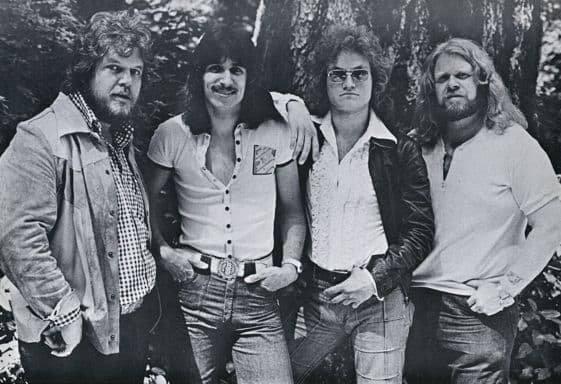
A Stutter, a Swagger, and a Surprise No. 1: The Playful Confidence of “You Ain’t Seen Nothing Yet”
When Bachman–Turner Overdrive released “You Ain’t Seen Nothing Yet” in 1974, few could have predicted that this cheeky, swaggering rocker—originally intended as a joke—would become their signature hit and a transatlantic chart-topper. Issued as a single from the album Not Fragile, the song soared to No. 1 on the Billboard Hot 100 in the United States and also reached No. 1 on the UK Singles Chart, cementing the Canadian band’s place in rock history. It was a rare moment when spontaneity, humor, and pure instinct aligned perfectly with the public mood.
By the autumn of 1974, Bachman–Turner Overdrive (BTO)—fronted by Randy Bachman, formerly of The Guess Who—were already riding high. Their album Not Fragile had knocked The Rolling Stones’ It’s Only Rock ’n Roll off the top of the U.S. album chart, reaching No. 1 on the Billboard 200. BTO had established themselves as purveyors of straight-ahead, no-nonsense rock—driven by muscular riffs, steady backbeats, and an unpretentious working-class ethos. But “You Ain’t Seen Nothing Yet” was something else entirely.
The story behind the song is one of rock’s most charming accidents. Randy Bachman wrote it partly as a playful nod to his brother, Gary Bachman, who had a stutter. The now-famous vocal stammer—“B-b-b-baby, you just ain’t seen n-n-nothin’ yet”—was originally recorded as a joke, never intended for release. In fact, Bachman had planned to remove the stuttered vocal before the album was finalized. Yet when the band’s label and radio programmers heard it, they insisted the version with the stammer was the one. What began as an inside joke became the hook that listeners couldn’t shake.
Musically, the song is built on a thick, rolling bass line from Fred Turner, a pounding rhythm section, and a riff that feels both bluesy and industrial—like the sound of machinery in motion. There is a certain mechanical persistence to the groove, but over it floats Bachman’s playful vocal, full of bravado and teasing charm. It’s a flirtation set to distortion, a promise wrapped in a grin.
Lyrically, “You Ain’t Seen Nothing Yet” is simple, almost boastful. It’s the voice of someone assuring a lover that the best is yet to come. But beneath that surface bravado lies something more resonant. In 1974, amid economic uncertainty and cultural change, perhaps that line—“You ain’t seen nothing yet”—felt like reassurance. It suggested that the story wasn’t over, that greater moments lay ahead. There’s optimism in that repetition, a stubborn refusal to let the present define the future.
For many, the song evokes the golden age of AM radio, when rock songs were shorter, punchier, and designed to leap from dashboard speakers on long drives. You can almost hear the crackle of vinyl, feel the weight of a 45 spinning on the turntable. The opening guitar riff still lands with the same punch it did five decades ago. It’s not ornate. It doesn’t aspire to poetic complexity. Instead, it thrives on immediacy—on the physical pleasure of a tight groove and a catchy refrain.
Interestingly, the song also stands as a testament to Randy Bachman’s resilience. After leaving The Guess Who, he faced skepticism about whether he could recreate his earlier success. With Bachman–Turner Overdrive, he not only proved his staying power but arguably surpassed it. “You Ain’t Seen Nothing Yet” became BTO’s only U.S. No. 1 single, but its impact endures far beyond chart statistics. It’s the kind of track that appears in films, commercials, and classic rock playlists, each time rekindling a spark of recognition.
There is something profoundly human about its backstory—a private joke turned public anthem. It reminds us that sometimes the moments we don’t overthink, the ones born from laughter and spontaneity, resonate the longest. The stutter that might have been erased instead became immortal. And in that quirk lies the heart of rock ’n’ roll: imperfection embraced, individuality amplified.
Nearly half a century later, “You Ain’t Seen Nothing Yet” still sounds like a wink across time. It carries the confidence of youth, yes, but also the memory of it—the echo of crowded arenas, of radios humming in garages, of a generation discovering its own volume. The promise embedded in its chorus remains timeless: whatever has already passed, there’s always more ahead.