
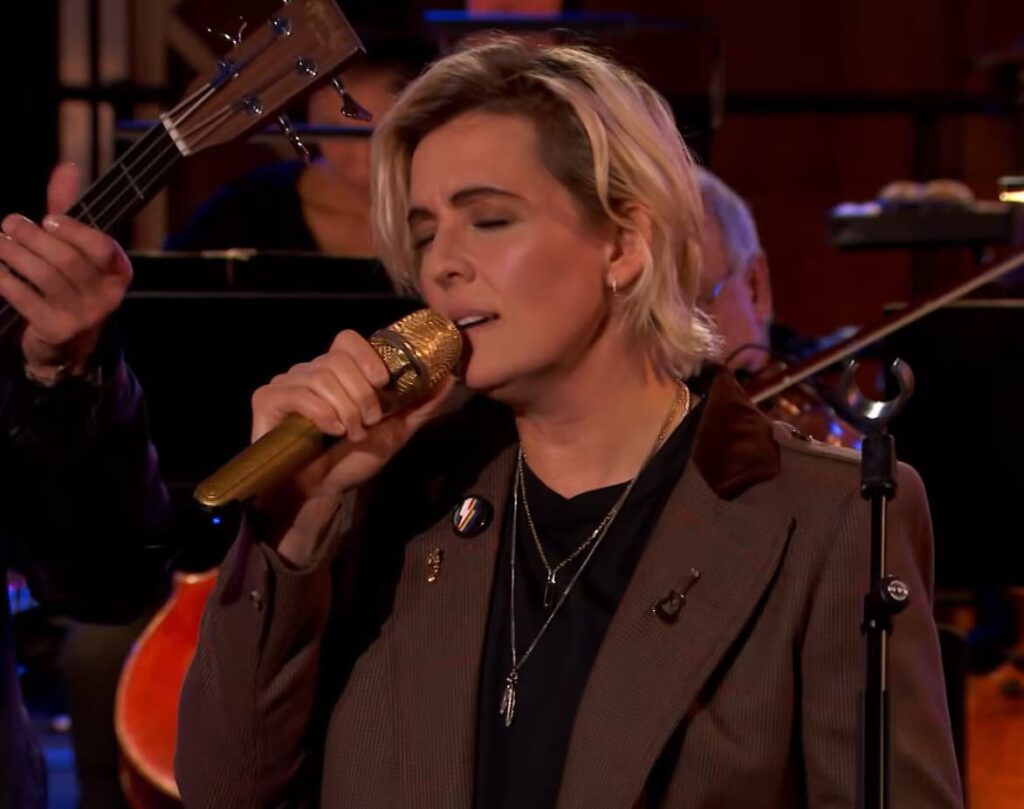
A song about standing bare before the world, admitting weakness not as failure, but as proof of being alive
When Brandi Carlile sings “Human,” she is not introducing a new song to the world so much as she is reopening an old wound—gently, honestly, and without disguise. Originally written and recorded by Rag’n’Bone Man, “Human” became a global hit in 2016–2017, reaching No. 1 on the UK Singles Chart and breaking into the Top 20 of the Billboard Hot 100. Carlile’s version, however, followed a very different path. It was not released as a commercial single, did not enter any official charts upon release, and yet it found a deep, lasting life through live performances and special recordings, particularly during the late 2010s when Carlile was emerging as one of the most emotionally trusted voices in American music.
That contrast matters. Where the original recording leans into dark, modern soul with a heavy, almost confrontational intensity, Brandi Carlile’s “Human” feels like a late-night confession. Her interpretation strips away bravado and leaves something quieter, more fragile, and perhaps more familiar to listeners who have lived long enough to understand disappointment—not as drama, but as fact.
Carlile has always been drawn to songs about moral weight and emotional responsibility. From “The Story” to “The Joke” and “Every Time I Hear That Song,” her catalog consistently circles the idea that strength and vulnerability are not opposites. In “Human,” that philosophy finds a perfect vessel. The song’s central line—“I’m only human after all”—is not delivered as an excuse, but as a weary truth. In Carlile’s hands, it sounds less like self-defense and more like a quiet apology to the people we could not save, the promises we could not keep, and the younger versions of ourselves who believed we might.
The story behind Carlile’s connection to “Human” is less about authorship and more about recognition. She did not need to rewrite the song to make it her own; she simply stood inside it. Her performances emphasize breath, phrasing, and silence. She allows certain lines to linger, as if weighing whether they are worth saying aloud at all. That restraint is a hallmark of her maturity as an artist. She understands that not every emotion needs to be shouted—some are more truthful when whispered.
Musically, Carlile’s version often leans toward a sparse arrangement, letting her voice carry the emotional argument. There is no attempt to outsing the song. Instead, she listens to it, responds to it, and invites the audience to do the same. This approach resonates deeply with listeners who came of age in an era when songs were companions, not content—when lyrics were memorized because they mattered, not because they were catchy.
The meaning of “Human” becomes especially powerful through this lens. It is a song about limits: emotional limits, moral limits, physical limits. It acknowledges the desire to be heroic while admitting the inevitability of failure. In Carlile’s interpretation, the song feels less concerned with judgment and more concerned with mercy—especially self-mercy. That perspective aligns closely with her broader body of work, particularly the themes explored on By the Way, I Forgive You, the album that marked her creative and commercial breakthrough.
What makes Brandi Carlile’s “Human” endure is not its chart position—because it has none—but its emotional accuracy. It speaks to listeners who understand that life rarely resolves cleanly, that intentions and outcomes often part ways, and that dignity sometimes lies in admitting we are unfinished. The song does not promise redemption. It offers recognition, which can be just as sustaining.
In the long conversation of popular music, “Human” as sung by Brandi Carlile occupies a quiet but meaningful space. It is not a hit in the traditional sense, but it is a mirror. And for those who have lived long enough to appreciate honesty over perfection, that may be the highest achievement a song can reach.