
A Tender Salute to Forgotten Souls and Quiet Rooms Where Love Still Waits
When Jason Isbell stepped into the sacred emotional space of “Hello in There”, he wasn’t merely covering a song—he was carrying forward a fragile inheritance. The song itself was written and first recorded by the incomparable John Prine in 1971 for his self-titled debut album John Prine. That album, released by Atlantic Records, climbed to No. 39 on the Billboard 200, and over the decades it has come to be regarded as one of the most profound debut albums in American songwriting history. While “Hello in There” was never a charting single in the commercial sense, it became one of Prine’s signature compositions—an enduring anthem of empathy that critics and fellow musicians have consistently placed among the greatest songs of its era.
From the beginning, “Hello in There” stood apart. In an age dominated by bombast and youthful rebellion, Prine—barely in his mid-twenties—wrote with astonishing sensitivity about aging, loneliness, and the invisibility that often comes with growing old. Inspired partly by elderly people he observed while working as a mailman in suburban Chicago, Prine imagined the quiet interior lives of a couple, Loretta and Vernon, whose children have grown and gone. The house is too large, the rooms too still. The world moves on. And yet, in the refrain—“You know that old trees just grow stronger / And old rivers grow wilder every day”—Prine offers not pity, but dignity.
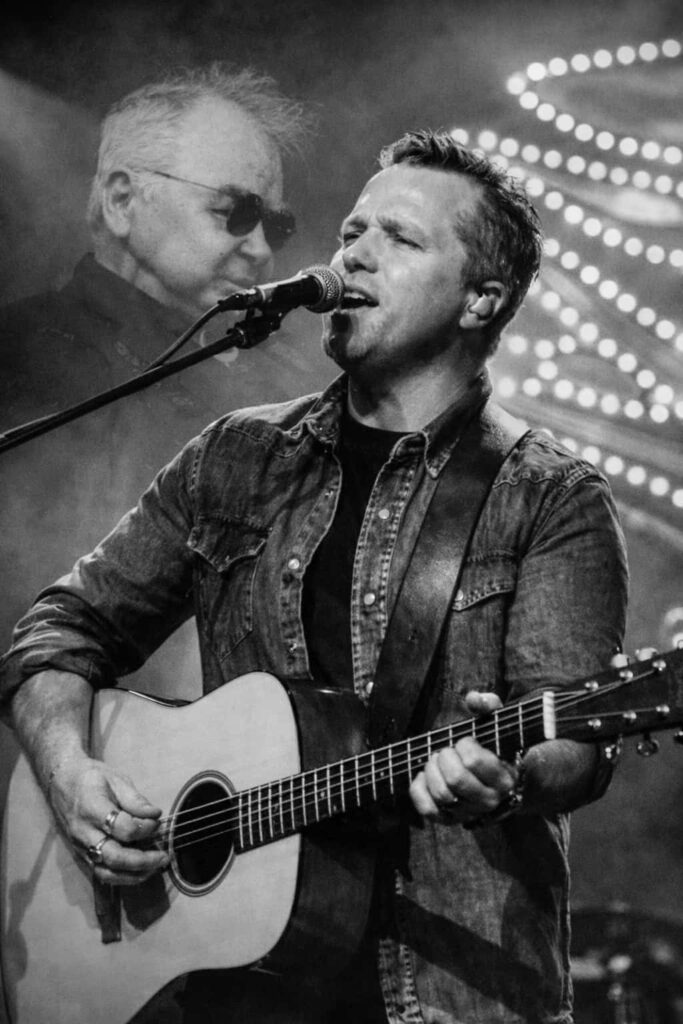
Over the years, many artists have honored the song, from Bette Midler to Joan Baez, but Jason Isbell’s interpretation carries particular weight. Isbell, a songwriter deeply influenced by Prine’s narrative clarity and moral compassion, performs “Hello in There” not as a museum piece but as a living confession. His voice—weathered yet steady—leans into the silences between lines. He understands that this song breathes in pauses. Where Prine’s original recording is gentle and almost conversational, Isbell’s version often feels like a candle lit in memory.
It is impossible to speak of this song today without acknowledging its renewed resonance following John Prine’s passing in 2020. In the months after his death, tributes poured in from every corner of the musical world. “Hello in There” took on a new dimension—no longer only about forgotten elders, but about absence itself. When Isbell performs it now, one senses not just empathy for fictional characters, but gratitude for the man who wrote it.
Musically, the composition is deceptively simple: acoustic guitar, subtle accompaniment, and a melody that drifts like a half-remembered lullaby. There is no grand crescendo. No dramatic flourish. The power lies in restraint. Prine once said that songs should “tell a story like you’re talking to a friend,” and “Hello in There” exemplifies that philosophy. Isbell, who has built his own reputation for literary songwriting—particularly through albums like Southeastern (2013)—recognizes this kinship. His cover is less about reinterpretation and more about stewardship.
The meaning of the song endures because it addresses something universal yet rarely spoken aloud: the fear of becoming unseen. The lyrics gently urge us to look up, to notice, to say “hello in there.” It is a small gesture, but in Prine’s worldview, small gestures are the foundation of humanity. Isbell delivers the lines with the understanding of someone who has lived enough to know that time moves quickly and that rooms grow quieter than we ever expect.
In revisiting “Hello in There,” Jason Isbell does not attempt to surpass John Prine. Instead, he bows to him. And in that bow, listeners are invited to remember not only a songwriter, but the countless lives quietly unfolding behind closed doors.
There are songs that dominate charts, and there are songs that shape hearts. “Hello in There” belongs firmly to the latter. It may never have been a commercial juggernaut, but its place in American music is unshakable—etched not in sales figures, but in the softened eyes of those who truly listen.