
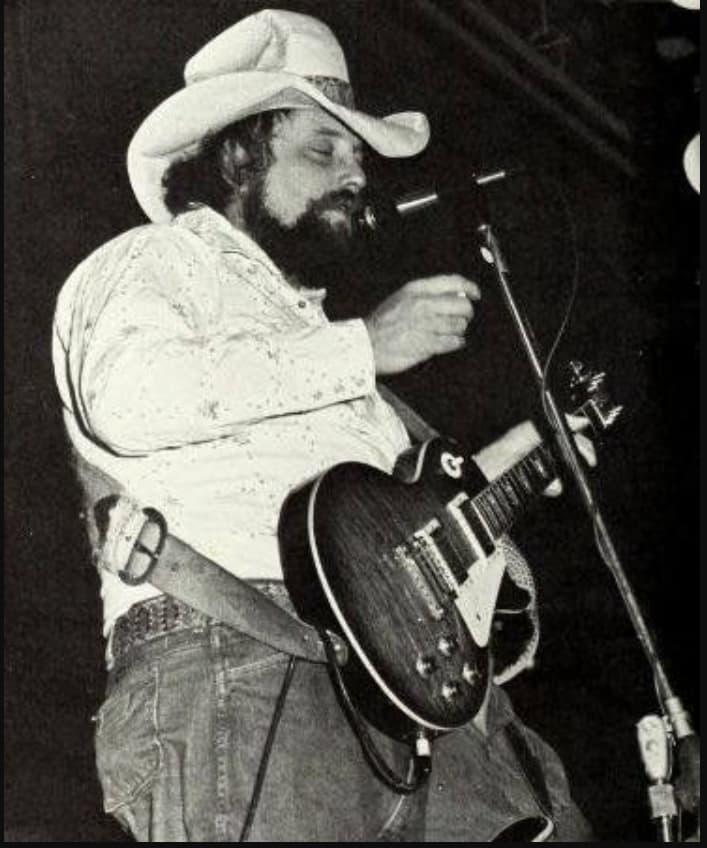
A Defiant Anthem of Southern Individualism and Unapologetic Freedom
When “Long Haired Country Boy” by Charlie Daniels first drifted across American airwaves in 1974, it did not roar onto the charts with explosive pop momentum. Instead, it settled in like a stubborn truth told on a front porch at dusk. Released as a single from the album Fire on the Mountain (1974), the song reached No. 82 on the Billboard Hot 100. It was never designed to dominate the pop mainstream. Rather, it became something far more enduring: a cultural signature, a declaration of independence that resonated deeply in a decade defined by distrust of authority and a yearning for personal liberty.
By the mid-1970s, Charlie Daniels was already carving out a reputation as a fierce fiddle player and bandleader, blending country, Southern rock, blues, and a hint of outlaw swagger. He had played sessions with the likes of Bob Dylan, including on Nashville Skyline, and was part of the shifting musical landscape that blurred the lines between country traditionalism and rock rebellion. Yet “Long Haired Country Boy” felt intensely personal — less a commercial calculation and more a statement of identity.
The opening lines set the tone with directness: “People say I’m no good and crazy as a loon…” From that moment, Daniels speaks in the voice of the misunderstood outsider — the rural individualist dismissed by polite society, yet unbowed by judgment. In a time when long hair still symbolized defiance in conservative circles, the song’s title itself carried cultural weight. The “long-haired country boy” was both insider and outsider: Southern, proud, but resistant to institutional control.
Musically, the track leans on a relaxed, almost conversational groove. Daniels’ fiddle work dances between the lines like a wry grin, while the rhythm section maintains a steady, unhurried pulse. Unlike the fiery bravado he would later unleash in “The Devil Went Down to Georgia” (1979), this performance is grounded, reflective, even slyly humorous. There’s a touch of blues phrasing in Daniels’ vocal delivery — slightly rough around the edges — that reinforces the authenticity of the message.
What makes the song endure is its layered irony. On the surface, it’s a simple rejection of social constraints: “I ain’t asking nobody for nothing, if I can’t get it on my own.” But beneath that declaration lies a broader commentary on American self-reliance. In the wake of Watergate and the Vietnam War, faith in institutions had eroded. The long-haired country boy became a symbol of the working-class citizen who trusted neither politicians nor preachers who strayed too close to politics. Daniels even addresses hypocrisy directly: he criticizes “rich politicians” and expresses distrust of organized authority without abandoning his Southern cultural roots.
There is also an undercurrent of libertarian sentiment that would later become more pronounced in Daniels’ public persona. Yet in 1974, the tone is less ideological and more instinctive — a gut-level assertion of freedom. It captures the mood of countless Americans who preferred to live quietly on their own terms, beyond the glare of government or social approval.
Though it peaked modestly on the charts, “Long Haired Country Boy” became a staple of the The Charlie Daniels Band live shows and remains one of Daniels’ most recognizable recordings. It has appeared on numerous compilations and continues to receive classic rock and country airplay decades after its release. Its staying power speaks not to chart dominance but to emotional resonance.
Looking back, the song feels like a snapshot of a particular American crossroads — where country music was stretching its boundaries, and where identity itself seemed negotiable. Daniels stood at that intersection, fiddle in hand, refusing to be boxed in by Nashville convention or rock orthodoxy.
There is something quietly comforting in revisiting this track today. It reminds us of a time when rebellion could still feel homespun, when independence was expressed not through grand gestures but through steady conviction. The “long-haired country boy” may have been labeled reckless, but he was guided by a personal code — work hard, mind your business, and answer to no one if you can help it.
In the end, “Long Haired Country Boy” is less about hair length and more about dignity. It is about holding onto one’s sense of self in a world eager to define it for you. And in that sense, it remains as relevant — and as quietly defiant — as it was in 1974.