
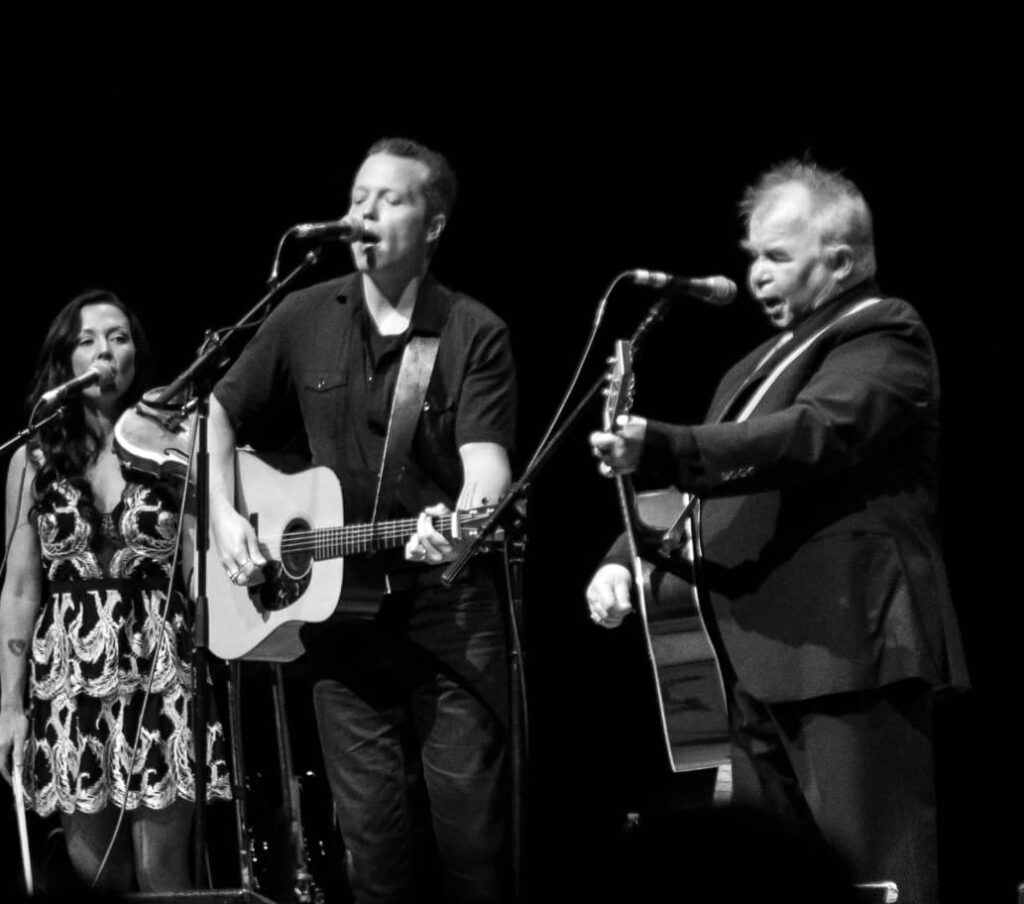
A Gentle Duet of Distance and Devotion — When Two Generations Meet Inside “Speed of the Sound of Loneliness”
When “Speed of the Sound of Loneliness” was first released by John Prine in 1986 on his album German Afternoons, it did not storm the upper reaches of the pop charts. In fact, it did not chart on the Billboard Hot 100 at all — and that, perhaps, tells you something essential about the song. It was never meant to be a radio spectacle. It was crafted as a quiet confession. Over time, however, it grew into one of Prine’s most beloved compositions, becoming a cornerstone of his live performances and a defining entry in the American songwriting canon.
The album German Afternoons, produced by Jim Rooney, marked a period when Prine was refining his already minimalist style — sparse arrangements, warm acoustic textures, and lyrics that spoke plainly yet pierced deeply. By 1986, Prine had long stepped away from the mainstream machinery of major labels. He was operating on his own terms through Oh Boy Records, the independent label he co-founded. There was no glossy marketing push, no heavy radio rotation. Just songs — honest, weathered, and achingly human.
At its core, “Speed of the Sound of Loneliness” is a conversation between two people who love each other but are drifting apart. The famous opening lines — “You come home late and you come home early / You come home big when you’re feeling small” — feel less like poetry and more like lived experience. The refrain, “Why you wanna be so alone? / Why you wanna be so alone?” is not accusatory; it’s bewildered, almost tender. Prine understood that loneliness can exist even in shared space. The “speed of the sound of loneliness” is a phrase that captures something immeasurable — how quickly distance grows in silence.
Decades later, when Jason Isbell joined John Prine to perform the song live — most memorably during collaborative appearances in the 2010s — the duet carried a symbolic weight that transcended the lyrics. Here was Isbell, one of the most respected songwriters of his generation and former member of the Drive-By Truckers, standing beside the elder statesman of Americana. Isbell has often cited Prine as a towering influence, not only for his craftsmanship but for his emotional honesty. Their shared rendition of the song felt less like a cover and more like a passing of a torch.
What made their duet so moving was not vocal acrobatics. Prine’s voice, especially in his later years after surviving throat cancer, had become gravelly, fragile — yet even more expressive. Isbell’s tone, rich and steady, seemed to cradle Prine’s phrasing. Together, they turned the song into a dialogue across generations. It was no longer only about romantic estrangement; it was about time, memory, and the quiet ache of watching life move forward.
The song’s legacy is further cemented by its many covers, including a celebrated 1999 version by Nanci Griffith, whose interpretation brought it to the Billboard Country chart, peaking at No. 70. Yet even among various renditions, there remains something sacred about hearing Prine sing his own words. His gift was never grandiosity. It was clarity.
There is something profoundly nostalgic about “Speed of the Sound of Loneliness” — not because it belongs to the past, but because it speaks to a feeling that accumulates with time. It reminds us of the quiet dinners, the unspoken worries, the distance that sometimes slips in unnoticed. Prine once said he liked writing about “ordinary people living extraordinary lives.” This song is a perfect embodiment of that philosophy.
When Jason Isbell sings it alongside him, we are reminded that great songs do not age — they deepen. They gather layers of meaning. They travel from one voice to another, from one era to the next, without losing their soul.
And perhaps that is the true speed of loneliness: not how fast it divides us, but how swiftly a song can bring us back together.