
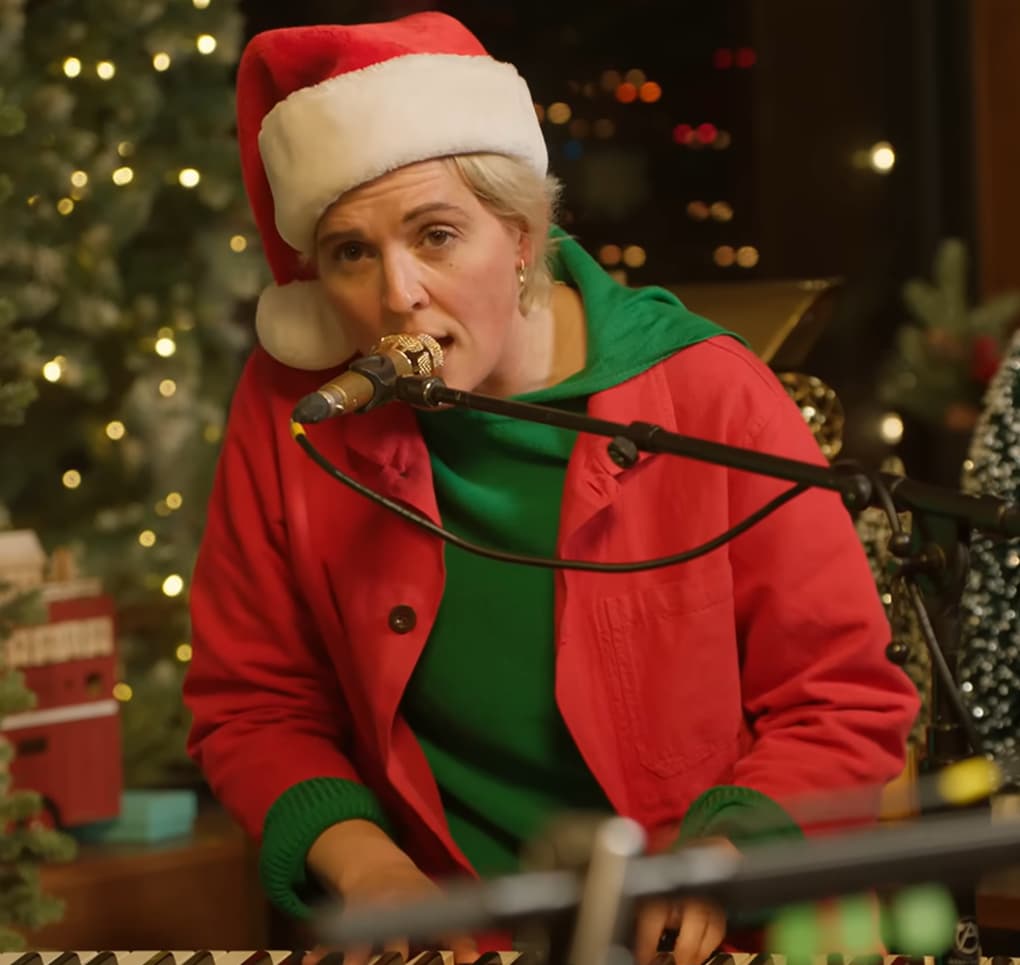
A Modern Voice Embracing a Celtic Lament of Love, Loss, and Hard Truths
When Brandi Carlile chose to record “Fairytale of New York”, she stepped into one of the most emotionally charged Christmas songs ever written—a song that has never belonged to glitter or sentimentality, but to bruised love, broken promises, and stubborn hope. The original “Fairytale of New York” by The Pogues featuring Kirsty MacColl was first released in 1987 and appeared on the album If I Should Fall from Grace with God. Upon its release, it reached No. 2 on the UK Singles Chart in December 1987, held from the top spot by the Pet Shop Boys’ “Always on My Mind.” Over the decades, it has re-entered the charts almost every Christmas season, finally reaching No. 1 on the UK Singles Chart in 2023, following rule changes that allowed older songs to compete fully in the streaming era. In Ireland, it also became a perennial favorite, reaching high positions repeatedly during the holiday season.
Written by Shane MacGowan and Jem Finer, the song was inspired by a challenge from Elvis Costello’s then-wife, Cait O’Riordan (a member of The Pogues), who suggested that MacGowan attempt to write a Christmas duet. What emerged was not a carol, but a gritty, cinematic portrait of Irish immigrants in New York—two lovers arguing in a holding cell on Christmas Eve. It was a story of dashed dreams, alcoholism, resentment, and yet, underneath the bitterness, an enduring, fragile tenderness. That tension between cruelty and devotion is what has kept the song alive for nearly four decades.
When Brandi Carlile approached the song decades later, she did not attempt to replicate the ragged fury of MacGowan or the sharp, aching clarity of MacColl. Instead, she brought her own emotional intelligence—tempered, reflective, deeply humane. Carlile, long celebrated for albums like By the Way, I Forgive You and In These Silent Days, has built her reputation on storytelling that respects pain without sensationalizing it. Her version of “Fairytale of New York” carries that same reverence.
The heart of the song lies in its brutal honesty. Lines like “I could have been someone” / “Well, so could anyone” cut deeper with time. In youth, they may sound like a lovers’ quarrel. With years behind us, they feel like an indictment of fate itself—of opportunities missed, of talent squandered, of love tested by hardship. And yet, the refrain “The boys of the NYPD choir were singing ‘Galway Bay’” wraps the argument in something almost sacred: memory. Nostalgia softens the blow. Christmas lights flicker in the background, even as dreams unravel.
Carlile’s interpretation highlights that undercurrent of reluctant devotion. Where The Pogues’ original bristled with punk-folk rawness—tin whistles, accordion flourishes, and MacGowan’s slurred, wounded delivery—Carlile leans into vocal clarity and emotional nuance. She reminds listeners that the song is not merely about dysfunction; it is about survival. Two flawed people clinging to what remains when illusions have faded.
Culturally, “Fairytale of New York” has endured because it refuses the artificial cheer of seasonal standards. It acknowledges that the holidays can magnify loneliness, regret, and unresolved love. And yet, paradoxically, that very honesty makes it comforting. The song understands that life rarely unfolds as planned. It recognizes that love is not always gentle—but it can persist.
For listeners who have carried memories across decades, who remember first hearing the song in the late 1980s as snow fell outside pub windows or through crackling radio speakers, Carlile’s rendition feels less like a remake and more like a conversation across generations. It is a reminder that great songs do not age—they gather meaning.
In revisiting “Fairytale of New York”, Brandi Carlile does not polish away its rough edges. Instead, she honors its humanity. And perhaps that is why the song continues to return each winter—not as background music, but as a reckoning. A love story stripped of illusion, yet still standing.