
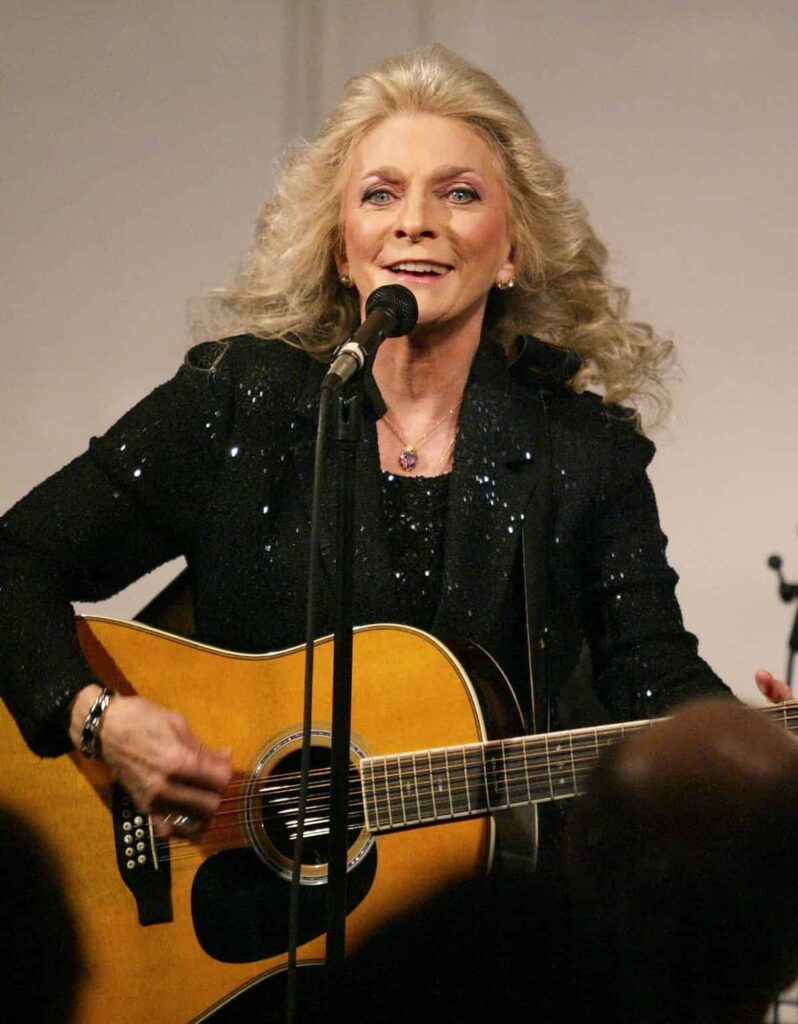
A quiet vow of love and waiting, told from the fragile edge of hope and distance
When Judy Collins recorded “Someday Soon” in the late 1960s, she was not merely covering a folk song — she was lending her unmistakable voice to a story that already carried dust, distance, and emotional restraint. Released on her 1968 album Who Knows Where the Time Goes, the song arrived at a moment when popular music was growing louder and more confrontational. Yet “Someday Soon” stood apart, gentle and resolute, trusting the listener to lean in rather than be overwhelmed.
Although it did not become a major chart sensation in the United States, Judy Collins’ version was released as a single and reached the lower half of the Billboard Hot 100, peaking at No. 55 in 1969. For a song so understated, this modest chart presence was almost beside the point. Its true success unfolded slowly, across decades, through repeated listening, late-night radio, and the quiet recognition of those who had lived long enough to understand its emotional truth.
The song was written by Ian Tyson, one half of the influential Canadian folk duo Ian & Sylvia, who first recorded “Someday Soon” in 1964. In its original form, it was already a remarkable narrative: a young woman in love with a restless cowboy, fully aware that devotion does not guarantee permanence. Unlike many love songs of its era, it does not plead, accuse, or dramatize. It simply waits — and that waiting is where its power lies.
What Judy Collins brought to the song was something uniquely her own. Her soprano voice, clear yet faintly autumnal, transforms the narrator from a young lover into a woman already tempered by experience. When she sings of riding “the high ridin’ plains” or watching her man disappear into the distance, there is no illusion left. This is not naïve hope. This is love that understands the cost of loving someone who belongs partly to the road.
Musically, “Someday Soon” is built with restraint. The arrangement on Who Knows Where the Time Goes is spare, allowing the melody and lyrics to breathe. There is space between the notes, and in that space lives longing — not the urgent longing of youth, but the patient, reflective longing that comes from knowing time does not always bend to desire. This simplicity aligns perfectly with Judy Collins’ artistic philosophy during this period: clarity over excess, emotion over display.
The meaning of “Someday Soon” deepens with age. On the surface, it is a love song about separation and hope. But beneath that lies a meditation on choices we make — and the choices others make that shape our lives without malice or drama. The cowboy is not cruel. He is simply who he is. And the woman who loves him does not demand that he change. She holds onto the idea that someday, perhaps, love and freedom will no longer be in conflict.
That emotional maturity is why the song has endured. It speaks quietly to listeners who have known waiting — waiting for someone to return, for life to settle, for answers that never arrive neatly. For those who have lived through decades of love and loss, “Someday Soon” feels less like a song and more like a shared memory.
Within Judy Collins’ broader catalog, the song sits comfortably alongside her other interpretations of introspective folk material, reinforcing her role as a curator of emotional honesty rather than a songwriter seeking the spotlight. Her ability to inhabit a song and allow it to speak through her, rather than over her, is precisely what gives “Someday Soon” its lasting resonance.
Today, the song remains one of those quiet landmarks in folk music history — not defined by sales or chart dominance, but by emotional accuracy. It reminds us that some songs do not shout their importance. They wait patiently, like the love they describe, until the listener is ready to truly hear them.