
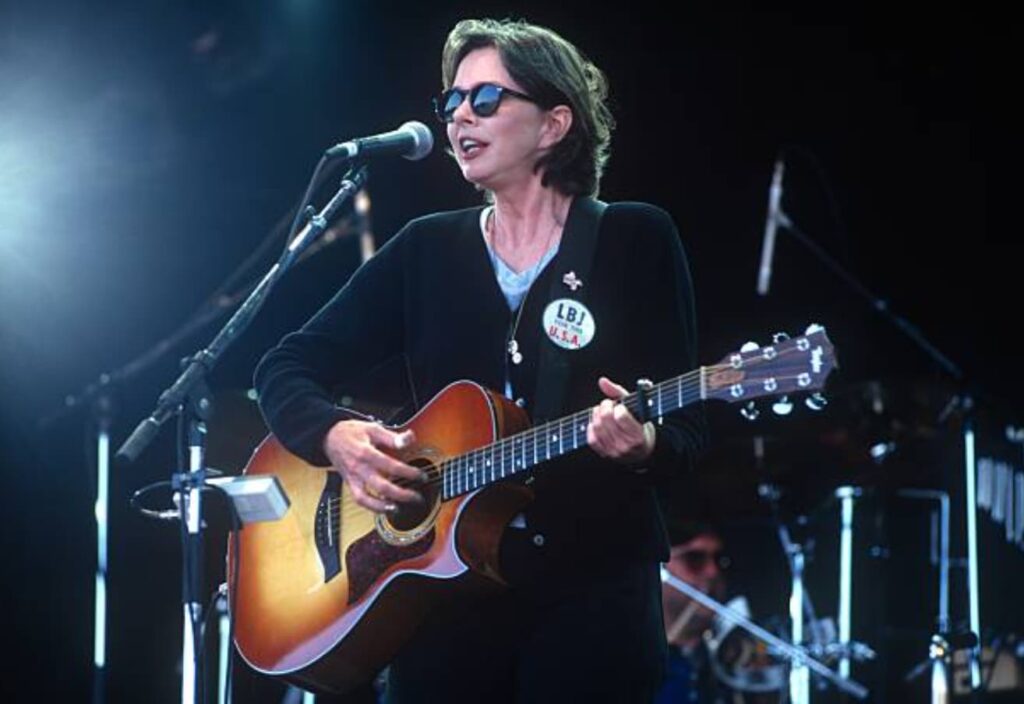
Nanci Griffith – a gentle storyteller who walked a lifetime alongside ordinary lives
The story of Nanci Griffith, to me, is not the story of a star crowned by titles or awards, but the quiet journey of a persistent storyteller—faithful to music and faithful to people. In Nanci, I have always sensed a beauty all her own: never loud, never showy, yet deeply resonant and lingering long after the sound fades.
Born in a small town in Texas, Nanci’s musical path seemed to take shape very early on. The moment a guitar replaced the French horn felt like a silent destiny. From playing music at the age of twelve to immersing herself in the vibrant songwriting scene of Austin, Nanci was always present as a small voice that could not be ignored. Among figures like Lyle Lovett, Guy Clark, and Townes Van Zandt, she never needed to shout to be heard. Her voice—fragile, tender, yet full of inner strength—was enough to hold the listener in place.
What makes me especially fond of Nanci is the way she wrote about ordinary life. Her songs feel like snapshots: a small café, an unfinished love, a bus leaving town, a field heavy with unspoken worries. Without drama or self-pity, she allowed her characters to live, breathe, and exist exactly as they were. In that world, listeners could easily see themselves—or someone who once passed quietly through their lives.
Nanci did not write only for herself. She listened closely to others and possessed a rare gift: the ability to make other people’s songs shine in a distinctly her own way. The story of From a Distance always moves me. Through nothing more than her sincere trust, Nanci breathed new life into a song once rejected, helping it become one of the most iconic songs of its time. In that moment, her character is clear—not someone who chased the spotlight, but someone willing to step back so that something good could spread.
To me, the album Other Voices, Other Rooms feels more like a profound tribute than a mere musical product. Nanci does not stand at the center as a star, but as a daughter within the great folk family, connecting generations of artists who had never shared the same stage. When those voices blend together, the meaning goes far beyond music: it is continuity, memory passed from hand to hand, tradition preserved through love.
Throughout her artistic life, whether facing illness or social upheaval, Nanci never lost her faith in humanity. Her music grew more reflective, more responsible, yet never lost its gentleness. When she spoke of wanting to hear her music played in old age, I understood that it was not a longing for fame, but a desire to continue walking alongside her listeners.
And perhaps that is exactly what has happened. Nanci Griffith has left the stage, but her stories continue to travel with us—like a familiar voice, faintly present in memory, close enough to comfort, and distant enough for us to reflect, from a very human distance.