
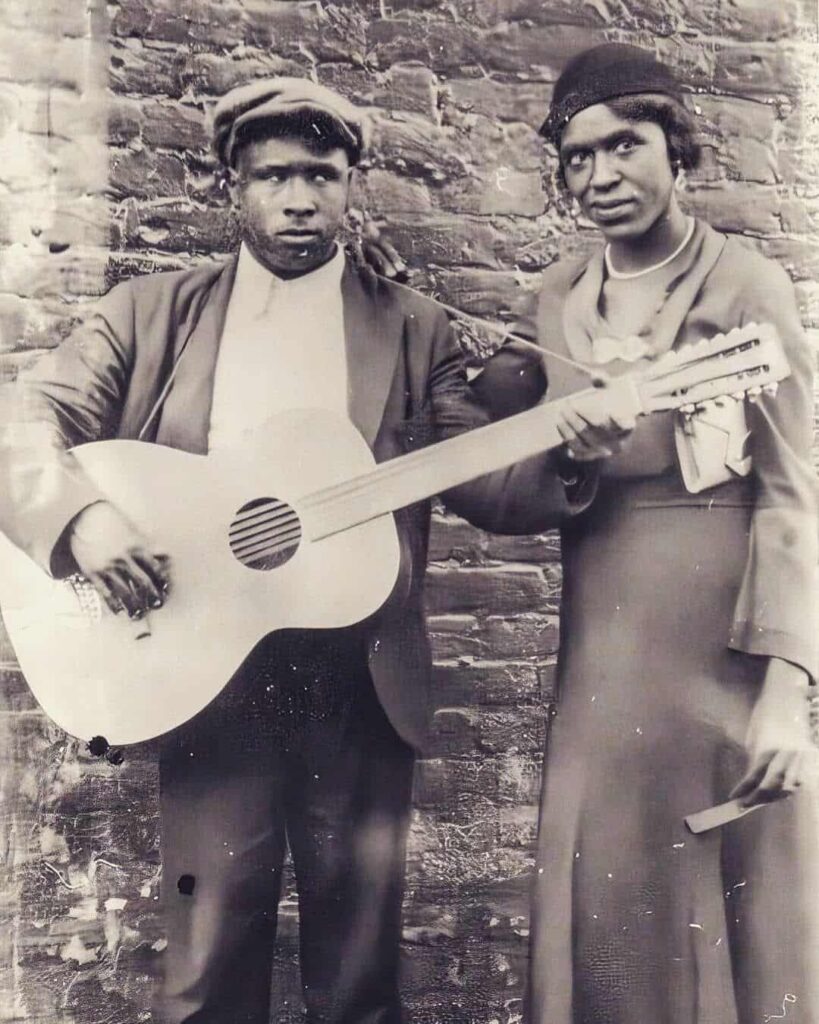
Dying Crapshooter’s Blues — a final roll of the dice, where fate, faith, and the road all fall silent
When “Dying Crapshooter’s Blues” is mentioned alongside the name Blind Willie McTell, it does not arrive as a song in the modern sense, but as a living document — a hushed confession captured at the edge of life, luck, and resignation. Recorded in 1929, during the final years of McTell’s earliest recording period, the song never knew chart positions, radio rankings, or commercial success in the way later generations would define them. Its importance lies elsewhere: in its truth, its atmosphere, and its quiet authority as one of the most haunting narratives in early American blues.
Blind Willie McTell, born William Samuel McTier, was already a seasoned traveler and observer of human fortune by the time he recorded “Dying Crapshooter’s Blues.” Blind from birth, he moved through the American South with extraordinary musical skill and emotional perception. Unlike many of his contemporaries, McTell was known for his fluid, elegant twelve-string guitar style and his clear, almost dignified vocal delivery — a voice that rarely shouted, yet carried immense weight.
The song itself unfolds like a whispered testimony. A man lies dying, wounded after a violent dispute at a gambling table. Craps — the rolling of dice — becomes more than a game; it is a symbol of chance, risk, and the fragile line between survival and ruin. As the narrator speaks, there is no dramatic climax, no redemption arc. Instead, there is acceptance. He recalls his choices, acknowledges his fate, and asks that his final wishes be carried out with dignity.
This is where “Dying Crapshooter’s Blues” reveals its deeper power. The song does not glorify violence or luck. It observes them. The dying man does not curse his end; he understands it. In a world where opportunity was scarce and danger constant, the gamble was often the only moment where a man felt control over his destiny — even if that control was an illusion.
McTell’s performance is restrained, almost reverent. His voice does not dramatize the pain; it documents it. Each line feels measured, as if spoken slowly to conserve strength. The guitar accompaniment flows beneath him with calm inevitability, like footsteps fading down a long road. There is no rush. Death, after all, is already waiting.
The historical context matters deeply here. Recorded during the late 1920s, just before the Great Depression fully reshaped American life, the song reflects a time when survival often depended on chance encounters, informal economies, and the ability to read both people and situations. Gambling dens, street corners, and juke joints were not merely places of recreation — they were crossroads of fate. McTell understood this world intimately, not as an outsider, but as someone who had lived within its rhythms.
What makes the song especially resonant for listeners today is its emotional restraint. There is wisdom in the way the narrator speaks of death — not with fear, but with a weary clarity. He asks for his debts to be settled, his body to be treated with respect, his story to be remembered honestly. These are the concerns of someone who has lived long enough to know that reputation and memory may be all that remains.
Over time, “Dying Crapshooter’s Blues” has grown in stature, not through popularity, but through reverence. Musicians, historians, and devoted listeners recognize it as a cornerstone of narrative blues — a song that does not entertain so much as it bears witness. It stands alongside McTell’s other recordings as proof of his unique gift: the ability to turn lived experience into quiet, enduring art.
Listening now, nearly a century later, the song feels unchanged. The dice still roll. The room still grows quiet. And Blind Willie McTell’s voice still guides us through that final moment, reminding us that every life, in the end, is a wager — and every song, if sung truthfully, becomes a legacy.