
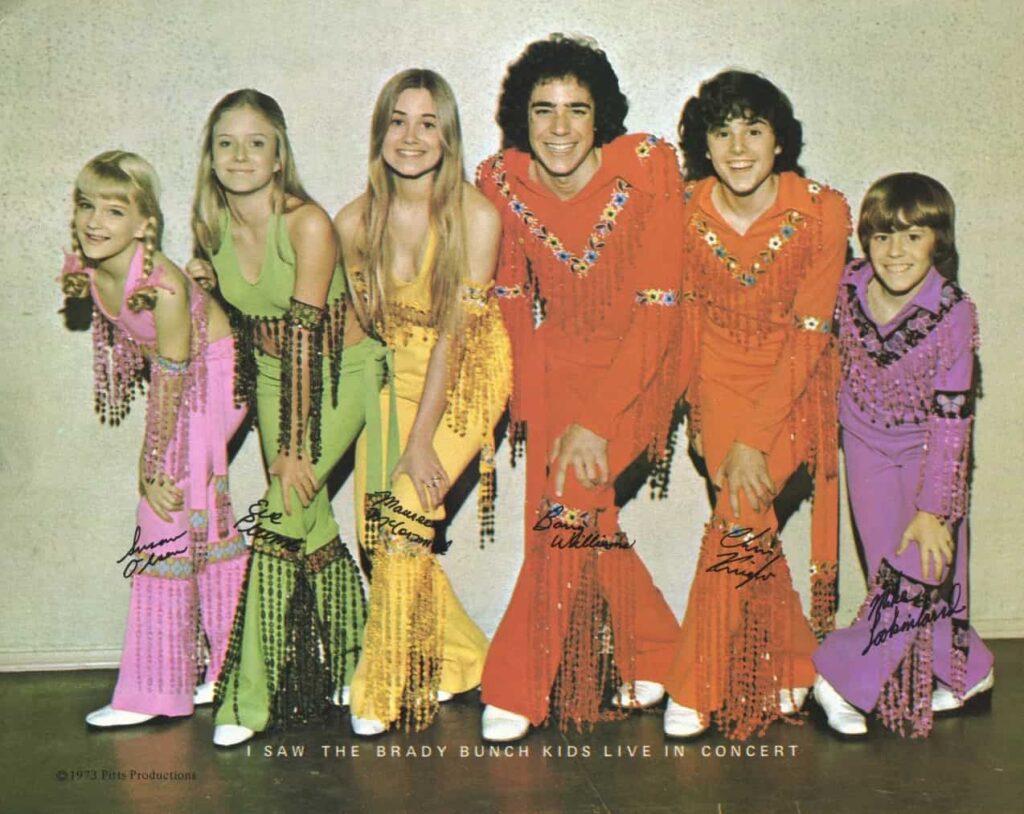
The Storybook Opening: How a Simple Jingle Became an Emblem of the American Family Dream
There are tunes that define an era, not because they topped the charts—though many certainly did—but because they became the ubiquitous soundtrack to everyday life. For many of us who grew up in the late 1960s and early 1970s, or for those who fell in love with the magic of reruns in the decades that followed, the theme from The Brady Bunch is exactly that. It’s an aural photograph of a time marked by colorful innocence, a hopeful vision of the blended family, and a simple, unironic kind of American optimism.
The theme song, instantly recognizable, serves a unique dual purpose: it is both an introduction and an essential narrative device. It doesn’t just announce the show; it visually and lyrically explains its entire premise in less than a minute. The now-iconic checkerboard grid of nine squares, a genius stroke of production design, framed the six kids, their parents, and the beloved housekeeper, all smiling into the camera. This arrangement, which creator Sherwood Schwartz also used for his previous hit, Gilligan’s Island, visually communicated the complex new family structure with an elegant, playful simplicity.
The lyrics, which begin with the famous, sing-song “Here’s the story of a lovely lady…”, quickly walk the viewer through the premise: a widow raising three girls (Marcia, Jan, and Cindy) meets a widower raising three boys (Greg, Peter, and Bobby). The union of the two families—”that’s how we all became The Brady Bunch“—is delivered with an upbeat, uncomplicated resolution that belies the real-life struggles of blending two households. The simplicity of the tune, which was written by Sherwood Schwartz himself along with Frank De Vol (who scored the first season) and later re-recorded with music by Jerry Fielding and lyrics by Schwartz, perfectly matched the show’s lighthearted tone.
In terms of chart position, the theme song was not released as a commercial single, so it has no official, contemporaneous peak on the Billboard Hot 100 or similar charts. Its success was measured in cultural impact and syndication longevity, not record sales. The various singing groups cast as The Brady Bunch children did release albums, such as Meet The Brady Bunch (1972) and The Kids From The Brady Bunch (1995), but it was the unadorned, televised theme that became the true hit, forever lodged in the collective memory.
The meaning of the theme, beyond its literal explanation of the plot, is perhaps its most profound element. It’s an ode to unity. In a changing era—one where the concept of a “traditional” family was being redefined—the theme offered a comforting, stable ideal. It promised that love and understanding could triumph over logistical complexities. It remains a sweet, indelible piece of nostalgia, a jingle that, upon hearing the first three notes, instantly transports a generation back to the warm, wood-paneled, relentlessly cheerful world of 1970s television. It’s more than a theme; it’s a pop-culture touchstone for a simpler time.