
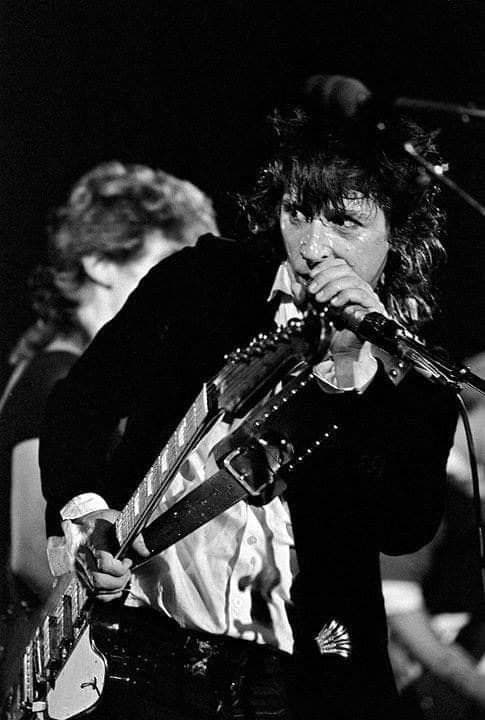
he Heartbreaking Ballad of a Love Lost and Found in the Gutters of Rock ‘n’ Roll 🎸
The New York Dolls, with their glitter, sneer, and glorious mess, gave birth to legends, but few burned as brightly, or as tragically, as Johnny Thunders. In 1978, amidst the chaotic aftershocks of the punk explosion he helped ignite, Thunders released his debut solo album, ‘So Alone’. A standout track from that record, and a testament to his raw, wounded genius, is “Great Big Kiss”. A song that manages to be simultaneously tender and defiant, it’s a quintessential piece of the Thunders mythos, capturing the doomed romanticism that defined his art and life.
While “Great Big Kiss” may not have soared to the dizzying heights of the mainstream charts—a world that often seemed too clean and polite for Thunders‘ gritty reality—its impact on the underground and on subsequent generations of punk and glam musicians is immeasurable. The track was featured as the B-side to the single “You Can’t Put Your Arms Around a Memory” in some territories, a song that also appeared on the ‘So Alone’ album. Neither track achieved a significant or lasting placement on the major charts like the Billboard Hot 100 or the UK Singles Chart at the time of release, reflecting Thunders’ status as a beloved, influential cult figure rather than a commercial behemoth. His art was too visceral, too close to the bone, for mass consumption, but for those who got it, the connection was profound and lasting.
The story behind “Great Big Kiss” is as entangled and complex as the man himself. By the time he recorded ‘So Alone’, Thunders was a veteran of rock’s trenches, having left the New York Dolls and formed the volatile, influential Heartbreakers. The ‘So Alone’ sessions in 1978 were a convergence of rock royalty, featuring guest appearances from Thin Lizzy’s Phil Lynott, The Sex Pistols’ Steve Jones and Paul Cook, and former bandmate Walter Lure. This collaboration, however, took place amidst a period of profound personal struggle for Thunders, who was battling severe addiction and navigating a life perpetually teetering on the edge. This fragility, this sense of barely holding it together, is the very soul of “Great Big Kiss”.
The song is not a Johnny Thunders original, which adds a fascinating layer to its depth. It’s a cover of a 1960 track by The Shangri-Las, the iconic girl group known for their teenage tragedy songs. This choice of material is highly significant. Thunders often reached back to the doo-wop, R&B, and girl-group sounds of his youth—the ’50s and early ’60s—imbued with a deep, street-level romanticism. By taking The Shangri-Las’ innocent, yearning melody and filtering it through his distinctive, ravaged rock-and-roll lens—all buzz-saw guitar and world-weary vocals—he transformed it into something else entirely: a testament to enduring hope amidst desolation.
At its core, “Great Big Kiss” is about the intoxicating, soul-saving power of love and connection. It’s a plea, a promise, and a declaration wrapped up in a three-chord wonder. The lyrics speak of a yearning for a love that can save the singer from the cold, hard world—a love represented by that singular, transformative “great big kiss.” For an older listener who has seen life’s sharp edges, this song resonates deeply. It’s the moment of solace found in a lover’s arms after a night of grinding struggle; it’s the simple, powerful comfort that anchors a life of chaos. When Thunders sings it, you hear the desperation and the beauty simultaneously. The song’s power lies in the fact that it retains the original’s sweet vulnerability but injects it with a desperate, adult urgency. It’s the sound of a beautiful soul looking for redemption in the only place he knows how: in a loud, glorious mess of guitars and a simple, heartfelt embrace. It’s a moment of pure, unadulterated yearning, a perfect encapsulation of the raw, beautiful tragedy that was Johnny Thunders.