
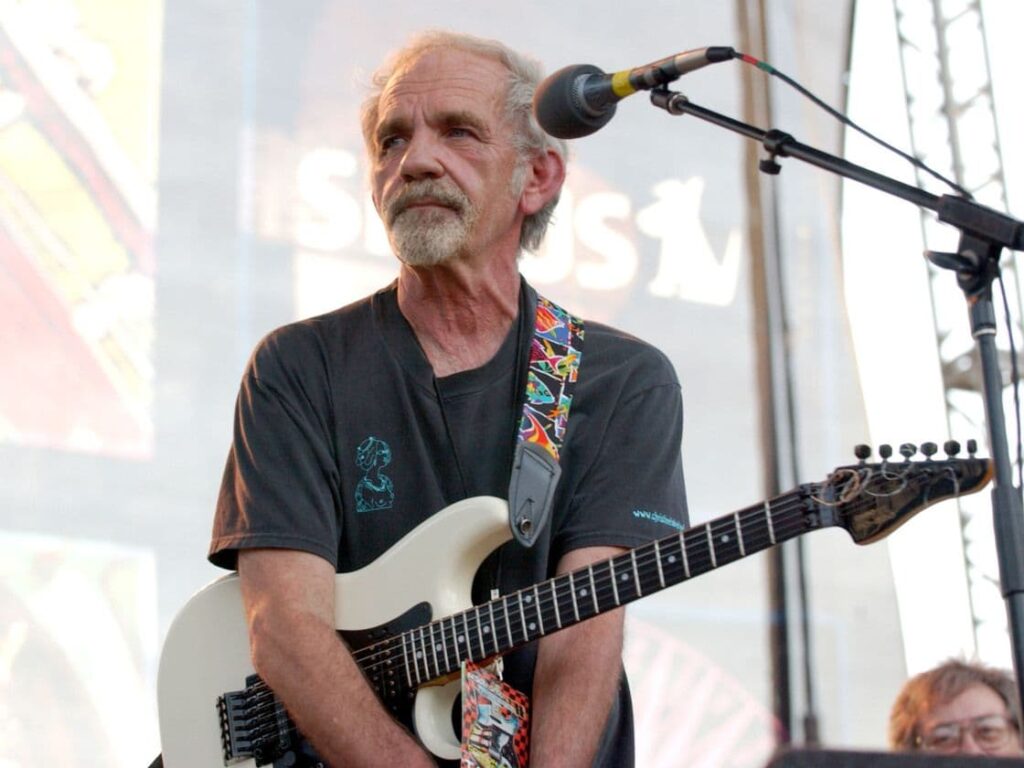
A hymn to restless freedom and quiet defiance, “Call Me The Breeze” captures the spirit of a man determined to keep moving—untouched, unburdened, and unapologetically himself.
When J.J. Cale released “Call Me The Breeze” in 1972 on his debut album Naturally, few could have predicted that this unassuming, laid-back track would become one of the defining statements of the Tulsa Sound. Issued on Shelter Records and produced by Audie Ashworth, the single itself did not enter the Billboard Hot 100, a reminder that commercial charts do not always measure cultural longevity. Yet history has a way of correcting such oversights. What did not storm the charts in 1972 quietly seeped into the bloodstream of American roots music.
From the very first bars—those crisp, unhurried guitar licks and the gentle, rolling shuffle—you hear something different. Not ambition. Not spectacle. But ease. “Call Me The Breeze” feels less like a performance and more like a shrug set to music. Cale’s voice, soft and almost conversational, drifts across the groove with a relaxed confidence that would later influence artists such as Eric Clapton, Mark Knopfler, and countless others who admired his restraint.
The song’s story is deceptively simple. A man declares himself “the breeze”—untethered, unattached, and unwilling to be weighed down by expectations or emotional complications. “I keep blowing down the road,” Cale sings, not with arrogance, but with calm acceptance. There is no bitterness in his independence. Instead, there is a sense of personal philosophy: life is movement, and attachment is friction. It speaks to a generation that had seen social upheaval, war, and shifting cultural values. In its understated way, the song suggests survival through lightness—through not allowing the world to pin you down.
Musically, the track embodies what became known as the Tulsa Sound—a hybrid of blues, country, rockabilly, and swampy rhythm & blues. Unlike the louder Southern rock bands emerging at the time, Cale’s approach was minimalistic. The groove breathes. The guitar never shouts. Even the solo seems content simply to glide rather than to impress. That subtlety became his signature.
Ironically, it was another artist who carried the song into the charts. In 1974, Eric Clapton recorded his own version for the album 461 Ocean Boulevard. Clapton’s rendition reached No. 26 on the UK Singles Chart and entered the Billboard Hot 100 in the United States, introducing a wider audience to Cale’s songwriting. Yet even in Clapton’s more polished production, the skeleton of Cale’s relaxed brilliance remained intact. Clapton himself openly acknowledged his debt to Cale, who also wrote Clapton’s later hit “Cocaine.”
Over the decades, “Call Me The Breeze” has become something of a rite of passage for roots and Southern rock musicians. Lynyrd Skynyrd famously recorded it for their 1974 album Second Helping, giving it a harder edge while preserving its wandering soul. Each version underscores the durability of Cale’s writing: a simple structure, a timeless groove, and lyrics that resist aging.
But beyond its musical influence, the song endures because of its emotional resonance. There is something deeply human in the desire to remain unencumbered—to move freely through life without being claimed or confined. And yet, beneath the surface bravado, one can sense a trace of solitude. The breeze, after all, never settles. It passes through towns, through lives, through memories—never staying long enough to belong.
Listening to “Call Me The Breeze” today is like opening an old photograph album. The sound carries the warmth of analog recording, the honesty of musicians playing without studio excess, and the quiet confidence of an artist who never chased fame. J.J. Cale did not need to dominate the charts to leave his mark. His influence traveled softly, like the wind itself—felt more than seen.
In an era often defined by volume and spectacle, Cale offered restraint. In a time of declarations, he offered understatement. And in “Call Me The Breeze,” he gave us a song that still moves gently through the decades—unrushed, unburdened, forever in motion.