
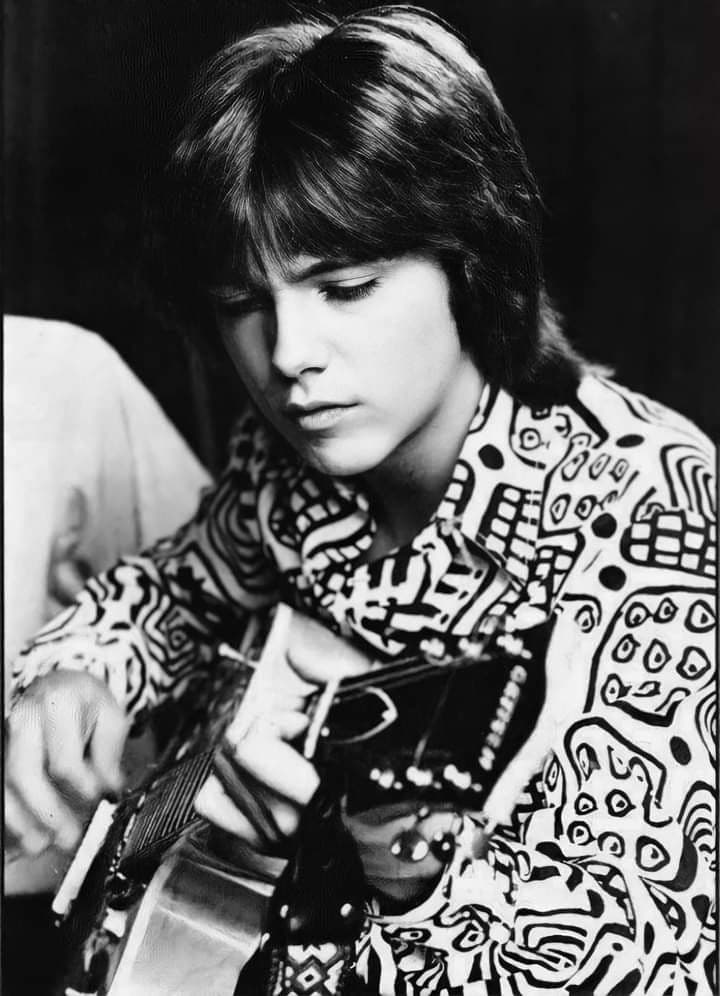
A Tender Farewell to Youth: The Enduring Echo of a Teen Idol’s Heart
Few figures from the golden age of 1970s pop culture stir memory and emotion quite like David Cassidy. At the height of his fame, he was not merely a singer or television personality—he was a symbol of youthful longing, innocence, and the irresistible optimism that defined an era. His legacy rests most prominently on the success of The Partridge Family, the television series that ran from 1970 to 1974, and the chart-topping hits that accompanied it.
In 1970, “I Think I Love You”, credited to The Partridge Family but sung by David Cassidy, became a cultural phenomenon. The single soared to No. 1 on the Billboard Hot 100 in November 1970 and remained there for three weeks. It also reached No. 1 in Canada and became an international hit, solidifying Cassidy’s status as a global teen idol. The song was featured on the debut album “The Partridge Family Album” (1970), which itself climbed to No. 4 on the Billboard 200 chart. These early achievements were not accidents of television marketing—they were genuine reflections of how deeply the music resonated with listeners.
Behind the polished harmonies and buoyant melodies, there was a more complex story. Though David Cassidy portrayed Keith Partridge on television, he insisted on contributing his own vocals to the recordings, stepping out from behind the illusion that studio singers were responsible for the show’s sound. In doing so, he proved that he was not merely a television face but a legitimate recording artist. Yet the very machinery that propelled him to fame also confined him. As his popularity grew—selling out arenas in the United Kingdom and Australia in 1972, sometimes drawing crowds of over 40,000 fans—he began to feel trapped by the teen-idol label.
Songs such as “Cherish” (1971), which reached No. 9 on the Billboard Hot 100, and “How Can I Be Sure” (1972), a Top 30 hit in the United States and a major success in the UK, revealed a more introspective side. These were not merely pop confections; they carried a vulnerability that mirrored Cassidy’s own inner conflicts. He yearned to be taken seriously as a musician, to move beyond bubblegum pop and into material that reflected emotional maturity.
By 1973, with the release of the album “Dreams Are Nuthin’ More Than Wishes”, Cassidy began reshaping his artistic direction. Though it did not replicate the massive commercial heights of his earlier releases, it stands today as evidence of his determination to evolve. His break from The Partridge Family marked both an ending and a quiet rebirth.
The meaning behind Cassidy’s most enduring songs lies in their simplicity. “I Think I Love You” captures the fragile hesitation of first love—the trembling uncertainty that accompanies confession. Its gentle orchestration and melodic clarity evoke a time when emotions were worn openly, without irony. That sincerity is precisely why the song continues to endure. It is not complicated, nor does it pretend to be. It speaks directly to the heart.
But to remember David Cassidy only as a teen idol is to overlook the human story. He faced the burdens of sudden fame at a young age, the expectations of millions, and the struggle to define himself beyond the posters and magazine covers. In later years, he spoke candidly about those pressures, offering a more reflective portrait of a man who once carried the dreams of an entire generation on his shoulders.
When Cassidy passed away in 2017, tributes poured in not only from fellow musicians but from countless listeners who had grown alongside his music. His voice had accompanied their coming-of-age moments—their first dances, their quiet afternoons by the radio, their hopes for something just beyond reach.
Listening now, decades later, there is a soft glow that surrounds those recordings. The production may carry the unmistakable stamp of early ’70s pop, but the emotional core remains timeless. The tremor in his voice, the earnest phrasing—these qualities transcend fashion.
In remembering David Cassidy, we are also remembering a chapter of our cultural history—when music and television merged to create shared national moments. His legacy is not defined solely by chart positions or album sales, though those achievements were significant. It lives in the tender ache of nostalgia, in the echo of harmonies that once drifted from transistor radios on summer evenings.
And perhaps that is the true measure of his impact: not just that he topped the charts, but that his songs still linger—quietly, faithfully—in the heart.