
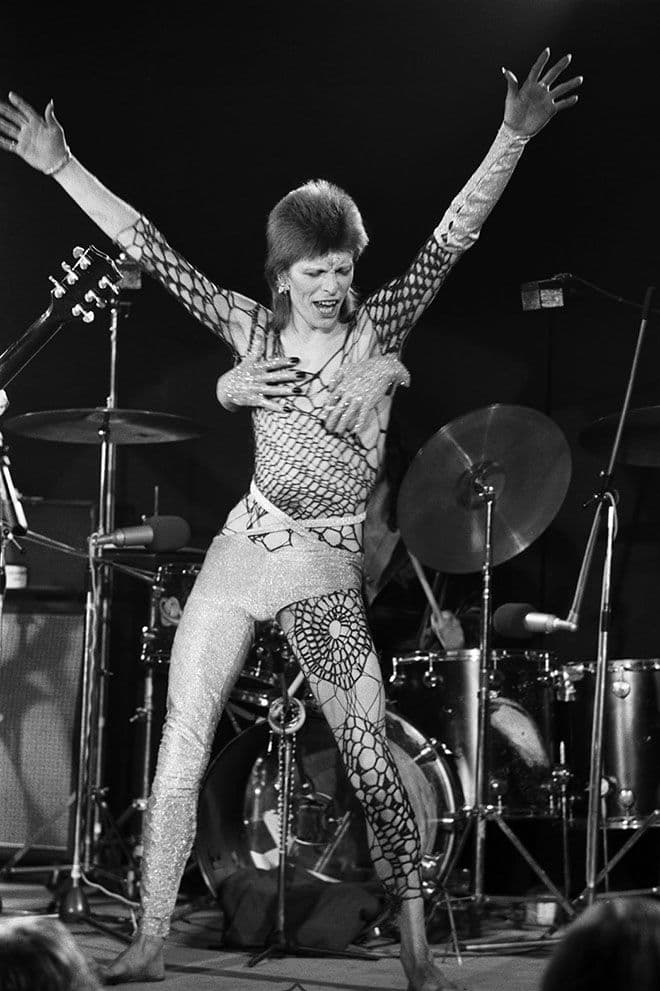
A Farewell to Illusion and Fame: When Ziggy Stardust Taught Us the Fragility of Stardom
Few songs have ever captured the blinding glare and quiet loneliness of fame quite like “Ziggy Stardust” by David Bowie. Released in 1972 as part of the landmark album The Rise and Fall of Ziggy Stardust and the Spiders from Mars, this song did not chart as a standalone single in the United Kingdom or the United States at the time of its release. Yet the album itself climbed to No. 5 on the UK Albums Chart and eventually reached No. 75 on the US Billboard 200, steadily building its reputation until it became one of the most celebrated concept albums in rock history. Its true triumph was not immediate commercial dominance, but lasting cultural immortality.
At the heart of “Ziggy Stardust” lies a fictional rock star — an androgynous, alien-like messiah of glam rock — brought vividly to life by David Bowie. The character was part prophet, part pop idol, and part tragic figure. Ziggy arrives on Earth as a savior through music, only to be destroyed by his own excess and by the very adoration that once sustained him. In many ways, Bowie was not simply telling a story; he was exploring the dangerous seduction of celebrity itself.
The early 1970s were a time of reinvention in popular music. The optimism of the 1960s had dimmed, and rock culture was searching for a new mythology. Bowie answered with glitter, platform boots, dyed hair, and theatrical ambition. Alongside guitarist Mick Ronson, whose sharp, electrifying riffs give “Ziggy Stardust” its muscular backbone, Bowie created a sound that was both raw and theatrical. The opening chords are deceptively simple, yet they carry an urgency that feels almost prophetic.
The lyric, “He was the nazz with God-given ass,” walks a fine line between irony and admiration. Bowie’s language is playful, even cheeky, but beneath it lies a sober meditation on how easily idols are constructed — and dismantled. Ziggy is adored by “the kids,” but ultimately undone by ego and isolation. The line “When the kids had killed the man, I had to break up the band” foreshadows the inevitable collapse, suggesting that the hunger of fandom can be as destructive as it is adoring.
There is also a deeply personal undercurrent. By 1972, Bowie himself was on the cusp of international stardom. The Ziggy persona was both a mask and a mirror. In interviews years later, Bowie admitted that he had to “kill” Ziggy onstage in 1973 at the Hammersmith Odeon in London — a legendary performance that stunned audiences when he announced it would be “the last show that we’ll ever do.” Many believed he meant his entire career. In truth, he was retiring the character before it consumed him. It was a bold and theatrical act, but also a necessary one.
Musically, “Ziggy Stardust” blends hard rock with glam flourishes. Ronson’s guitar work is crisp and assertive, yet never overwhelms Bowie’s vocal performance, which balances swagger with vulnerability. There is a sense of tension throughout — a recognition that brilliance can be fleeting. Unlike many songs of its era that celebrated excess without consequence, this track carries a cautionary tone.
Over time, the album has been certified multi-platinum in the UK and remains a cornerstone of rock canon. Publications such as Rolling Stone have repeatedly ranked it among the greatest albums of all time. But statistics alone cannot measure its impact. Its influence can be traced through generations of artists who embraced theatrical identity — from glam metal to alternative rock.
What makes “Ziggy Stardust” endure is not just its melody or myth, but its emotional truth. It speaks to anyone who has witnessed the rise and fall of idols, who has felt the bittersweet sting of watching something brilliant burn too brightly. The song reminds us that behind every shining star is a human soul — fragile, ambitious, and vulnerable.
Listening to it today, one can almost feel the glitter settling into memory, the echo of a guitar fading into the distance. David Bowie did not merely create a character; he gave us a parable wrapped in rhythm. And in doing so, he ensured that Ziggy — though fictional — would never truly fade away.