
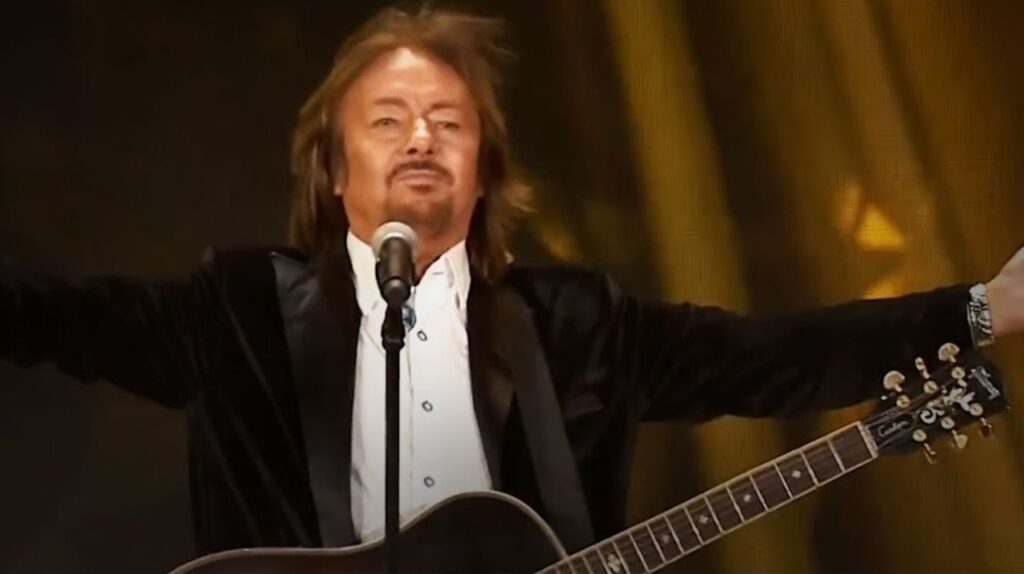
A tender farewell wrapped in quiet strength and bittersweet acceptance
When Chris Norman chose to record “Don’t Think Twice, It’s Alright”, he was not merely revisiting a classic—he was entering into a conversation with time itself. Originally written and recorded in 1963 by Bob Dylan for the landmark album The Freewheelin’ Bob Dylan, the song had already secured its place in musical history. Dylan’s version reached No. 14 on the UK Singles Chart in 1965 during his British breakthrough, while in the United States it became a cornerstone of the folk revival, later interpreted by countless artists including Peter, Paul and Mary, whose 1963 rendition climbed to No. 9 on the Billboard Hot 100.
But when Chris Norman, the unmistakable voice of Smokie, lent his raspy, weathered tone to this composition decades later, he transformed it from a youthful folk lament into something more reflective—almost confessional. His interpretation appeared on his solo releases and live performances in the 2000s, resonating particularly with European audiences who had followed his journey since the 1970s. While his version did not chart as a major single, it found life among devoted listeners who appreciated his mature, heartfelt delivery.
The story behind “Don’t Think Twice, It’s Alright” is steeped in personal upheaval. Bob Dylan reportedly wrote it in the wake of his relationship with Suze Rotolo, during a period of artistic awakening and emotional restlessness in New York’s Greenwich Village. Unlike the dramatic heartbreak ballads of the era, the song carries a different emotional weight. There is no accusation, no pleading—only a quiet resignation. “It ain’t no use to sit and wonder why, babe…” opens the song not with bitterness, but with clarity. The narrator walks away, yet he does so with dignity.
What makes Chris Norman’s rendition so compelling is how naturally the song fits his voice. That gravelly timbre, which once carried hits like “Living Next Door to Alice” and “If You Think You Know How to Love Me”, now carries the wisdom of years. Where Dylan’s original felt like a young man convincing himself to move on, Norman’s interpretation feels like someone who has lived through many partings and understands that some goodbyes are necessary.
Musically, the song’s structure remains deceptively simple: fingerpicked acoustic guitar, a steady melodic flow, and lyrics that unfold like a quiet conversation at dawn. But beneath that simplicity lies profound emotional architecture. Each verse builds gently, never erupting, never collapsing. It is a farewell without theatrics—a departure made with calm eyes and a steady heart.
The enduring meaning of “Don’t Think Twice, It’s Alright” lies in its acceptance. It is not a song about lost love in the dramatic sense; it is about emotional maturity. It acknowledges disappointment without surrendering to despair. In an era when many pop songs thrived on grand gestures and melodrama, Dylan wrote something intimate and restrained. And decades later, Chris Norman reminds us that such restraint is powerful.
There is something deeply nostalgic in hearing Norman sing these lines. His voice carries echoes of radio evenings, vinyl records turning softly under lamplight, and a time when lyrics mattered. The performance does not try to modernize the song; instead, it honors its roots. And perhaps that is why it resonates so deeply—because it respects the emotional honesty that made the original immortal.
In the broader history of popular music, “Don’t Think Twice, It’s Alright” stands as one of the defining songs of the 1960s folk movement. It helped solidify Bob Dylan’s reputation as a songwriter of rare insight, eventually contributing to his Nobel Prize in Literature decades later. Yet its beauty lies in its adaptability. From folk trio harmonies to country interpretations by artists like Johnny Cash, and now to the seasoned voice of Chris Norman, the song continues to breathe.
Listening today, one feels not just the sadness of farewell, but the strength of letting go. It is a reminder that sometimes the most courageous act is walking away without anger. And when Chris Norman sings it, there is an added layer—a sense that he understands every word not just as a performer, but as a man who has seen the seasons turn.
In that quiet refrain—“Don’t think twice, it’s alright”—we find not indifference, but grace.