
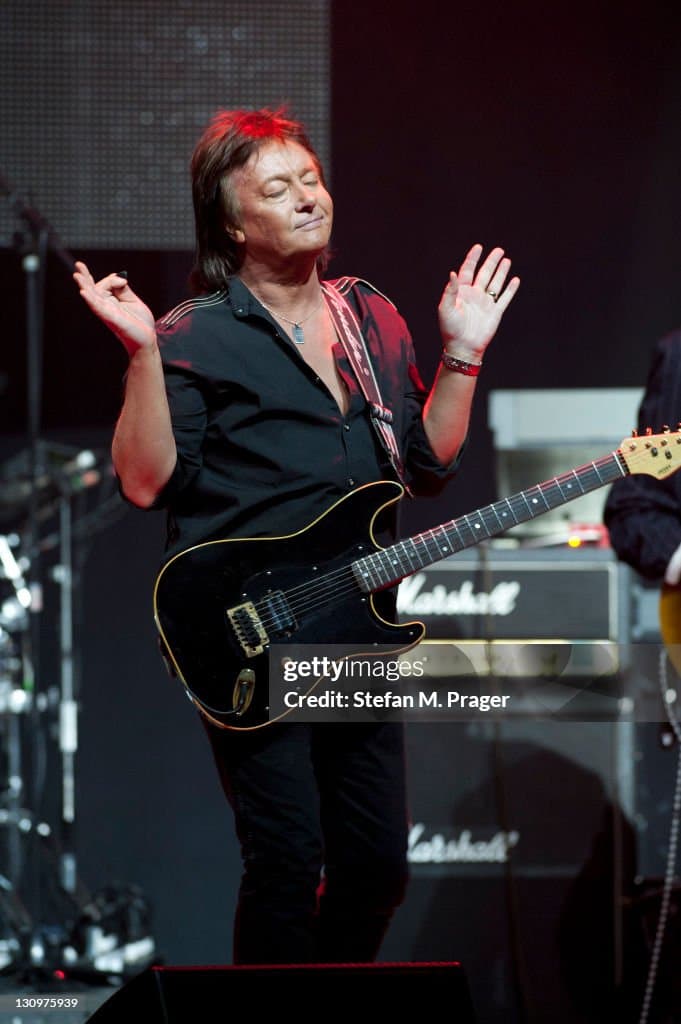
“Stop At Nothing” – an earnest turn in Chris Norman’s reflective musical odyssey
When we talk about Chris Norman and his remarkable journey from the frontman of Smokie to an evocative solo artist whose voice carries both grit and tenderness, the song “Stop At Nothing” is one of those lesser-celebrated yet deeply resonant moments tucked into the emotional tapestry of his mid-1980s work. Released as part of his 1986 album Some Hearts Are Diamonds, the track may not have scaled high on international singles charts like some of his other songs, but it stands as a testament to the heartfelt vulnerability and yearning that defined Norman’s solo voice in that era.
By the time Some Hearts Are Diamonds was released in October 1986, Chris Norman had already undergone a profound personal and artistic transition. After years as the distinctive voice of the British rock band Smokie, with hits like Living Next Door to Alice and If You Think You Know How to Love Me, Norman stepped confidently into a solo career earlier that decade. His breakthrough single as a solo artist, Midnight Lady, had become a number-one hit in Germany and much of Europe, endearing him to fans who cherished his gravelly vocal timbre and emotive delivery.
Nestled in the heart of the Some Hearts Are Diamonds tracklist, “Stop At Nothing” carries a poignancy that might be missed at first listen but is unmistakable upon reflection: it is a song of relentless pursuit, of the strange and sometimes unsettling desire to be seen, felt, and understood—even when that passion borders on obsession. The lyrics unfold with a raw simplicity—“I’ll stop at nothing to make you feel…”—revealing a narrator caught between longing and anguish, zeal and vulnerability, the tension of love and frustration all bound together.
While it was not issued as a major single and therefore doesn’t have a documented peak position in the mainstream chart histories like Midnight Lady or Some Hearts Are Diamonds itself, the album that includes it performed admirably. Some Hearts Are Diamonds climbed into the Top 20 on several European album charts, including peaking at No. 14 in Germany and reaching high placements in Norway and Switzerland, showing that Norman’s reach extended far beyond his Smokie years and that audiences were deeply receptive to his introspective solo voice.
Behind the scenes, the entire project was shaped by collaborations steeped in the musical currents of the 1980s. Produced in part by Dieter Bohlen—famed for his work with Modern Talking—the album offered a blend of polished pop-rock textures with Norman’s unmistakable timbre at the fore. Though “Stop At Nothing” itself wasn’t singled out for major promotional attention, its presence within the album’s narrative contributes to a larger emotional arc: a journey through love’s highs and lows, the ache of desire, and the resilience of the human heart.
For many listeners who grew up with Norman’s music in the 1970s and 1980s, rediscovering “Stop At Nothing” now can feel like opening an old letter from a friend—one that was written at a moment of personal intensity and still carries the weight of that feeling decades later. Norman’s voice, simultaneously tender and world-weary, gives voice to the inner urgencies that many of us have known: the way love can grip us, make us restless, drive us forward even when logic whispers otherwise.
In its own subtle way, the song reflects not just a musical moment in 1986 but also a kind of emotional truth about that era’s softer rock balladry—a willingness to wear your heart on your sleeve, to explore the edges of emotion in rich, unvarnished tones. There’s a certain timelessness to that, a quality that makes “Stop At Nothing” a beautiful, evocative piece of the larger mosaic that is Chris Norman’s enduring career.