
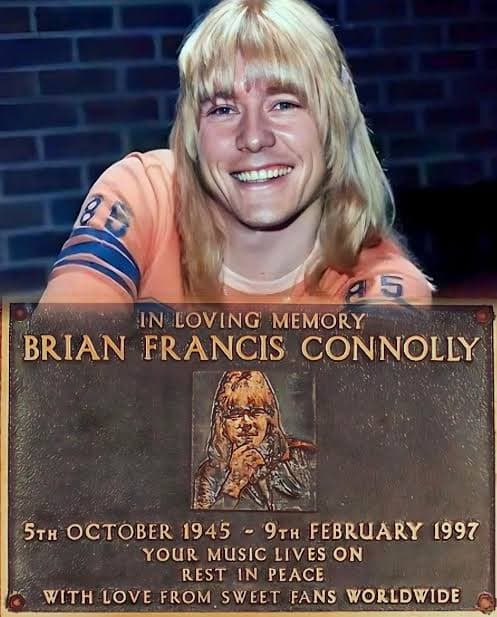
More Than a Frontman: How Brian Connolly Became the Soul of Sweet
Brian Connolly’s place in Sweet’s history goes far beyond the role of a frontman; his voice was the spark that turned the band’s songs into cultural moments. From the first chaotic shout that ignites “Ballroom Blitz” to the sleek, cinematic tension running through “Fox on the Run,” Connolly didn’t simply perform the material — he shaped its emotional architecture. Those records didn’t just sound exciting; they felt dangerous, theatrical, and alive, largely because of the way his voice carried urgency and drama in equal measure.
What made Connolly especially distinctive was the contrast he embodied. Offstage, he was soft-spoken and almost shy; on record, his vocals cut like a blade. That sharp, high-register delivery became Sweet’s sonic signature, instantly recognizable on radio, even amid the glitter-saturated chaos of the glam era. While many glam acts leaned heavily on image, Sweet — and Connolly in particular — pushed the music into heavier, more aggressive territory. Tracks like “Action,” “Hell Raiser,” and “Set Me Free” reveal a singer who could balance pop hooks with a raw, near-metal intensity years before hard rock fully embraced that sound.
There is also a technical side to Connolly’s legacy that often goes unnoticed. His phrasing was unusually precise, locking tightly with Mick Tucker’s pounding drums and Steve Priest’s layered harmonies. Sweet’s trademark stacked vocals — often mistaken for studio trickery alone — relied heavily on Connolly’s clear lead line to anchor the chaos. Without that vocal center, the band’s sound risked tipping into excess. With it, the songs exploded but never collapsed.
After Connolly’s departure in 1979, Sweet continued to exist, and even to evolve, but something fundamental had shifted. The songs were still loud, the guitars still sharp, yet the emotional tension — that sense of barely controlled hysteria — was gone. It wasn’t simply a matter of nostalgia; it was the absence of a voice that had once acted as the band’s emotional trigger.
Today, when Sweet’s classic hits resurface on the radio or in films and commercials, it is Connolly’s voice that still commands attention. It doesn’t sound dated; it sounds immediate, even urgent. His legacy endures not as a tragic footnote or a glam-era cliché, but as the defining human element of Sweet’s most powerful and enduring period — the sound that turned catchy songs into anthems that refuse to fade.