
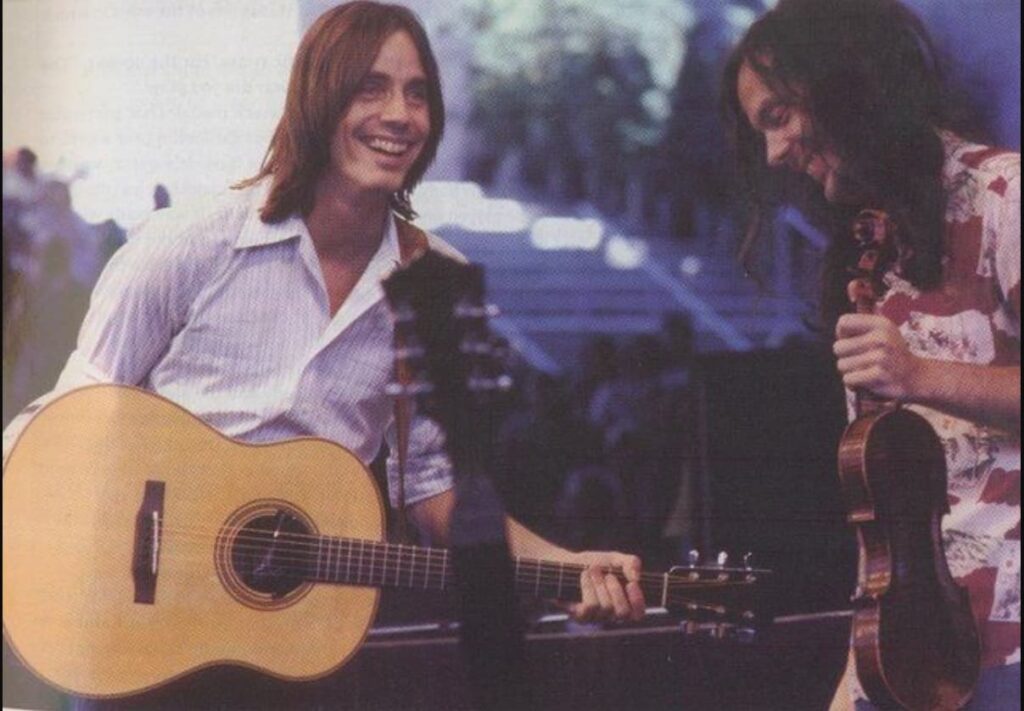
An anthem for the world-weary soul, questioning the price of lost innocence.
The Cynical Optimist: Jackson Browne‘s Enduring Question
Ah, Jackson Browne. Just the name itself conjures up images of sun-drenched, melancholic afternoons and the deep, introspective spirit that defined the Southern California singer-songwriter scene of the early 1970s. His music was the soundtrack to a generation wrestling with idealism lost and the dawning of adulthood’s complicated realities. And perhaps no song captured that unique tension quite as perfectly as “Doctor, My Eyes.”
Released in 1972 on his self-titled debut album, Jackson Browne, this track served as his true arrival on the national stage. It was a surprise hit that belied its complex, slightly bleak message with an infectiously upbeat sound. It shot up the charts, landing at Number 8 on the Billboard Hot 100 in the spring of 1972, and even reached Number 4 in Canada, becoming his first taste of mainstream success. This chart performance was a high he wouldn’t touch again until 1982’s “Somebody’s Baby,” which speaks volumes about the song’s immediate impact. It proved that a pop audience was hungry for music that went deeper than simple love songs, delivered by a fresh-faced twenty-something with the wisdom of an old soul.
The story behind the song is almost as layered as the track itself. Browne, barely in his twenties, had initially written a much darker, more cynical version. He’d penned the song after experiencing a severe eye condition, which provided the literal metaphor, but the true meaning was existential. However, ever the shrewd businessman, his record company, Asylum Records’ founder David Geffen, reportedly found the original lyric too pessimistic. He asked the young Browne to revise it, softening the blow of its fatalistic conclusion. The resulting track, while still deeply introspective, became a masterpiece of ambiguity. The protagonist is a stoic, world-weary individual who has endured “the slow parade of fears without crying,” but now fears the cost of that emotional armor. The plea to the doctor isn’t for physical sight but for the restoration of his capacity to feel, to truly see the world without the jaded lens of experience: “Was I unwise to leave them open for so long?” It’s the moment we realize that in trying to protect ourselves from the pain of the world, we might have inadvertently sealed ourselves off from joy, too.
This lyrical somberness is brilliantly—almost paradoxically—juxtaposed with the musical arrangement. The vibrant, signature piano riff, a catchy four-four beat carried by the legendary session rhythm section, “The Section” (bassist Leland Sklar and drummer Russ Kunkel), gives the song an undeniable, rollicking energy. Adding to the lush, Laurel Canyon sound, the inimitable harmonies of David Crosby and Graham Nash elevate the chorus, lending a hopeful, soaring quality that counterbalances Browne‘s bittersweet vocal. This contrast is what makes the track so enduring; it’s a melancholy song you can’t help but tap your foot to. It speaks to the older reader, those of us who have seen a few cycles of good and evil, who’ve experienced the inevitable dulling of youthful idealism, and who sometimes look in the mirror and wonder if we’ve lost a little bit of the wonder along the way. It’s a beautifully honest admission that the wisdom of age often comes with the burden of weariness, a struggle we all share.