
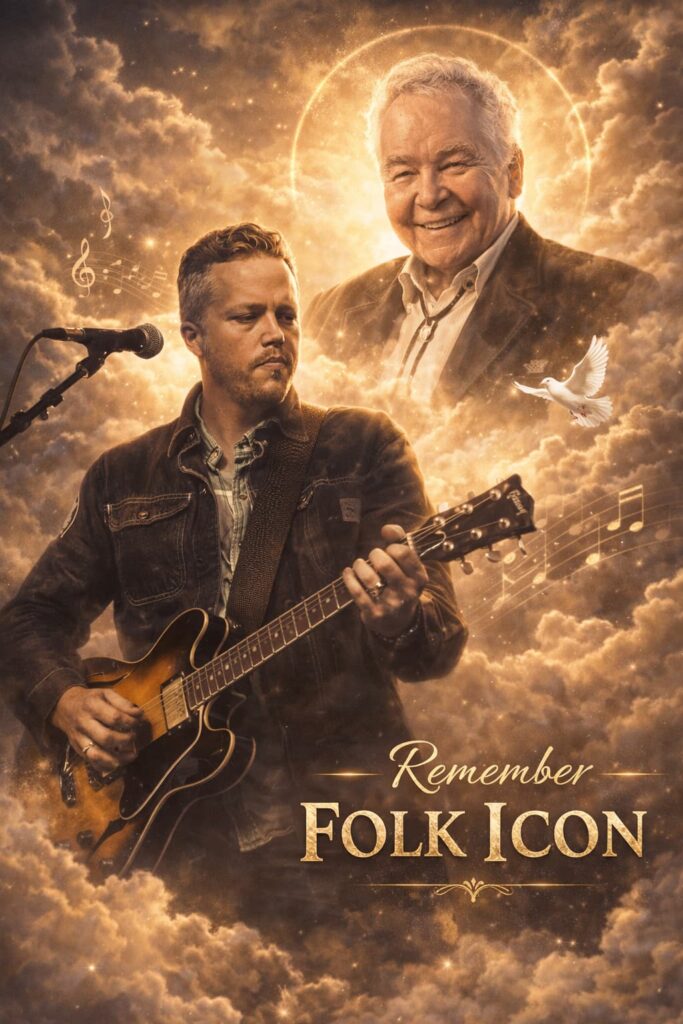
A Son’s Tribute, A Legacy in Song: When “Souvenirs” Became a Bridge Between Generations
When Jason Isbell chose to record “Souvenirs” in 2020, it was far more than a cover of a beloved folk-country classic. It was a gesture of reverence, a quiet bow to a songwriter who had shaped his artistic conscience. Originally written and recorded by John Prine for his 1972 album Diamonds in the Rough, the song resurfaced nearly five decades later in a new light—hauntingly intimate, steeped in gratitude and grief. Isbell’s version appeared on the tribute album Broken Hearts & Dirty Windows, Vol. 2, released in 2020 following Prine’s passing. While the tribute album itself did not chart prominently on major Billboard rankings, its emotional impact far outweighed commercial metrics. The importance of this recording lies not in chart positions, but in lineage—one master songwriter honoring another.
To understand the weight of “Souvenirs,” we must first return to John Prine, one of America’s most cherished songwriters. When he released Diamonds in the Rough in 1972, it followed the remarkable success of his self-titled debut John Prine (1971), which had already cemented him as a major voice in American folk and country songwriting. Though “Souvenirs” was not released as a charting single, it quickly became a staple in Prine’s live performances and one of his most enduring compositions. Over the years, it was embraced by audiences who saw in it a quiet truth: that life leaves us with memories that weigh more than possessions.
The song’s opening line—“All the snow has turned to water”—is one of those deceptively simple phrases that reveals more the longer you live with it. “Souvenirs” speaks about time slipping away, about friendships fading into distance, about the bittersweet nature of memory. It does not rage against loss; it accepts it with a sigh. The narrator reflects on old companions, on younger days, on moments that can never be reclaimed. “Broken hearts and dirty windows / Make life difficult to see,” Prine sings—a line that would later inspire the title of the tribute albums dedicated to his work. The imagery is plainspoken, almost homespun, yet it carries the emotional density of lived experience.
For Jason Isbell, recording this song was deeply personal. A longtime admirer of Prine, Isbell often cited him as a foundational influence. In interviews following Prine’s death in April 2020, Isbell spoke openly about the mentorship and kindness he received from him. Isbell’s rendition of “Souvenirs” strips the arrangement to its bones—acoustic guitar, restrained accompaniment, and a voice that trembles just enough to betray its vulnerability. There is no attempt to modernize it, no glossy reinterpretation. Instead, Isbell leans into the song’s stillness, allowing each lyric to settle gently, like dust in a quiet room.
What makes this version especially poignant is timing. Released only months after Prine’s passing due to complications from COVID-19, Isbell’s performance felt less like a cover and more like a farewell letter. The words “You can’t dance to it” take on a different resonance now; they feel like an acknowledgment that some songs are meant to be sat with, not celebrated. In Isbell’s voice, the song becomes both homage and inheritance—a reminder that great songwriting does not fade but finds new caretakers.
The enduring meaning of “Souvenirs” lies in its humility. It does not offer grand revelations. Instead, it recognizes that what we carry forward are fragments—voices remembered, laughter echoed in empty rooms, small tokens that anchor us to who we once were. In an age that often equates success with visibility and chart dominance, this song stands apart. It was never about climbing the Billboard Hot 100. It was about longevity of spirit.
Listening to Jason Isbell’s interpretation today, one hears not only the craftsmanship of two extraordinary songwriters but also the gentle passing of a torch. The song feels like sitting at a wooden kitchen table late at night, remembering faces that shaped your life. It reminds us that the truest souvenirs are not objects at all, but the emotional imprints left behind by people who mattered.
And perhaps that is why “Souvenirs” continues to resonate. Because long after the applause fades and the vinyl stops spinning, what remains are the songs that quietly understand us.