
A Defiant Anthem of Glam Rock Brilliance and Electric Youth
When T. Rex released “20th Century Boy” in March 1973, it did not merely enter the charts—it stormed them with glittering confidence. The single climbed to No. 3 on the UK Singles Chart, affirming Marc Bolan’s status as one of the defining architects of the glam rock era. Although the song was not included on the original UK version of the album Tanx (1973), it was recorded during the same fertile creative period and later appeared on various compilations and international pressings. From its opening riff—thick, distorted, and swaggering—it announced itself as something bold, modern, and unapologetically electric.
At the heart of “20th Century Boy” lies the genius of Marc Bolan, whose songwriting blended primal rock ’n’ roll instincts with a poetic mysticism all his own. By 1973, Bolan had already led T. Rex to a remarkable run of hits—“Ride a White Swan,” “Hot Love,” “Get It On (Bang a Gong)”—that helped define the early 1970s British soundscape. Yet this song carried a different kind of urgency. It felt less whimsical than some of his earlier work and more grounded in raw identity. The riff, often cited as one of glam rock’s most memorable guitar lines, drives the entire track forward with muscular repetition. There is no overcomplication here—just rhythm, attitude, and presence.
The story behind the recording is equally compelling. Produced by Tony Visconti, a longtime collaborator of Bolan’s, the track was built around a simple but commanding structure. The sessions reflected Bolan’s desire to toughen his sound, to move slightly away from the more fairy-tale imagery of earlier albums and into something sharper, more urban. Visconti’s production gives the guitar a dense, almost percussive weight, while the backing vocals add a teasing call-and-response quality that feels playful yet assertive. It was glam rock at its most self-assured.
Lyrically, “20th Century Boy” is deceptively simple. Bolan sings, “Friends say it’s fine, friends say it’s good / Everybody says it’s just like rock ’n’ roll.” The line captures a sense of generational confidence—a declaration of belonging to a new age defined by amplified guitars and liberated expression. The “20th century boy” is not merely a young man; he is a symbol of modernity, of self-creation, of stepping into a world shaped by sound and style. In many ways, Bolan was describing himself—an artist who embraced flamboyance, eyeliner, and feather boas while still delivering hard-edged rock riffs.
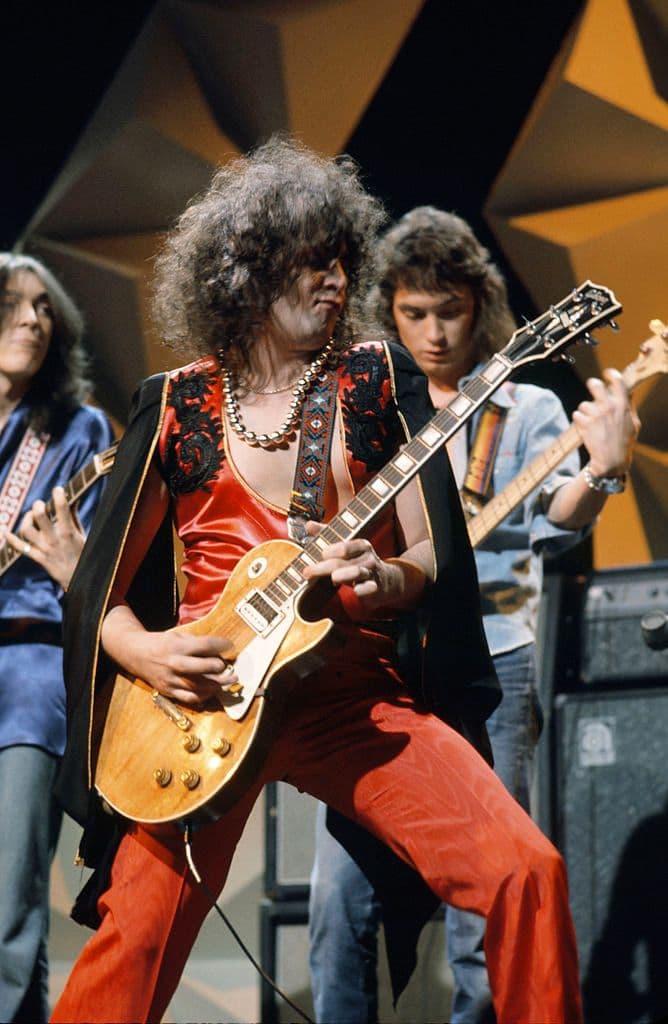
For listeners who lived through that era, the song evokes memories of transistor radios, vinyl singles spinning under soft lamplight, and the electric thrill of seeing glam rock explode across television screens. Programs like Top of the Pops amplified T. Rex’s presence, turning Bolan into a glittering icon whose curls and confident stare seemed to leap through the screen. His performances of “20th Century Boy” were magnetic—part rock star, part poet, entirely unforgettable.
Beyond its chart success, the song’s cultural legacy has endured for decades. It has been featured in films, commercials, and documentaries, reintroducing its driving riff to new generations. Yet for those who remember its original release, the magic lies in that first encounter—the shock of that opening chord, the realization that rock music could still surprise and energize.
What makes “20th Century Boy” so enduring is its balance of simplicity and swagger. It does not rely on elaborate arrangements or philosophical complexity. Instead, it thrives on conviction. Bolan’s voice—slightly husky, teasing, intimate—feels like a confidant whispering through the decades. There is warmth in it, even beneath the bravado.
In retrospect, the song stands as one of the purest expressions of glam rock’s golden moment. It captures a time when music shimmered with theatrical flair yet remained rooted in the primal pulse of rhythm and blues. Listening to it now, one cannot help but feel a stirring of nostalgia—not just for youth, but for a time when three chords and a fearless attitude could define an era.
“20th Century Boy” remains a testament to T. Rex and to Marc Bolan’s remarkable ability to turn a simple riff into a cultural statement. It is not merely a song; it is a memory set to distortion, a flash of glitter under stage lights, and a reminder that the spirit of rock ’n’ roll—bold, unpolished, and alive—still echoes from that unforgettable opening chord.