
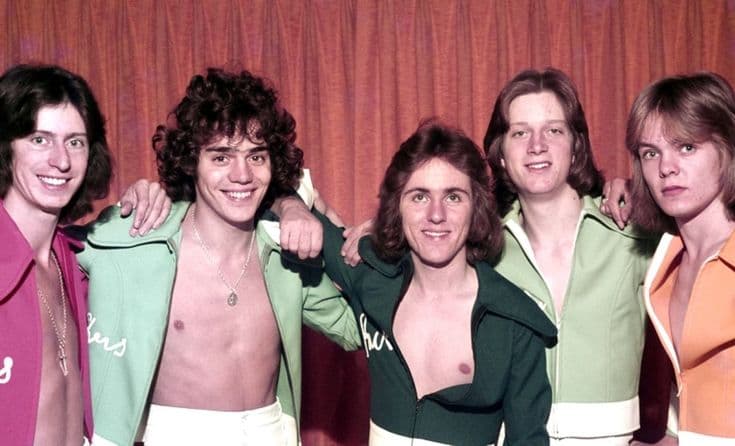
A Playful Dance Craze That Captured a Brief, Glittering Moment of the 1970s
When “The Bump” by Kenny burst onto the airwaves in 1974, it did more than climb the charts—it caught the pulse of a generation eager for uncomplicated joy. Released at the height of the glam-pop era, the single quickly soared to No. 3 on the UK Singles Chart in early 1975, becoming the band’s most enduring hit. In continental Europe, particularly in Germany, it achieved even greater commercial success, cementing its place as a dance-floor staple during a time when pop music and youth culture were inseparable forces.
Kenny, a British pop group formed by producers and songwriters Bill Martin and Phil Coulter, had already tasted success with bubblegum-flavored hits like “The Sound of Super K” and “Julie Anne.” But it was “The Bump” that defined them. Originally titled “Do the Bump,” the song was written by Martin and Coulter, two craftsmen who understood perfectly how to package a musical moment: a simple rhythm, a catchy chorus, and a dance that anyone could follow. Much like earlier crazes—the Twist, the Hucklebuck—“The Bump” thrived on physical immediacy. It was music designed not merely to be heard, but to be felt in the hips and shoulders.
Musically, the track sits squarely within mid-1970s pop—bright guitars, buoyant piano lines, and a rhythmic drive that is at once playful and commanding. The beat invites movement from the very first bar. Lyrically, it is uncomplicated, almost delightfully naïve, urging listeners to gather close and quite literally “bump” along to the groove. Yet beneath its simplicity lies something revealing about its time. The early 1970s were an era of social transition—post-Beatles Britain, economic uncertainty, and shifting youth identities. In such an atmosphere, a song like “The Bump” provided escape. It didn’t ask heavy questions. It offered release.
There is also an interesting irony in the song’s legacy. Though it became Kenny’s signature, the band itself was very much a studio creation. Like many acts of the era shaped by strong behind-the-scenes producers, Kenny represented the polished, commercially savvy side of pop. Bill Martin and Phil Coulter had already proven their songwriting credentials with hits for The Bay City Rollers and even the Eurovision Song Contest. They knew how to tap into mass appeal. With “The Bump,” they caught lightning in a bottle.
The dance associated with the song became a minor cultural phenomenon. It was simple: partners would gently bump hips in time with the beat. Compared to the sensual overtones that disco would soon amplify, the Bump felt almost innocent—playful rather than provocative. And that innocence is part of its enduring charm. Listening to it now, one hears not just a catchy pop tune but a snapshot of a fleeting moment before disco’s mirror balls and synthesizers took over completely.
Commercially, the song’s strong chart performance in the UK (No. 3) was complemented by impressive showings across Europe, especially in Germany where it topped the charts. Yet, as often happens in pop history, the craze was short-lived. Later singles such as “Julie Anne” could not quite recapture the same explosive magic. By the late 1970s, tastes had shifted, and Kenny faded from the spotlight.
And yet, decades later, “The Bump” still evokes something vivid. The opening chords instantly conjure images of glittery television appearances, youthful faces framed by feathered hair, and crowded dance floors where laughter was as important as rhythm. It reminds us that not every great pop song must carry profound lyrical weight. Some exist simply to mark a time, to embody a collective mood.
In retrospect, “The Bump” stands as a testament to the craftsmanship of 1970s pop production—a reminder that even a seemingly lightweight dance tune can carry the emotional residue of an era. It belongs to that category of songs that, when heard again after many years, transports the listener not just to a sound, but to a feeling: the thrill of a new dance, the camaraderie of shared movement, the brief but radiant shimmer of youth culture at play.
For those who remember its first spin on the radio, or its appearance on programs like Top of the Pops, the song is more than a novelty. It is a warm echo from a simpler, brighter chapter in popular music history—one that still makes the feet tap and the heart smile.