
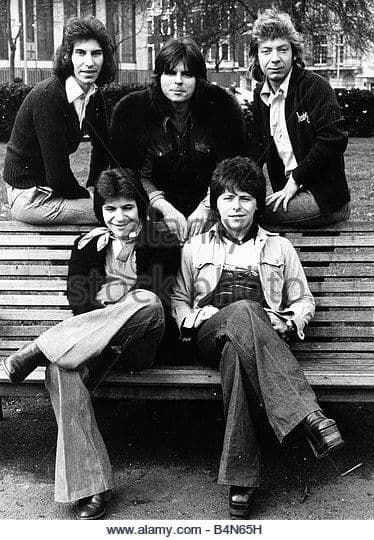
A Glam Rock Anthem of Working-Class Pride and Unspoken Solidarity
Few songs from the glittering yet gritty era of British glam rock capture the spirit of everyday resilience quite like “People Like You And People Like Me” by The Glitter Band. Released in 1975, at a moment when Britain was wrestling with economic uncertainty and social tension, the song rose to No. 5 on the UK Singles Chart, becoming one of the band’s most enduring hits. It was more than just another chart success—it was a declaration of identity, a mirror held up to the ordinary man and woman navigating a changing world.
By 1975, The Glitter Band had already stepped out from the long shadow of their early association with Gary Glitter. Having served as his backing musicians during the explosive early 1970s glam boom, they carved out a distinctive identity of their own—less flamboyant, perhaps, but sturdier, more grounded. Their breakthrough single “Angel Face” had topped the UK chart in 1974, proving they were no mere supporting act. Yet it was “People Like You And People Like Me” that solidified their rapport with a broad audience.
From the opening bars, the song carries that unmistakable Glitter Band sound—pounding tribal drums, handclaps that echo like a call to arms, and harmonized vocals that feel communal rather than individual. Unlike the more theatrical glam rock of the early ’70s, this track trades glitter for grit. Its lyrics speak plainly and directly: about ordinary people, about shared struggles, about the quiet dignity of simply getting through life. There is no irony here, no elaborate metaphor. Instead, there is warmth.
The mid-1970s in Britain were marked by industrial strikes, inflation, and an undercurrent of uncertainty. Pop music often leaned toward escapism, but this song did something different. It offered reassurance. “People like you and people like me” was not a slogan—it was a lifeline. It suggested that in a divided society, there remained a sense of fellowship. Listening to it now, decades later, one hears not only the beat of glam rock but the heartbeat of a generation learning to endure.
Commercially, its success was significant. Reaching No. 5 in the UK meant heavy rotation on radio and frequent appearances on television programs such as Top of the Pops. But numbers alone cannot explain its resonance. The record’s appeal lay in its simplicity. It did not aim for artistic grandeur. It aimed for connection. And it achieved it.
There is also something poignant about the timing. Glam rock, by 1975, was beginning to fade. Punk was just over the horizon, ready to challenge everything that glittered. Yet in that transitional space, this song stood firm—rooted in melody, rhythm, and a straightforward message. It felt less like a party anthem and more like a communal hymn for the dance hall.
Musically, the production balances swagger and sincerity. The dual-drum attack—a signature of The Glitter Band—creates a stomping, almost marching quality. It invites participation. One can almost picture crowded halls, arms around shoulders, voices raised together in chorus. The song’s structure is uncomplicated, but that is its strength. The refrain lingers long after the final note fades, like a familiar phrase that returns in quiet moments.
Looking back, “People Like You And People Like Me” endures because it speaks to something timeless. Trends fade, fashions change, but the need to belong—to feel seen and understood—remains constant. In its three-minute span, the song captured that longing with remarkable clarity.
Today, when we revisit this track, it carries with it not just the sound of mid-’70s Britain but the memory of a particular mood: hopeful yet cautious, bruised yet unbroken. It reminds us that pop music, at its best, does more than entertain. It comforts. It binds. And sometimes, in the simplest of refrains, it tells us exactly what we need to hear—that in this wide and complicated world, there are always people like you and people like me.