
A Song of Quiet Longing and Unspoken Dreams in Ordinary Lives
Few songs in the American songbook carry the quiet ache and emotional dignity of “Angel from Montgomery.” Written by John Prine and immortalized in different ways by Bonnie Raitt and later by Alison Krauss, the song stands as one of the most moving portraits of middle-aged disillusionment ever set to music. Though never a major charting single upon its initial release, its legacy far outweighs its modest commercial beginnings. The original recording appeared on John Prine’s self-titled debut album, John Prine (1971), a record now considered a cornerstone of American folk songwriting. When Bonnie Raitt recorded her version for Streetlights (1974), the song found a new emotional register—bluesier, more grounded, and deeply personal.
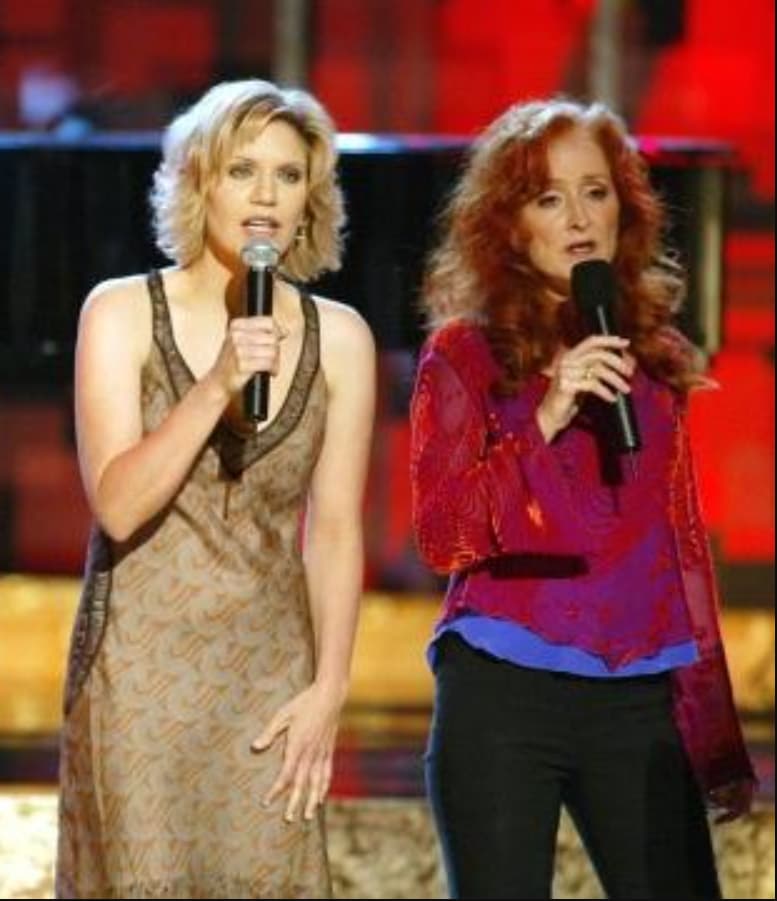
Commercially, neither version stormed the pop charts in the way radio-driven hits did in the 1970s. However, the cultural reach of the song grew steadily over time. Bonnie Raitt’s interpretation became one of her signature pieces in concert, solidifying her status as one of the most emotionally authentic performers of her generation. The duet performance by Bonnie Raitt and Alison Krauss—most notably captured during televised appearances and tribute concerts—brought the song into the 21st century with renewed tenderness and reverence. Their version did not chart as a commercial single, but its emotional resonance became part of the enduring legacy of the song.
The story behind “Angel from Montgomery” is both simple and extraordinary. John Prine, barely in his mid-twenties when he wrote it, astonishingly crafted the voice of a middle-aged housewife reflecting on her life with weary clarity. Inspired in part by Montgomery, Alabama, and perhaps even by the literary echoes of Southern storytelling, Prine stepped outside his own experience and into the inner world of a woman trapped in routine, marriage, and faded dreams. The genius of the song lies in its empathy. It does not mock or dramatize. It simply observes—with compassion.
When Bonnie Raitt first heard the song, she felt an immediate connection. Her 1974 recording transformed it from folk meditation into something earthier and blues-inflected. Raitt’s phrasing, slightly behind the beat, gives the lyrics room to breathe. When she sings, “Make me an angel that flies from Montgomery,” it is not theatrical—it is pleading, restrained, human. Her version helped introduce the song to wider audiences during the 1970s folk-blues revival, even though it did not enter the Billboard Hot 100. Instead, it became something more lasting: a concert staple, a rite of passage, a shared emotional memory.
Decades later, Alison Krauss, with her crystalline bluegrass soprano, would approach the song from another angle. Where Raitt brings gravel and blues smoke, Krauss brings fragility and almost sacred stillness. When the two voices blend—particularly in televised performances—the contrast is breathtaking: one voice weathered by time, the other luminous and pure. Together, they remind listeners that longing does not belong to one generation alone.
The meaning of “Angel from Montgomery” has deepened over time. On the surface, it is about dissatisfaction in marriage and the monotony of domestic life. But beneath that lies something universal: the quiet question many carry inside—“Is this all there is?” It is about the slow accumulation of compromise. About dreams once vivid, now folded away like old photographs. Yet it is never bitter. The song acknowledges pain without losing tenderness.
Musically, the structure is deceptively simple: gentle chord progressions, steady tempo, no dramatic flourishes. This simplicity allows the lyrics to carry the emotional weight. It reflects the ordinary life it portrays—no spectacle, just reality.
What makes “Angel from Montgomery” endure is its honesty. It respects its character. It respects the listener. In an era of grand gestures and stadium anthems, it chose intimacy. And perhaps that is why it still feels fresh more than five decades later.
When Bonnie Raitt sings it today, the years in her voice add new layers. When Alison Krauss harmonizes, she brings a sense of generational continuity. And behind it all stands John Prine, the songwriter who understood that sometimes the most powerful stories are whispered, not shouted.
Some songs dominate charts. Others quietly enter the bloodstream of culture. “Angel from Montgomery” belongs to the latter—an enduring hymn for anyone who has ever stared out a window and wondered about the roads not taken.