
A Song of Quiet Longing and Hard-Won Grace in Everyday Life
Few songs in American popular music capture the quiet ache of ordinary existence quite like “Angel from Montgomery” by Bonnie Raitt. Released in 1974 on her landmark album Streetlights, the recording did not storm the singles charts at the time of its release—there was no major Billboard Hot 100 breakthrough attached to it. Yet, paradoxically, it became one of the most enduring performances in her catalog and one of the defining interpretations in modern folk-blues history. The song itself was written by John Prine, first appearing on his 1971 debut album John Prine, and over the decades it has grown into a standard—passed from voice to voice, stage to stage—like a well-worn letter folded and unfolded across generations.
From the very first lines, sung in Raitt’s warm, weathered timbre, the listener is drawn into the interior life of a middle-aged woman in Montgomery, Alabama—trapped not by dramatic tragedy, but by the slow erosion of dreams. “Make me an angel that flies from Montgomery…” The plea is not for spectacle. It is for transcendence, for the briefest moment of relief from the routine and the resignation that life sometimes quietly imposes. When Bonnie Raitt chose to record the song, she did more than cover a composition—she inhabited it. Her interpretation gave the narrative flesh, sorrow, and dignity.
Commercially, Streetlights marked a transitional period in Raitt’s career. While the album did not dominate the Top 10 of the Billboard 200, it strengthened her reputation as a discerning interpreter of song, blending blues, folk, and country with an emotional intelligence that was rare even in the 1970s singer-songwriter era. “Angel from Montgomery” became a centerpiece of her live performances, a song audiences waited for in hushed anticipation. It would later appear on compilations and live albums, reinforcing its place as one of her signature works—even though it was not written by her.
The story behind the song’s creation is itself rooted in observation and empathy. John Prine, still in his early twenties when he wrote it, crafted the voice of a woman decades older than himself. That imaginative leap—astonishing in its maturity—spoke to Prine’s rare gift: he could see into lives overlooked by mainstream pop narratives. There is no melodrama here, only the stark poetry of lines like “If dreams were thunder, and lightning was desire…” It is language that feels both humble and eternal.
When Bonnie Raitt embraced the song, she recognized something deeply human in it. Raitt’s own artistry had always gravitated toward stories of resilience and emotional truth. Her slide guitar and smoky phrasing lent the track a blues undercurrent, subtly shifting it from pure folk storytelling into something earthier—more embodied. In concert, she often introduced the song with affection for Prine, acknowledging the genius of the writer while making it unmistakably her own. Over time, audiences began to associate “Angel from Montgomery” as much with Raitt as with its creator.
The meaning of the song unfolds gently but persistently. It speaks of marriage not as romance but as endurance. It reflects on aging not with bitterness, but with a quiet reckoning. The kitchen, the radio, the passing years—these ordinary images become symbols of confinement and longing. And yet, beneath the melancholy, there is a thread of hope. The request to be made “an angel” is not escapism in the childish sense. It is the yearning to remember who one once was, to reclaim a spark of vitality before it disappears entirely.
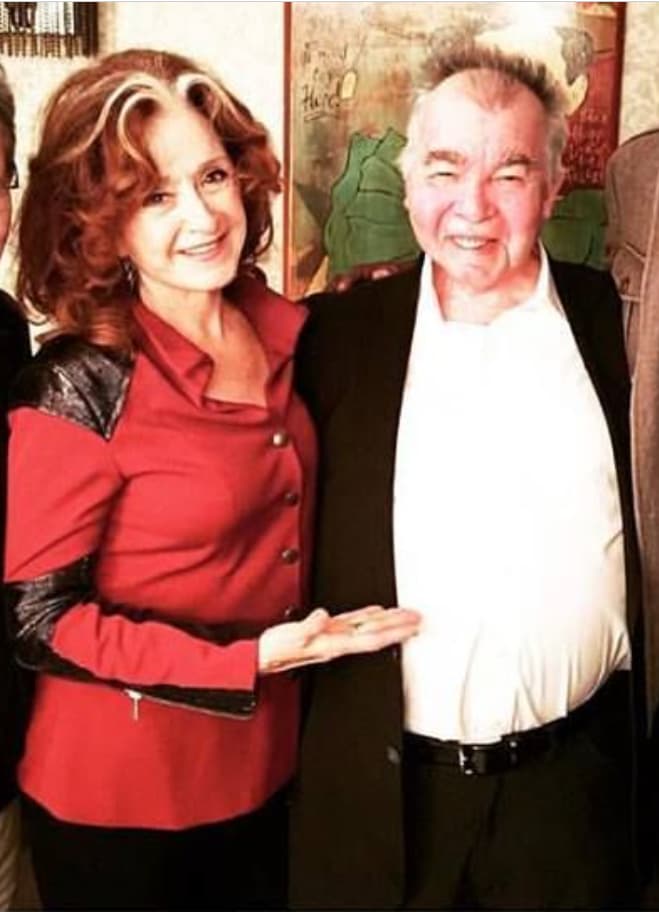
In retrospect, the song’s lack of explosive chart success seems almost fitting. “Angel from Montgomery” was never meant to be a fleeting radio hit. It is a companion piece—a song that grows richer with time. It resonates differently as years accumulate, as the listener begins to recognize themselves in its verses. That is why it has endured in setlists, tribute concerts, and collaborations—including moving duet performances between Bonnie Raitt and John Prine himself, moments that felt less like concerts and more like shared confessions.
Today, “Angel from Montgomery” stands not as a chart statistic but as a testament to songwriting craft and interpretive depth. In the hands of Bonnie Raitt, it became a mirror—held gently but honestly—to the quiet corners of the human heart. And for those who have lived long enough to understand its sighs and silences, it remains not just a song, but a memory wrapped in melody.