
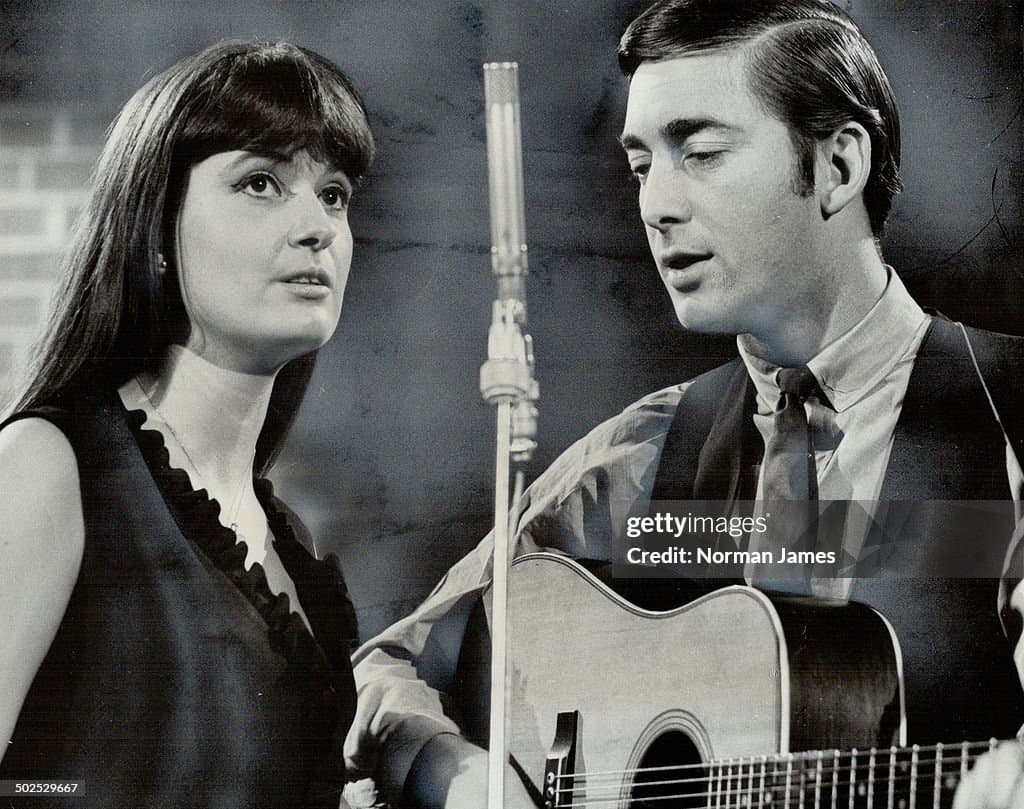
“Tomorrow Is A Long Time” — A mournful ode to longing, where time itself feels heavier without the presence of love.
In the shimmering dawn of the 1960s folk revival, there exists a recording that feels like an echo from another lifetime — fragile, honest, and drenched in longing. Ian & Sylvia’s rendition of “Tomorrow Is A Long Time” stands not merely as a song on an album, but as a quiet companion for the hearts that have known deep love and deeper absence. Released as a track on their 1963 album Four Strong Winds, this song may not have climbed pop charts on its own, yet its emotional resonance ensured it lingered far beyond its modest commercial imprint.
At first glance, the track’s placement — nestled among traditional folk tunes and original compositions — might seem unassuming. It didn’t become a single with a chart position like a mainstream hit might; it wasn’t the “headline” of the record. But for those who leaned closer, tuning into the warmth of Ian & Sylvia’s harmonies, the song quickly revealed itself to be a quiet gem in the folk canon. Its inclusion on Four Strong Winds, a pivotal album in the duo’s career with Vanguard Records, placed it amid songs that helped define folk music’s heartfelt simplicity and sincerity in the early 1960s.
What makes “Tomorrow Is A Long Time” so enduring is its lineage. Written by Bob Dylan in the early 1960s, the song was first brought into the world not by Dylan himself but by Ian & Sylvia, who recorded and released it before Dylan’s own version was officially available. Dylan’s own recording wouldn’t see release until his 1971 compilation Bob Dylan’s Greatest Hits Vol. II, though the song was known in bootleg circles long before that.
The song’s heart is its aching introspection. There are no flashy productions here — no grand orchestral swells — only the raw, open vulnerability of a voice yearning for presence in the face of absence:
“If tomorrow wasn’t such a long time / Then lonesome would mean nothing to you at all…”
These words, simple in construction, hold a universe of feeling. They are a meditation on time’s cruelty when love is distant — a sentiment that feels all the more poignant with passing years. For those who have lived through long nights separated from a loved one, days that stretch into weeks or months, or the slow ache of memory itself, this song’s quiet lament becomes almost tactile.
Ian Tyson’s and Sylvia Tyson’s harmonies carry this lament with grace. Their voices intertwine in a way that brings out not just the melancholy of Dylan’s words but the depth of human tenderness beneath them. They convey the sense that to wait for love — to hope for it “tomorrow” — is a kind of timeless ache that every soul must understand at some point.
The story behind the song adds another layer. Bob Dylan wrote it during his early Greenwich Village years, inspired by his own relationships and by the pulsing emotional currents of that era’s folk scene. Though Dylan became its songwriter, Ian & Sylvia’s rendition helped introduce it to the world, standing as an early testament to how folk artists of the time shared and transformed each other’s work in a deeply communal way.
For an older listener, there is something almost sacred in returning to this track. It feels like gathering around a fire with a friend and remembering — the way the wind sounded that one autumn night, the hush of morning streets, the quiet ache of a heart that once waited, hoped, and loved. “Tomorrow Is A Long Time” holds up a mirror to those memories, not to make them fade, but to let them breathe again.
In a world that has often prized immediacy and spectacle, this song remains a quiet testament to patience, to longing, and to the timeless beauty of honest emotion.
Whether you first heard it on an old record player, in a quiet afternoon reverie, or in a moment of deep personal remembrance, “Tomorrow Is A Long Time” feels less like a song and more like a companion through the long quiet nights of the heart.