
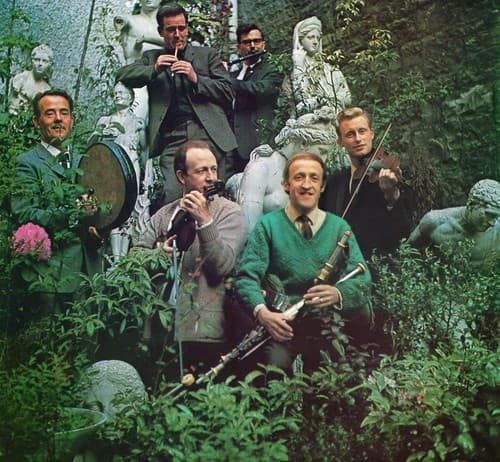
“The Foggy Dew” — a haunting tribute to sacrifice and the longing for freedom, forever echoing across generations.
A song that sings of heartbreak and hope, of young lives lost under misty Irish skies, performed with a voice that carries the weight of history itself.
In the rich tapestry of Irish traditional music, few recordings resonate with the same emotional gravity and historical resonance as The Chieftains’ rendition of “The Foggy Dew” featuring the distinctive, soul-piercing vocals of Sinéad O’Connor. First released in 1995 on the album The Long Black Veil, this version of the century-old ballad has become one of the most listened-to interpretations of a song rooted firmly in one of Ireland’s most turbulent chapters.
Although “The Foggy Dew” wasn’t originally composed by The Chieftains or Sinéad O’Connor, their recording breathed new life into an old rebel song — a traditional Irish ballad written by Father Charles O’Neill around 1919, in the aftermath of the 1916 Easter Rising. That historic rebellion, led by a band of Irish nationalists in Dublin, sought to end British rule and proclaim an Irish Republic, and though it was militarily crushed, it became the emotional and psychological spark for Ireland’s later push toward independence.
What makes this rendition particularly remarkable isn’t just its beautiful arrangement — a slow, almost devotional pace in the key of E major with a tempo around 91 BPM — but the way it bridges centuries of struggle with a contemporary ear. The melody itself, drawn from older folk traditions and shaped through countless singers before them, is transformed here into something reverent, urgent, and timeless.
When it first reached listeners in 1995, The Long Black Veil was already a remarkable project — a crossroads where traditional Irish music met global voices and styles. Alongside collaborations with Mick Jagger, Van Morrison, and Marianne Faithfull, The Chieftains invited Sinéad O’Connor to lend her voice to “The Foggy Dew.” O’Connor’s vocal performance is stark and haunting: there are no gimmicks, no dramatic flourishes — just truth laid bare. It’s the voice of someone speaking from memory, from loss, from empathy.
In terms of reception, this interpretation of “The Foggy Dew” has enjoyed a deep and enduring life with audiences worldwide. On streaming platforms like Spotify, the track has become one of The Chieftains’ most played songs, peaking at #16 in Ireland and amassing millions of streams — a testament to its lasting power and cultural importance. While it may not have stormed mainstream pop charts in the way a hit single might, its impact is felt in the passionate devotion of listeners who return to it year after year, particularly around anniversaries of the Easter Rising and other moments of national remembrance.
What makes the song so meaningful — particularly for listeners with deep ties to the past — is how it balances sorrow with resilience. The lyrics recount a journey “down the glen one Easter morn” only to find Dublin transformed by armed men willing to die for something greater than themselves. The chorus, “And the Angelus bells o’er the Liffey swells rang out in the foggy dew,” sounds like a lament and a blessing rolled into one — bells for the dead, bells for hope.
For older audiences, or anyone acquainted with the weight of history, this song doesn’t simply evoke a moment — it opens a window on a lifetime of memory, loss, and the stubborn persistence of hope. O’Connor’s voice, in its raw clarity, invites us into that window, urging us not only to remember the past but to feel it — to stand with those who chose their own soil over distant battlefields, who looked death in the eye and chose home.
In a world that often rushes past remembrance for rhythm and trend, The Chieftains’ “The Foggy Dew” with Sinéad O’Connor is a rare song that pulls music back into the realm of the sacred. It reminds us why songs matter: not just for entertainment, but for preservation of the human spirit, for honoring those whose voices might otherwise be lost to the foggy dew of history.