
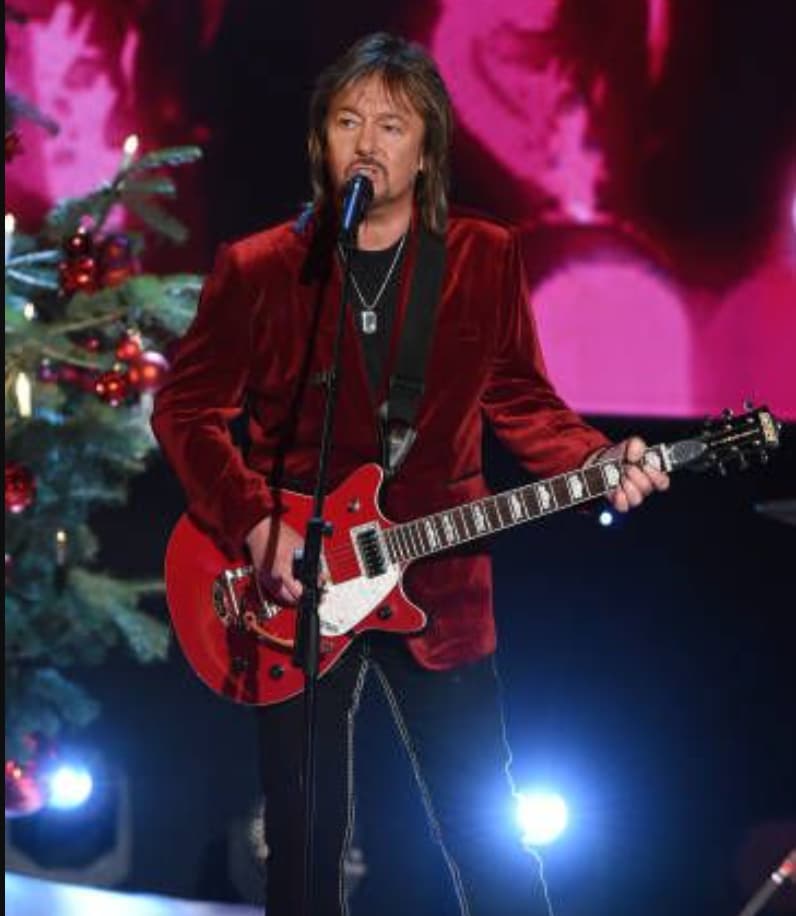
Silent Night, Holy Night — a familiar prayer reborn through a weathered voice and a lifetime of longing
There are songs that arrive once a year yet feel as though they have lived inside us forever. “Silent Night, Holy Night”, when sung by Chris Norman, belongs firmly to that rare category — not as a reinvention, but as a quiet homecoming. His version does not seek novelty, chart dominance, or spectacle. Instead, it leans into memory, into faith, and into the soft glow of reflection that only time can bring.
Chris Norman recorded “Silent Night, Holy Night” during his later solo years, long after the thunderous success of Smokie and long after his own voice had traveled through decades of pop, rock, and adult contemporary music. Unlike commercial Christmas singles that often aim for seasonal chart success, Norman’s recording did not enter major international charts upon release. Its purpose was different. It was made to be felt, not counted.
What makes this performance resonate so deeply is the voice itself. By the time Norman approached this carol, his once-youthful rasp had matured into something warmer, grainier, and profoundly human. Every breath carries experience. Every phrase feels earned. When he sings “Silent night, holy night, all is calm, all is bright,” the calm is not naïve — it is hard-won. It sounds like peace discovered after a long road.
The story behind this recording is inseparable from Norman’s career arc. From the 1970s onward, he became known as a voice of tenderness wrapped in gravel — capable of intimacy even in pop structures. Hits like “Living Next Door to Alice” and later “Stumblin’ In” showcased his ability to balance vulnerability with restraint. By the time he turned to “Silent Night, Holy Night,” that balance had deepened. He was no longer singing about romantic uncertainty alone, but about something larger: stillness, faith, and reconciliation with time itself.
The song’s meaning, of course, is universal. Written in the early 19th century, “Silent Night” has always been about quiet revelation — about light arriving without noise. In Norman’s interpretation, that meaning shifts subtly. The holiness feels less ceremonial and more personal. It sounds like a man standing alone in a quiet room, reflecting on love, loss, gratitude, and survival. The “holy night” becomes not only Bethlehem, but every moment in life when silence finally allows us to breathe.
There is also something deeply comforting in the absence of excess. Norman does not oversing. He does not decorate the melody with vocal acrobatics. He lets the song remain what it has always been: a simple prayer. His phrasing is unhurried, almost conversational, as if he understands that the power of this carol lies in its restraint. In doing so, he aligns himself with listeners who value sincerity over display.
For those who have followed his journey — from smoky clubs to international stages, from youth to maturity — this recording feels like a quiet nod of recognition. It says: I am still here. I still believe in softness. I still understand the value of silence. And that message lands with particular weight for anyone who has watched the world change faster than the heart can adapt.
Unlike festive recordings meant to fill shopping malls or radio rotations, Chris Norman’s “Silent Night, Holy Night” feels best experienced late at night, when the world slows down. It invites memory: family gatherings long past, winter evenings filled with candlelight, moments when music did not rush but waited patiently with us.
In the end, this version does not ask us to celebrate loudly. It asks us to remember quietly. And in that quiet, there is warmth — the kind that stays long after the final note fades.
It is not a performance chasing applause.
It is a voice offering peace.