
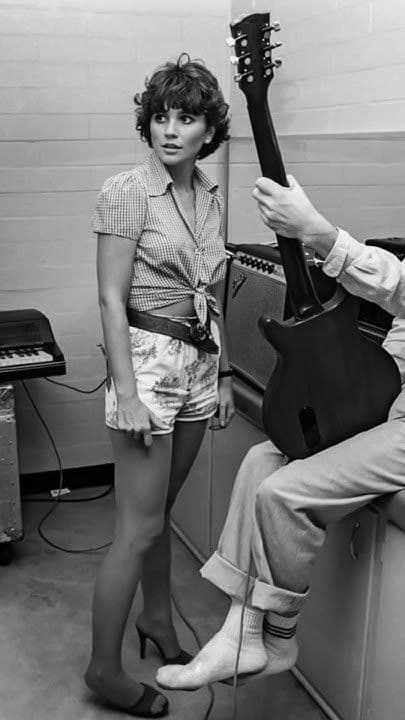
“That’ll Be the Day” – A Timeless Echo of Young Love, Loss, and the Long Road Back to Memory
There are songs that simply play, and then there are songs that return—as if carried on a quiet breeze from another lifetime. “That’ll Be the Day”, in the hands of Linda Ronstadt, is one of those rare recordings that doesn’t merely revisit the past; it revives it with a tenderness both familiar and startlingly alive. Her 1976 rendition, released on the acclaimed album Hasten Down the Wind, became one of the defining reinterpretations of her career, climbing to #11 on the U.S. Billboard Hot 100 and #27 on the Country chart, while soaring to #2 in Canada—a reminder of just how deeply her voice resonated across generations.
And yet, every great song has a shadow behind it, an earlier shape. The story begins in 1957, when Buddy Holly & the Crickets first recorded “That’ll Be the Day.” It was a turning point in early rock ’n’ roll—a moment when a young artist, still full of hope and uncertainty, captured lightning in a bottle. Holly’s version shot to #1 on Billboard’s Best Sellers chart and became one of the most influential singles of the 1950s, later earning a place in the Grammy Hall of Fame and the U.S. Library of Congress. It was a song built on swagger, heartbreak, and a youthful defiance that seemed to stare straight into the future.
Nearly two decades later, when Ronstadt stepped into the studio to record her own version, she didn’t try to replicate that fire. Instead, she built something more reflective—something gentler, wiser, steeped in the soft ache of hindsight. Her voice, warm and unguarded, transforms the song into a conversation with memory itself. The jangling rockabilly spark becomes a rolling, country-rock embrace; the bold bravado of Holly’s delivery becomes a quiet confrontation with the way love flickers, fades, returns, or refuses to let go.
What gives Ronstadt’s performance its power is the emotional truth she draws out of the lyric. “That’ll be the day,” in her phrasing, carries a double meaning: part promise, part doubt, part resignation. It’s the sound of someone who has lived long enough to know that certainty is fragile, and that even the sweetest devotion is never entirely safe from time’s erosion. In her voice, the song becomes not just a declaration but a reflection—a soft recounting of the moments when love felt so sure, only for life to prove otherwise.
For many listeners, especially those who grew up through the eras when both Holly and Ronstadt shaped the musical landscape, her version stirs a deep and immediate nostalgia. It brings back the scent of vinyl sleeves, the glow of radios at dusk, the rush of first dances, first heartbreaks, first glimpses into the tender confusion of adulthood. Ronstadt’s gift has always been her ability to make emotions feel not only honest but shared. In this recording, she invites the listener to revisit their own memories—some sweet, some unsettled, all profoundly human.
More than a hit single, more than a respectful tribute, Ronstadt’s “That’ll Be the Day” serves as a bridge between two eras of American music. She honors the bold, early energy of rock ’n’ roll while giving the song a new emotional center, one shaped by experience, vulnerability, and an unmistakable depth of feeling. The result is a version that stands on its own—distinct, resonant, and unforgettable.
In the end, her recording reminds us of something quietly profound: time changes the world around us, but the songs that carried our hearts still return, again and again, to remind us of who we were—and maybe, who we still are.