
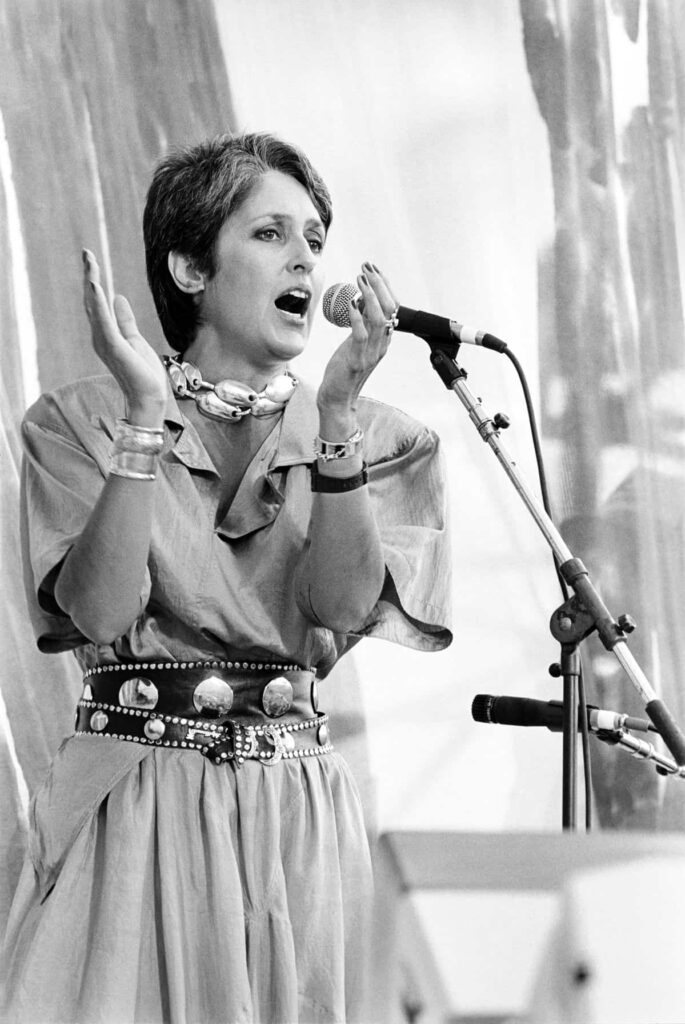
The Ballad of the Forbidden Heart: A Mother’s Warning and the Dawn of a Legend
To hear Joan Baez’s voice is to be transported to a time of earnest conviction, quiet revolution, and the pure, unadorned beauty of traditional folk music. When her self-titled debut album, Joan Baez, arrived in October 1960, it was a revelation. It was a stark, almost austere collection featuring primarily her crystalline soprano and acoustic guitar, and the opening track, “Silver Dagger,” set the tone for the entire burgeoning folk revival. As a traditional American folk ballad with deep roots in the British Isles (sharing common lineage with songs like “Drowsy Sleeper”), this song, by its very nature, did not have a measurable chart position as a commercial single. However, the album itself was a spectacular, slow-burn success, establishing the 19-year-old Baez as the undisputed “Queen of Folk.” The LP eventually went Gold and peaked at No. 15 on the Billboard 200 chart in 1962, a staggering achievement for an album of unaccompanied traditional material.
The enduring power of “Silver Dagger” lies in its grim, fatalistic meaning—a chilling warning about the heartache of romantic love. The lyrics are sung from the perspective of a young woman who must reject her suitor. Her mother, scarred by her own romantic pain, enforces this rejection with a frightening, visceral symbol: “And in her right hand, a silver dagger, / She says that I can’t be your bride.” The mother’s counsel, born of deep, inherited trauma, is uncompromisingly harsh: “All men are false, says my mother, / They’ll tell you wicked, lovin’ lies. / The very next evening, they’ll court another.” It is a narrative that speaks volumes about the historical vulnerability of women, their limited agency in love and life, and the burden of passing on painful wisdom from one generation to the next. The “dagger” is both a literal threat and a profound metaphor for the emotional self-defense necessary to survive a world where men are perceived as charming betrayers.
For those of us who came of age during the tumultuous Sixties, this track carries the weight of a monumental cultural shift. It wasn’t just a song; it was the starting gun for Joan Baez’s career and, by extension, the entire American folk music revival that would soon intertwine with the Civil Rights and anti-war movements. Her voice, so perfectly pitched and emotionally restrained, gave these ancient tales a modern, urgent relevance.
In the context of the early 1960s, a time when youth culture was desperately seeking authenticity and grappling with inherited societal rules, “Silver Dagger” felt deeply profound. It was a rejection of the glossy, packaged pop standards of the day, offering instead a raw, painful truth about the cost of love. Hearing Baez’s solo, acoustic performance—no embellishment, no studio tricks—was like stepping out of a noisy world into a sacred, quiet space where only the truth of the story mattered. It’s a haunting, beautiful touchstone that reminds us that before she became a celebrated activist, she was simply a profound interpreter, using her voice to breathe life into the timeless struggles of the human heart.