
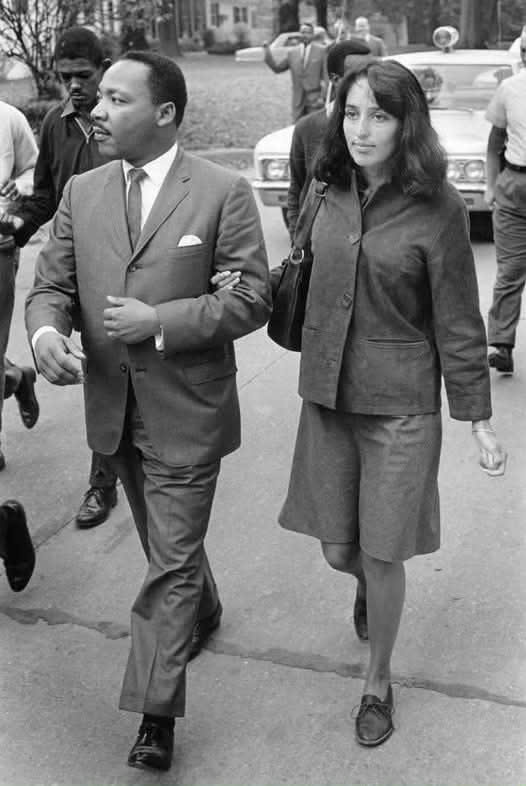
We Shall Overcome — a hymn of quiet courage, carried by one voice and millions of hearts
Few songs in modern history belong not just to an artist, but to a people. “We Shall Overcome”, as sung by Joan Baez, is one of those rare works where music steps beyond entertainment and becomes moral witness. When Baez recorded and performed the song in the early 1960s, it was already an old spiritual in origin, shaped by African American church traditions and labor movements. Yet it was her clear, unwavering voice that helped carry it into the conscience of the world.
Important context first:
Joan Baez recorded “We Shall Overcome” in 1963, releasing it on the album Joan Baez in Concert, Part 2. Her rendition was also issued as a single in the United Kingdom, where it reached the Top 30 of the UK Singles Chart upon release — a remarkable achievement for a song rooted in protest rather than pop. In the United States, it did not chart on mainstream pop listings, but its impact far exceeded numbers. This was a song measured not in sales, but in resolve.
By the time Baez sang it publicly, “We Shall Overcome” had already become the anthem of the American civil rights movement. It was sung in churches, on picket lines, and during marches where fear walked hand in hand with hope. What Baez brought to it was something rare: restraint. She did not embellish the song. She did not dramatize it. She allowed its simplicity to speak — and in doing so, she made its promise feel unbreakable.
Her version is almost austere. A single voice. Minimal accompaniment. No attempt to persuade through force. Instead, Baez trusts the song’s quiet repetition, the steady insistence of its words. “We shall overcome, someday.” Not today. Not easily. But someday. That patience is the song’s strength, and Baez understood that deeply.
Behind the performance lies Joan Baez herself — an artist who, at that moment in history, refused to separate music from conscience. She sang “We Shall Overcome” not from a stage removed from reality, but from within the movement itself. She stood alongside marchers, activists, and ordinary citizens who risked everything simply to be seen and heard. When Baez sang the song at rallies and protests, it was not symbolic — it was participatory. Her voice did not lead from above; it rose from within the crowd.
The meaning of the song, especially through Baez’s interpretation, goes far beyond civil rights alone. It speaks to anyone who has endured injustice and dared to believe in moral progress. There is no anger in the song, no threat — only faith. Faith that dignity will prevail. Faith that time, guided by courage, can bend toward justice. That is why the song has endured across decades and continents.
For listeners encountering Baez’s version later in life, the song often carries a second weight — memory. It recalls a time when music felt essential, when songs mattered because they stood for something larger than the self. Baez’s pure soprano becomes a time capsule, transporting the listener back to moments when voices joined together not for applause, but for change.
What makes “We Shall Overcome” especially powerful today is its refusal to age. The recording does not feel dated, because the struggle it names — the long road toward fairness and compassion — remains unfinished. Baez’s voice, calm and unwavering, reminds us that progress is rarely loud. It is patient. It is persistent.
In the end, Joan Baez’s “We Shall Overcome” is not a performance to be admired from a distance. It is a song to be carried — quietly, steadily — through the years. It stands as proof that sometimes the most enduring strength comes not from shouting, but from standing firm, singing softly, and believing, still, in tomorrow.