
That Open Road, A Reflection of Life’s Unending Journey, Half-Full or Half-Empty
The Fuel Gauge and the Human Heart: Jackson Browne’s “Running on Empty”
Few songs capture the aching, bittersweet poetry of perpetual motion—the exhilarating rush of freedom and the crushing weight of existential exhaustion—quite like Jackson Browne’s “Running on Empty.” Released in 1977 as the title track from his fifth, and arguably most unique, album, this song transcended the confines of the rock circuit to become a resonant anthem for an entire generation navigating the long, unforgiving highways of life and early adulthood. The song’s success was immediate and enduring, helping its parent album, “Running on Empty,” soar to a peak position of No. 3 on the Billboard Pop Albums chart in 1978 and remain on the charts for a staggering 65 weeks. The single itself, a live recording lifted directly from a concert at the Merriweather Post Pavilion in Columbia, Maryland, on August 27, 1977, was a significant radio hit, peaking at No. 11 on the US Billboard Hot 100 after its release in early 1978.
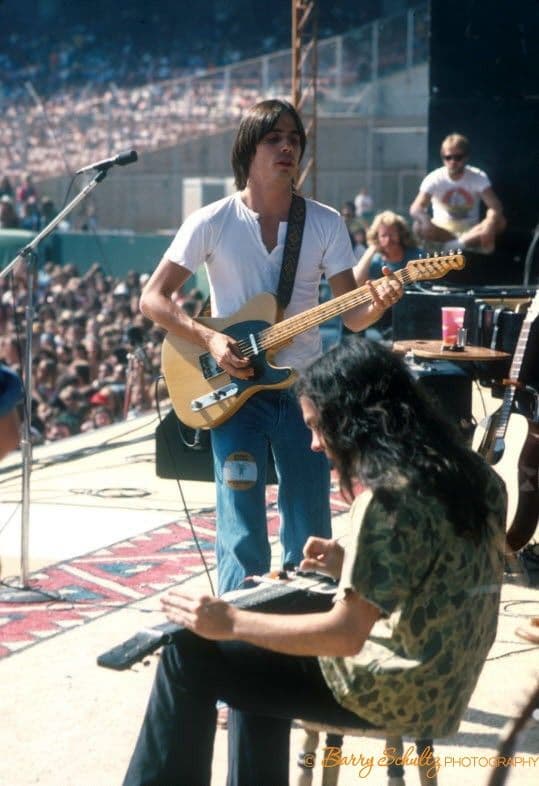
This track is the beating heart of an album that was a profound conceptual and technical innovation at the time. The entire “Running on Empty” album was conceived and recorded on the road—not just in concert, but in the gritty, mundane spaces of the touring musician’s life: backstage dressing rooms, hotel suites, and even on the tour bus. This audacious approach lent the music an unparalleled sense of documentary realism, a raw, vérité quality that made the stories feel immediate and true. The title track, therefore, is not a studio fabrication; it is an authentic moment, capturing Browne and his phenomenal band (including Danny Kortchmar, David Lindley, Leland Sklar, and Russ Kunkel) in the very element they were singing about—the endless cycle of performance, travel, and fleeting connections.
The story behind the song is deeply rooted in Browne’s own life and his growing weariness with the relentless grind of touring. He took the literal observation of a perpetually low gas tank on the road—the necessity of pushing on, always “running behind”—and transformed it into a masterful metaphor for a life lived at full speed, often without a clear destination or purpose. It is a reflective look back at youthful promises and the compromises made along the way. The lyrics, with their specific autobiographical markers (“In ’65 I was seventeen…” “In ’69 I was 21…”), connect the singer’s journey with the shared history of his listeners, reminding them of the idealism and recklessness of their own youth.
The true, deep meaning of “Running on Empty” lies in its honest confrontation with the human condition’s restlessness. It articulates the pervasive feeling that one is constantly expending energy, chasing an elusive goal, and running from an undefined past, all while watching the future rush closer. The narrator, looking into the eyes of his friends, sees not just his own exhaustion but a collective generational malaise—the realization that they are all running, blind and behind, into the sun. Yet, in that shared recognition, there’s a subtle, almost defiant resilience. The act of pushing on, of “trying not to confuse [love] with what you do to survive,” becomes a quiet, persistent heroism. For those of us who came of age during those years, who may have spent our twenties in perpetual motion—career ambition, romantic pursuits, or just escaping the confines of where we started—the song echoes with the sound of our own mileage, our own faded dreams reflected in the rear-view mirror. It is a melancholic celebration of the journey itself, even when you no longer remember why you started driving. The track’s infectious, propulsive beat acts as a cruel counterpoint to the resigned lyrics, making the act of ‘running on empty’ feel less like a failure and more like a simple, undeniable fact of modern life.