
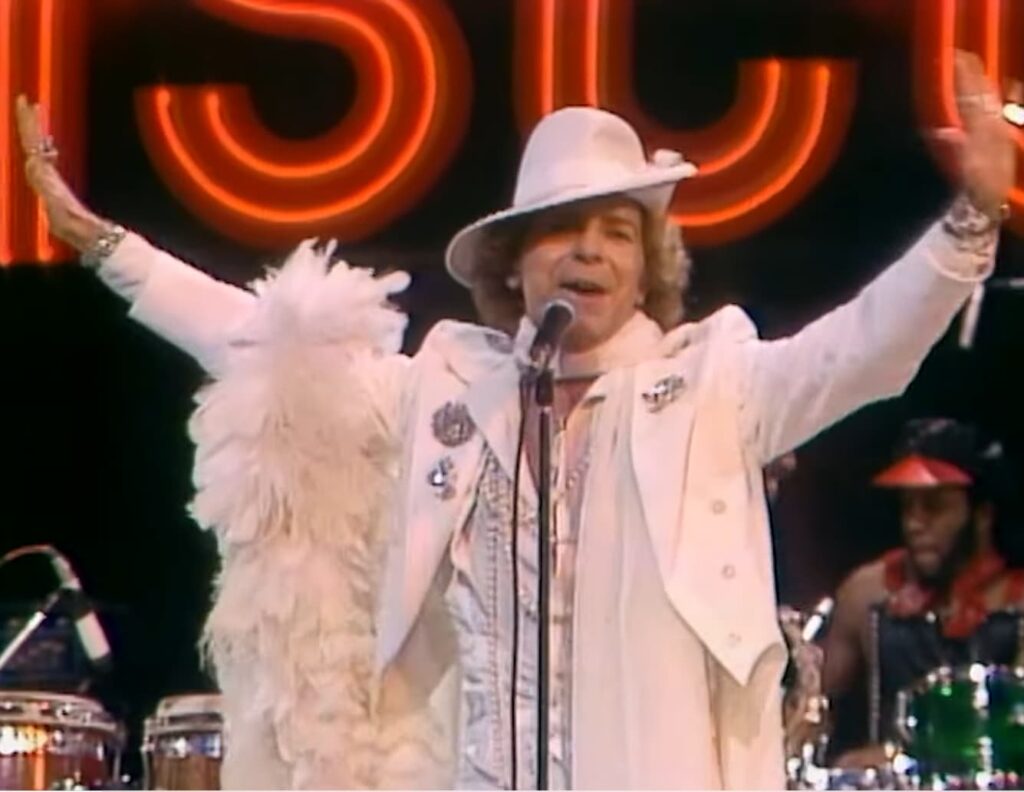
A glittering farewell to innocence on the dance floor — where joy, camp, and pure rhythm met in one unforgettable groove
When “I Wanna Dance Wit’ Choo (Doo Dat Dance)” burst onto the airwaves in 1975, it was more than just a novelty hit—it was a shimmering snapshot of the mid-’70s American dance floor at its most flamboyant and carefree. Recorded by Disco Tex & The Sex-O-Lettes, the single climbed to No. 23 on the Billboard Hot 100 in early 1976 and reached No. 6 on the UK Singles Chart, marking it as one of those transatlantic curiosities that captured a moment in pop culture with surprising force. In Canada, it even soared into the Top 10. For a group often remembered as theatrical outsiders, those chart positions tell us something important: this song connected.
Behind the outrageous stage name stood Monti Rock III, a flamboyant personality who had once worked as a celebrity hair stylist before reinventing himself as “Disco Tex.” He wasn’t a traditional singer in the mold of a soul shouter or a crooner. Instead, he was a ringmaster of spectacle—half emcee, half glam prophet—surrounded by the dazzling trio known as The Sex-O-Lettes. Together, they leaned unapologetically into camp, glitter, and high-heeled theatricality at a time when disco itself was still crystallizing into a cultural movement.
Produced by Bob Crewe, the legendary architect behind hits for The Four Seasons and co-writer of classics like “Can’t Take My Eyes Off You,” the track bore the fingerprints of a seasoned pop craftsman. Crewe understood hooks—simple, infectious, impossible to shake. “I Wanna Dance Wit’ Choo” was built on that very principle: a chant-like chorus, a driving beat, and a melody that felt both playful and hypnotic. It didn’t aim for lyrical profundity. Instead, its message was gloriously direct: an invitation to the dance floor, to connection, to surrendering oneself to rhythm.
And that simplicity was its secret weapon.
In 1975, America was emerging from a turbulent era. The dance floor had become a sanctuary. Disco clubs in New York, Philadelphia, and beyond offered more than music—they offered transformation. Under spinning mirror balls, identities blurred, inhibitions loosened, and self-expression flourished. “I Wanna Dance Wit’ Choo” captured that spirit in its most distilled form. It wasn’t political, it wasn’t introspective—it was celebratory. The repetition of its chorus felt like a mantra, as though joy itself could be summoned through rhythm and communal movement.
Musically, the song sits at an interesting crossroads. It still carries traces of glam rock flamboyance—echoes of David Bowie’s theatricality or Elton John’s playful excess—while fully embracing the four-on-the-floor pulse that defined early disco. The groove is steady, almost insistent. The backing vocals shimmer with studio polish. There’s a sense that everyone involved understood they were creating not just a record, but an atmosphere.
The album “Disco Tex & His Sex-O-Lettes Review” (1975) housed the track, but it was the single that truly defined their brief moment in the spotlight. And brief it was. Disco Tex would not sustain major chart success beyond this era. Yet perhaps that fleeting quality is part of the song’s charm. It feels like a glittering firework—brilliant, joyful, and gone too soon.
There’s something deeply nostalgic about revisiting this track today. Not because it was the most sophisticated song of its time, but because it represents a particular kind of innocence in popular music—when the invitation to dance was enough. No irony. No cynicism. Just rhythm and sparkle. The exaggerated vocals, the theatrical flair, the unabashed glamour—they speak to a time when pop music allowed itself to be fun without apology.
And when that chorus rolls in—“I wanna dance wit’ choo, doo dat dance!”—it’s hard not to smile. It carries with it the memory of crowded floors, of colored lights flickering across polished shoes, of laughter echoing over bass lines. Even listeners who may not have set foot in Studio 54 can feel that electricity.
In the grand history of disco, Disco Tex & The Sex-O-Lettes might not stand alongside titans like Bee Gees or Donna Summer, but they occupy an essential corner of the mosaic. They remind us that the disco era was as much about theatrical exuberance as it was about musical precision.
“I Wanna Dance Wit’ Choo” endures not because it changed the world, but because it understood something timeless: sometimes, the most honest human impulse is simply to reach out a hand and say—come dance with me.