
A Lament by the Water’s Edge: “Blue Bayou” as a Song of Longing, Memory, and Unfinished Love
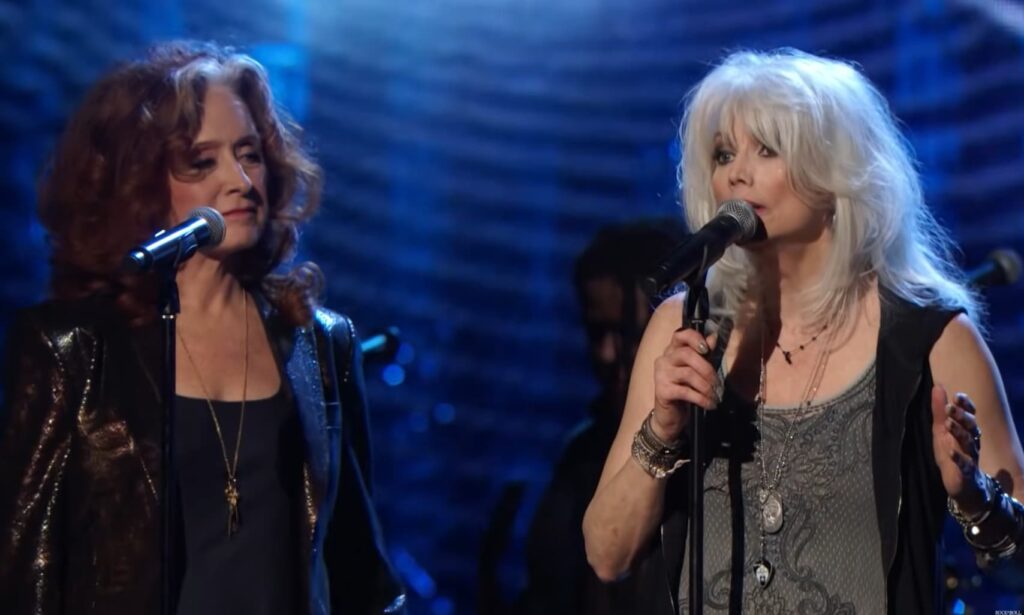
When Carrie Underwood, Emmylou Harris, and Bonnie Raitt joined voices on “Blue Bayou”, they were not simply revisiting a beloved classic—they were stepping into a lineage of longing that stretches back more than half a century. The song itself was first written and recorded by Roy Orbison in 1961, but it was Linda Ronstadt’s 1977 rendition, from her landmark album Simple Dreams, that transformed it into a cultural touchstone. Ronstadt’s version soared to No. 3 on the Billboard Hot 100 and No. 2 on the Billboard Hot Country Singles chart, while reaching No. 3 on the Adult Contemporary chart—an extraordinary crossover achievement that confirmed the song’s universal appeal. It also earned Ronstadt a Grammy nomination and remains one of the defining performances of her career.
By the time Underwood, Harris, and Raitt lent their voices to “Blue Bayou,” the song was already steeped in history. Yet their interpretation felt less like a cover and more like a quiet gathering of kindred spirits. Each artist carries her own deep roots in American music: Carrie Underwood, the modern country powerhouse with crystalline control; Emmylou Harris, the poetic torchbearer of country-folk tradition; and Bonnie Raitt, the blues-inflected storyteller whose voice seems etched with life’s hard-won truths. Together, they form a generational bridge—past and present conversing in harmony.
“Blue Bayou” is, at its heart, a song about yearning for home. But “home” here is not simply a place on a map. It is a state of grace, a memory suspended in amber. The lyrics paint an image of a woman far from where she longs to be, dreaming of returning to a peaceful bayou where “the folks are fine” and the world feels gentle again. There is an ache in that refrain—“If I could only see / That familiar sunrise”—that resonates with anyone who has ever felt displaced, emotionally or physically. It is the sound of someone measuring the distance between who they are and who they once were.
Roy Orbison reportedly wrote the song with a sense of wistful romanticism, inspired by images of the American South and a yearning for simplicity. Yet it was Linda Ronstadt who uncovered the song’s feminine vulnerability and gave it a trembling intimacy that defined the 1970s soft-rock era. Her vocal climbs in the final chorus remain among the most breathtaking moments in pop history—controlled yet bursting with emotional release.
In the hands of Underwood, Harris, and Raitt, “Blue Bayou” becomes something more reflective, less urgent but no less profound. There is a maturity in their phrasing, a lived-in tenderness. Harris brings a weathered grace, her voice like dusk settling over still water. Raitt’s subtle rasp carries the blues of love tested by time. Underwood, often celebrated for vocal power, shows restraint here—allowing the melody to breathe, honoring the song’s fragile core.
The beauty of this collaboration lies in its restraint. No one over-sings. No one dominates. Instead, they weave harmonies that feel almost conversational, as though three women are remembering different chapters of the same story. The arrangement leans into acoustic textures, allowing the lyrics to remain front and center. It is not about spectacle. It is about remembrance.
What makes “Blue Bayou” endure across decades is its universality. Every generation discovers its own version of longing. For some, it is the pull of a childhood town long changed. For others, it is the memory of a love that once felt like home. The bayou itself becomes symbolic—a still, blue refuge untouched by the complications of time.
Listening to this version, one senses not just nostalgia but acceptance. The voices do not cry out in desperation; they carry the quiet understanding that some distances can never fully be closed. And perhaps that is the song’s deepest truth: longing is part of being alive. We carry our blue bayous within us, revisiting them in memory, knowing we may never truly return.
In revisiting “Blue Bayou,” Carrie Underwood, Emmylou Harris, and Bonnie Raitt do more than honor a classic—they remind us why it mattered in the first place. It mattered because it gave language to a feeling so many could not articulate. It mattered because it sounded like twilight, like a photograph fading at the edges. And it still matters, because the ache of home—real or imagined—never quite leaves us.
Some songs age. Others deepen. “Blue Bayou” belongs to the latter, growing more poignant with each passing year, its waters forever calm, forever calling us back.