
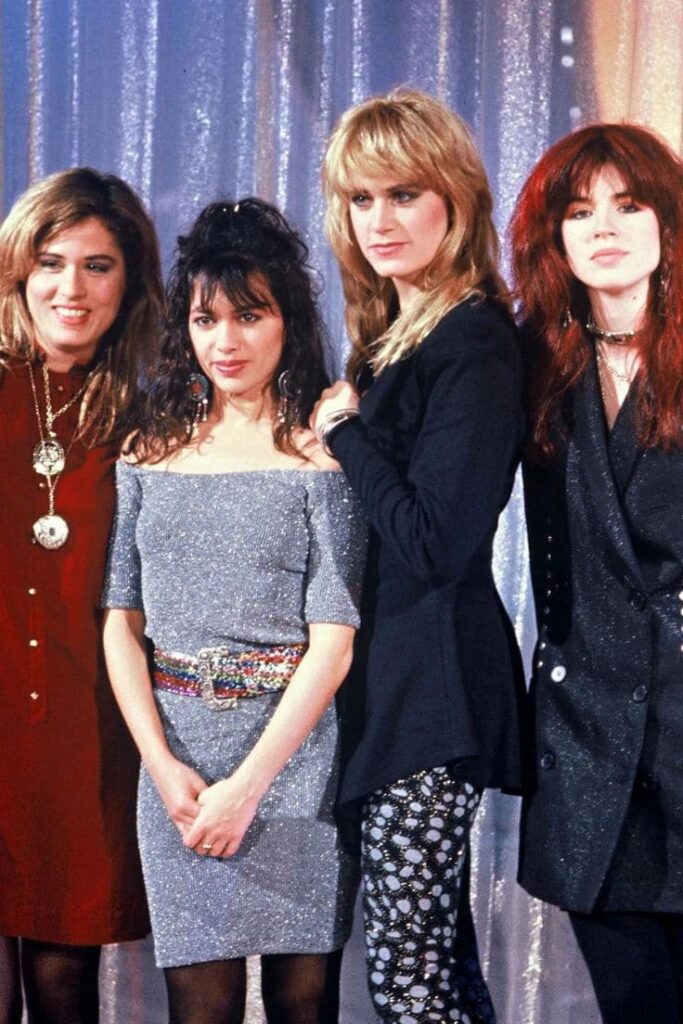
A Playful Groove That Turned Pop Into Pure Pop-Culture Phenomenon
When The Bangles released “Walk Like an Egyptian” in 1986, they did more than top the charts—they captured a fleeting cultural moment and crystallized it into three irresistible minutes of rhythm, wit, and stylish mischief. The song soared to No. 1 on the Billboard Hot 100, where it remained for four consecutive weeks (December 1986–January 1987). It also became Billboard’s No. 1 song of the year for 1987, an extraordinary achievement that confirmed its reach far beyond radio novelty. In the UK Singles Chart, it climbed to No. 3, further cementing its global impact. Included on their album Different Light (1986), the track helped propel the record into multi-platinum territory and established the band as one of the defining pop acts of the decade.
The origins of the song are as curious as its title. Written by Liam Sternberg, “Walk Like an Egyptian” was reportedly inspired by the swaying movements of passengers struggling to keep balance on a ferry crossing the English Channel. Sternberg imagined how those awkward stances resembled the stylized poses seen in ancient Egyptian art—figures in profile, arms and legs arranged in angular symmetry. It was an image both humorous and oddly poetic. When The Bangles recorded the track, they leaned into that playful absurdity rather than smoothing it out. Each member—Susanna Hoffs, Vicki Peterson, Debbi Peterson, and Michael Steele—took turns singing lead lines, giving the song a theatrical, almost vaudevillian quality. That rotating vocal structure became one of its most charming features.
Musically, “Walk Like an Egyptian” is deceptively simple. Built around a tight drum pattern, clipped guitar figures, and a distinctive bass groove, it balances new wave crispness with pop accessibility. The whistling hook—instantly recognizable—floats above the rhythm like a mischievous wink. Producer David Kahne ensured the track had a clean, radio-ready sheen without sacrificing the band’s character. Beneath the novelty, however, lies a sophisticated pop construction: sharp syncopation, dynamic vocal phrasing, and subtle shifts that keep the listener engaged from the first beat to the final fade.
The mid-1980s were saturated with bold imagery and MTV-driven stardom, and “Walk Like an Egyptian” thrived in that environment. The music video, with its parade of eccentric characters mimicking Egyptian poses—from diners to office workers—became a staple on MTV. It invited audiences not just to listen, but to participate. Few songs of the era inspired such immediate physical response. It was impossible to hear that rhythm without instinctively raising your arms into angular form.
Yet for all its playful surface, the song reflects something deeper about pop music’s power. It reminds us how art can be joyful without being trivial. At a time when political tension and cultural shifts defined the headlines, here was a song that encouraged laughter, movement, and collective amusement. It crossed generational lines. You might remember hearing it spill from car radios, echo across shopping malls, or animate school dances with unrestrained enthusiasm. Its melody seemed to travel effortlessly through the air, instantly recognizable from the first few notes.
Within Different Light, the track stands alongside more introspective hits like “Manic Monday” (written by Prince) and “If She Knew What She Wants.” Yet “Walk Like an Egyptian” remains the band’s most commercially triumphant moment. Some critics at the time debated whether its novelty overshadowed the group’s musicianship, but history has been kinder. Revisited today, the song reveals the band’s tight interplay, their willingness to embrace humor, and their instinct for crafting indelible hooks.
The Bangles, often compared to 1960s girl groups and garage-rock bands, bridged eras with remarkable ease. “Walk Like an Egyptian” embodies that bridge: retro in spirit yet unmistakably 1980s in sound. It stands as a reminder of how a clever idea, executed with conviction, can become timeless.
Decades later, the song still triggers that involuntary smile. The beat still prompts the shoulders to sway. And somewhere, in that familiar whistle, there lingers a memory of youth, of brightly colored music videos, of shared laughter in simpler moments. “Walk Like an Egyptian” endures not because it was serious—but because it dared to be joyous, and in doing so, it became unforgettable.