
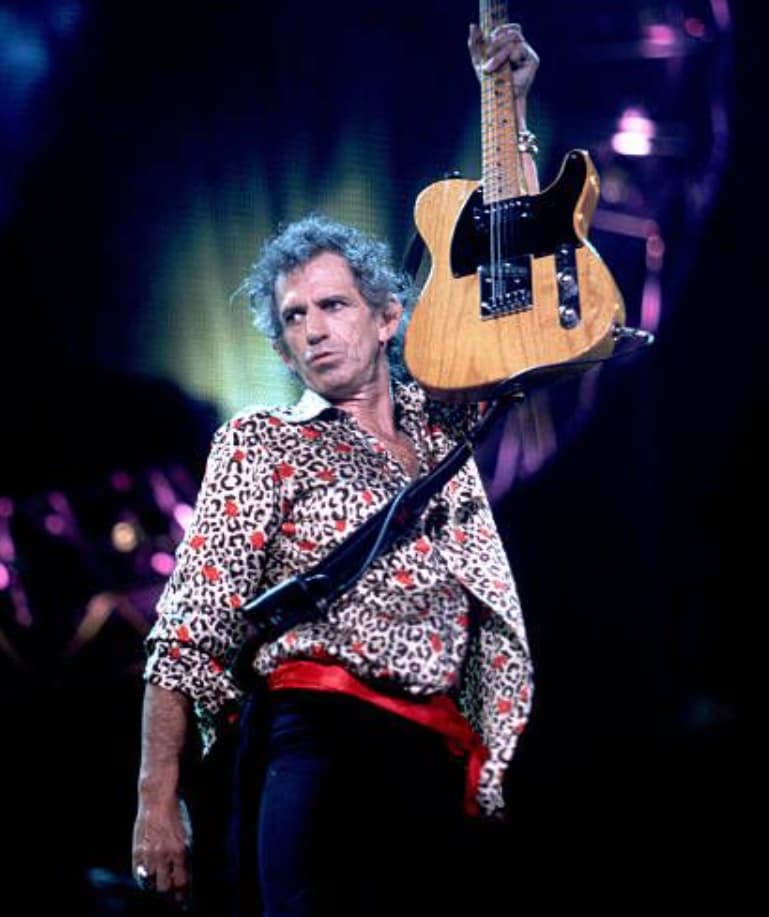
Big Enough — a rough-edged declaration of freedom from a man stepping out of the shadows
When “Big Enough” arrived in the late 1980s under the name Keith Richards, it felt like something quietly radical. Not because it was loud or defiant in the usual rock-and-roll sense, but because it revealed a man long known as a supporting pillar finally speaking in his own voice — weathered, uncompromising, and unmistakably honest. This song comes from Talk Is Cheap (1988), Richards’ first solo album, and it stands as one of the clearest statements of who he was when he stepped away from the familiar orbit of the Rolling Stones.
Released as a single in 1988, “Big Enough” achieved respectable success without relying on spectacle. It reached the lower half of the Billboard Hot 100, peaking just inside the Top 50, and performed notably well on American rock radio, where it found a natural home among listeners who valued grit over gloss. These numbers mattered less than the context: this was not Mick Jagger’s charismatic frontman, nor the Stones’ mythic outlaw. This was Keith Richards, unfiltered.
The story behind Talk Is Cheap is inseparable from a tense chapter in the Stones’ history. Creative fractures within the band had grown sharp by the mid-1980s, and Richards — long portrayed as the eternal sideman — felt an urgent need to prove something, not to others, but to himself. He assembled a group of trusted musicians, later known as the X-Pensive Winos, and went into the studio with a clear intention: make a record that sounded like him, or don’t make it at all.
“Big Enough” embodies that mission perfectly. Musically, it leans on Richards’ signature rhythm guitar — loose, slightly behind the beat, breathing rather than driving. There is no polish trying to disguise the imperfections. The groove feels lived-in, like an old leather jacket softened by years of wear. And above it all floats a vocal that doesn’t ask for approval. It simply tells its story.
Lyrically, the song is deceptively simple. On the surface, it speaks of independence and self-assurance — of standing one’s ground and claiming space in a world that often demands compromise. But beneath those lines lies something more personal. “Big enough to keep you satisfied, big enough to keep you alive” sounds less like bravado and more like a quiet reckoning. This is a man asking whether what he has — musically, emotionally, spiritually — is enough after decades of excess, loyalty, conflict, and survival.
What makes the song resonate so deeply with seasoned listeners is that it never pretends youth still reigns. Richards sings with the calm authority of someone who has already seen the cost of chasing approval. There is strength here, but also acceptance. The acceptance that freedom is not about proving oneself endlessly, but about knowing when to stop trying.
In the broader arc of his career, “Big Enough” marked a turning point. It proved that Richards was not merely a legendary guitarist standing behind someone else’s spotlight. He was a storyteller with his own scars, his own humor, his own sense of rhythm — both musical and emotional. The album’s success surprised many at the time, not because it chased modern sounds, but because it trusted authenticity.
For listeners who had grown older alongside the music of the 1960s and 1970s, this song felt like companionship rather than nostalgia. It spoke to the dignity of endurance. To the idea that after years of noise, silence and honesty matter more. “Big Enough” doesn’t shout. It stands firm.
And perhaps that is its greatest legacy. Long after chart positions fade, the song remains a reminder that some voices grow stronger not by reaching higher, but by settling deeper into who they truly are.