
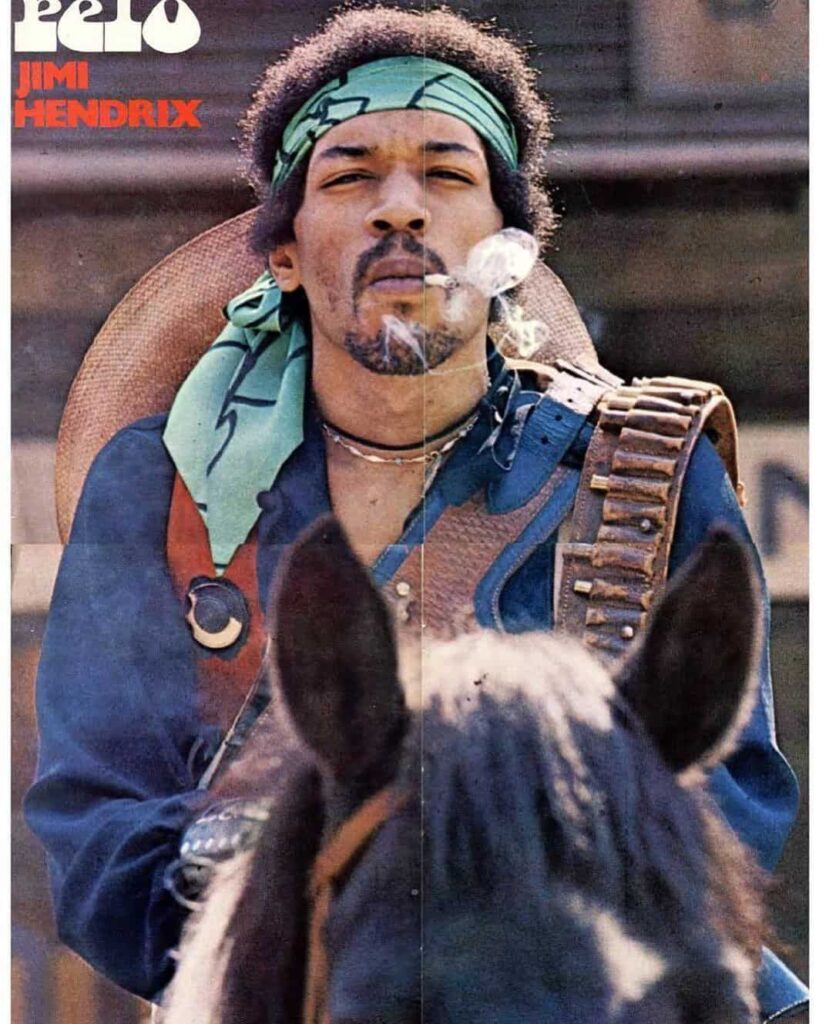
All Along the Watchtower — A haunted cry of warning carried on a storm of electric fire
From the first piercing notes, “All Along the Watchtower” in the hands of Jimi Hendrix feels like a gust of wind blowing through an unsettled world — a warning, a confession, and a revelation all at once. It is a song that seems to open a door into a darker landscape, where tension hums in the air and every word feels heavy with meaning. Long before it became one of Hendrix’s most defining recordings, it lived quietly as a stripped-down folk piece. But in 1968, Hendrix transformed it into something vast, cinematic, and urgent — a version so complete, so visionary, that even its original writer would later adopt Hendrix’s interpretation as his own.
Released as a single in September 1968, the recording quickly became Hendrix’s highest-charting hit in the United States, climbing to No. 20 on the Billboard Hot 100 — the only Top 40 success he would have in his lifetime. In the United Kingdom, it reached No. 5, making it one of his most successful singles and remarkably the first stereo-only single to ever break into the British Top 5. Those chart numbers, though simple on paper, hint at something larger: this was the rare moment when Hendrix’s artistry aligned fully with the public’s ear, when his daring vision resonated across continents.
The story behind the recording is just as compelling as the song itself. Hendrix first attempted the track early in 1968 in London, but he felt the results were lacking. Over the following months in New York, he returned to it again and again — layering guitars like storm clouds, reshaping the rhythm, sculpting the atmosphere until it carried the weight he imagined. During these sessions, he played not only the soaring guitar lines but also the bass, after dissatisfaction within the band left him shaping the song alone. That sense of solitary determination, of wrestling with a vision only he could see, gives the final recording its almost prophetic intensity.
And then there is the story Dylan told afterward — how hearing Hendrix’s version felt overwhelming, how the electrified arrangement revealed emotional textures even he hadn’t considered. In the years that followed, Dylan performed the song live in a way that leaned closer to Hendrix’s creation than to his own original. There may be no greater testament to Hendrix’s interpretive genius: he didn’t merely cover a song; he revealed its hidden architecture.
What gives “All Along the Watchtower” its enduring power is the way it balances anxiety with defiance. The lyrics speak of a world where order is unraveling, where uncertainty reigns — yet Hendrix’s guitar pushes against that darkness, rising like a voice refusing to be drowned out. For listeners who remember the era when it first arrived, the song often carries memories of a changing world, restless streets, and a generation searching for direction. Even now, its opening riff can transport you back to those days when music felt larger than life, when every note carried a spark capable of igniting something deep within.
More than five decades have passed, but the song has lost none of its electricity. It remains a journey — from despair to revelation, from quiet warning to thunderous proclamation. Listening today, you might still feel the echo of that first release: the trembling anticipation, the sense that something important — something urgent — was unfolding. “All Along the Watchtower” endures because it speaks to the part of us that has known fear, has known hope, and has stood on the edge of change waiting to see what comes next.