
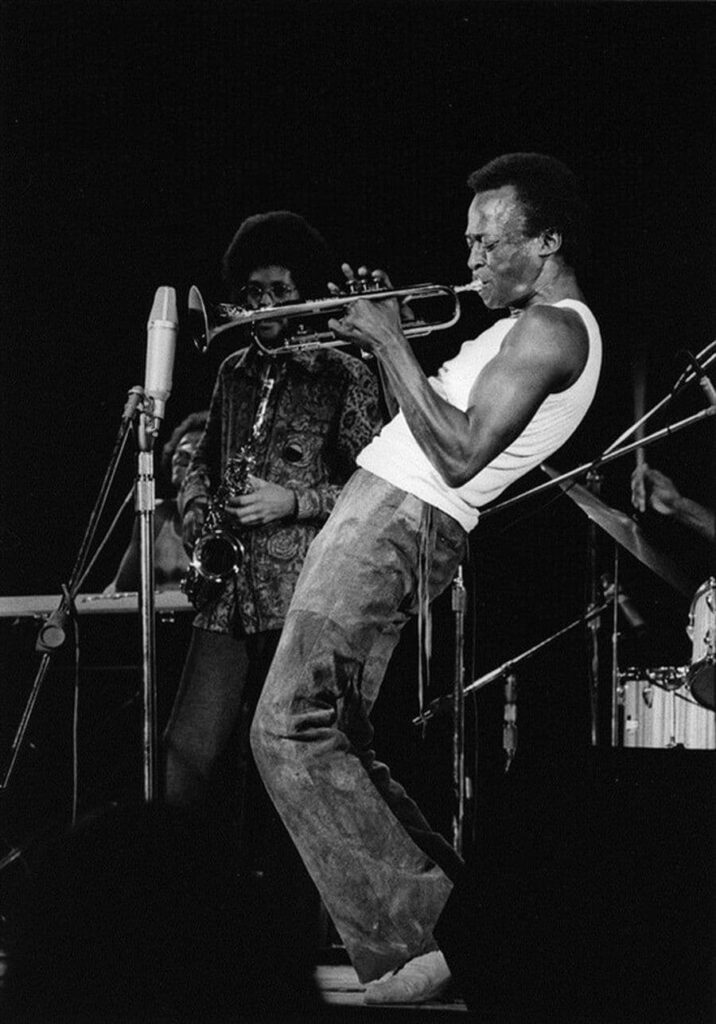
The Ultimate Statement of Cool and Creative Departure
The very title, “So What”, is a distilled statement of unflappable cool, a question mark posed as an assertion that would fundamentally redirect the course of jazz music. This foundational track, the opener to Miles Davis‘s epoch-making 1959 album, Kind of Blue, is not merely a song but an anthem of modal jazz—a radical departure from the dense harmonic structures that characterized the preceding Bebop era. While individual jazz tracks rarely appeared on the mainstream popular charts of 1959, the album that housed it, Kind of Blue, would become, and remains, the best-selling and most widely celebrated jazz album of all time, eventually achieving 5x Platinum status in the US, cementing its position not just in jazz, but as a touchstone of all 20th-century music. In the year of its release, the album charted on Billboard‘s Jazz Albums chart, where it peaked at number 2, demonstrating its immediate, if not genre-shattering, commercial and critical success.
Kind of Blue was recorded in just two sessions in the spring of 1959, with “So What” being laid down on March 2nd. The astonishing fact is that Miles Davis provided his star-studded sextet—featuring John Coltrane on tenor saxophone, Cannonball Adderley on alto saxophone, Bill Evans on piano, Paul Chambers on bass, and Jimmy Cobb on drums—with little more than sketches of the modal scales and melodic ideas just before they recorded. This deliberate approach, favoring improvisation over scales (modes) rather than complex, quickly moving chord changes, forced the musicians to focus on melody, texture, and space, resulting in a feeling of profound, yet deceptively simple, lyricism.
The story of the title itself has a wonderful, anecdotal flavor. Legend suggests it sprung from the casual, dismissive reply Davis‘s friend, the actor Dennis Hopper, would often give to the trumpeter’s philosophical or political pronouncements: “So what?” That nonchalance perfectly mirrored the tune’s own musical spirit—a relaxed, almost defiant, simplicity in the face of the era’s frantic musical complexity.
Musically, “So What” is an exercise in the Dorian mode, a minor-key scale that gives the track its signature, slightly melancholic, yet undeniably sophisticated, mood. Its structure is a simple AABA form, but its genius lies in the economy of its material: 16 bars of D Dorian, followed by 8 bars of E-flat Dorian (the B section, or “bridge”), and a return to 8 bars of D Dorian. This two-chord architecture, a universe away from the harmonic obstacle courses of Bebop, suddenly offered soloists an expansive canvas. It’s the sound of a musician finally taking a deep, unhurried breath.
The opening, written by pianist Bill Evans (and orchestrated by the great Gil Evans), is instantly recognizable—a hushed, introductory call-and-response between the piano and bass. Then comes the legendary moment: Paul Chambers‘ double bass steps out, playing the main, memorable theme, and the horns respond with a two-note “answer.” This inversion of roles, placing the bass at the forefront of the melody, was another subtle, masterful way Davis signaled that the old rules were off the table.
For those of us who came up listening to the intricate gymnastics of older jazz, the first time you heard “So What” felt like stepping out of a noisy, crowded party and into the quiet, cool night air. The solos from Miles, Coltrane, and Adderley are perfectly contained lessons in tonal storytelling, moving with purpose and emotion, rather than a frantic desire to simply fill every available space. It’s music that demands you listen to the silence between the notes, that reminds you that true artistry often lies in elegant restraint. The track is a timeless reminder that sometimes the deepest expression is found in asking the simplest, most resonant question. It is, unequivocally, a defining cultural moment that still beckons new generations into the subtle, profound world of jazz.