
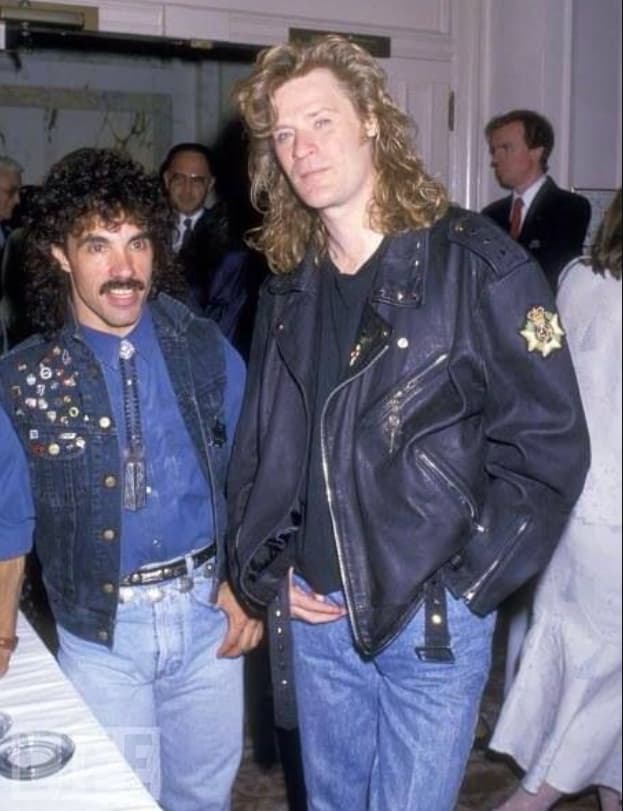
“Maneater”: A Warning Wrapped in an Irresistible Beat
Ah, Hall & Oates – the very name brings a certain warmth to the heart, doesn’t it? For those of us who grew up with the radio as our constant companion, their unique blend of blue-eyed soul, pop, and rock was the soundtrack to so many moments, both big and small. And among their impressive string of hits, few resonate quite as deeply, or carry such a fascinating undercurrent, as “Maneater.”
Released on September 28, 1982, as the lead single from their critically acclaimed eleventh studio album, H2O, “Maneater” quickly proved to be an irresistible force. It stormed the charts, seizing the coveted number one spot on the Billboard Hot 100 on December 18, 1982. This wasn’t just a fleeting visit; “Maneater” held that top position for a remarkable four consecutive weeks, outperforming even some of their other chart-toppers. Across the globe, its infectious groove captivated listeners, reaching number 4 in Australia, number 2 in Switzerland, and a respectable number 6 on the UK Singles Chart, among many other top ten placements worldwide. It became an anthem, a cautionary tale disguised as a dancefloor filler, its vibrant sax riff and pulsing beat instantly recognizable.
But here’s where the story of “Maneater” takes an intriguing turn, one that many a casual listener might have missed over the years. While the lyrics paint a vivid picture of a dangerous, alluring woman – “Watch out boy she’ll chew you up,” “The beauty is there but a beast is in her heart” – the true genesis of the song, according to John Oates, lay not in a person, but in a place: New York City in the 1980s. He explained that the initial idea was to capture the city’s predatory, avaricious nature, a landscape of “greed, avarice, and spoiled riches.” The personification of this urban jungle as a “maneater” was a deliberate artistic choice, a way to make a complex, abstract concept more relatable and visceral.
Yet, despite this intention, the song undeniably works on the more literal level. Who among us hasn’t, at some point, encountered someone who fits that “maneater” description, a person whose charm masks a colder, more self-serving core? This duality is precisely what gives the song its enduring power. It’s a masterclass in lyrical ambiguity, allowing listeners to project their own experiences onto its narrative. For many, it’s a playful warning about romantic pitfalls; for others, a deeper commentary on the ruthless pursuit of success in a bustling metropolis.
The song’s infectious energy, driven by Daryl Hall’s impassioned vocals and that iconic saxophone solo by Charles DeChant, belies its darker undertones. It’s a testament to Hall & Oates’ genius that they could wrap such a potent message in such an undeniably catchy package. The production, a collaboration between Daryl Hall and John Oates themselves, with co-production by Neil Kernon, perfectly blends their signature blue-eyed soul sound with the evolving synth-pop and new wave sensibilities of the early ’80s. The music video, directed by Mick Haggerty and C.D. Taylor, further solidified the song’s imagery, albeit leaning into the more literal interpretation of a femme fatale, with the memorable, albeit challenging to film, appearance of a black cougar.
“Maneater” stands as a shimmering example of Hall & Oates at their peak, a band that consistently defied easy categorization and produced music that was both commercially successful and artistically compelling. It’s a song that evokes a specific time – the vibrant, often extravagant, 1980s – yet its themes of allure, danger, and hidden motives remain timeless. So, the next time you hear that unmistakable bassline kick in, take a moment to reflect. Is it the woman, the city, or perhaps something else entirely that’s the true “maneater” in your own personal narrative? Such is the enduring charm of this iconic track.