
“Sam Stone” – A Quiet Song About a Wounded Soldier and a Country That Looked Away
When John Prine released “Sam Stone” in 1971, it did not storm the charts, nor was it designed to. The song appeared on his debut album John Prine (1971), a record that would later be hailed as one of the most remarkable singer-songwriter debuts in American music. While the album itself reached No. 47 on the Billboard 200, “Sam Stone” was never intended to be a commercial single. Instead, it slowly became one of the most powerful and respected songs in the entire American folk and country songwriting tradition.
In the decades that followed, critics and fellow musicians would point to “Sam Stone” as the moment when the world realized that John Prine was not just another folk singer, but a storyteller of rare compassion and honesty.
At first glance, the song tells a simple story. Sam Stone, a soldier, returns home from war. But the war has followed him back. The trauma he carries inside leads him toward addiction, isolation, and ultimately tragedy. In just a few verses, John Prine paints a portrait so vivid that listeners can almost see the quiet sadness in the man’s eyes.
One of the most haunting lines ever written in American songwriting appears in the chorus:
“There’s a hole in daddy’s arm where all the money goes.”
It is a line that lands softly, yet cuts deeply.
The Vietnam War was still raging when John Prine wrote this song. America was divided, families were worried, and many returning soldiers were struggling with invisible wounds long before the term PTSD became widely understood. Rather than writing a protest song filled with anger, Prine chose a more devastating approach — quiet empathy.
He didn’t preach.
He simply told a story.
And that story said everything.
The power of “Sam Stone” lies in its restraint. The melody is gentle, almost lullaby-like. The arrangement on the album — featuring subtle acoustic guitar and understated instrumentation — allows the lyrics to carry the emotional weight. It feels less like a performance and more like a confession overheard in a quiet room.
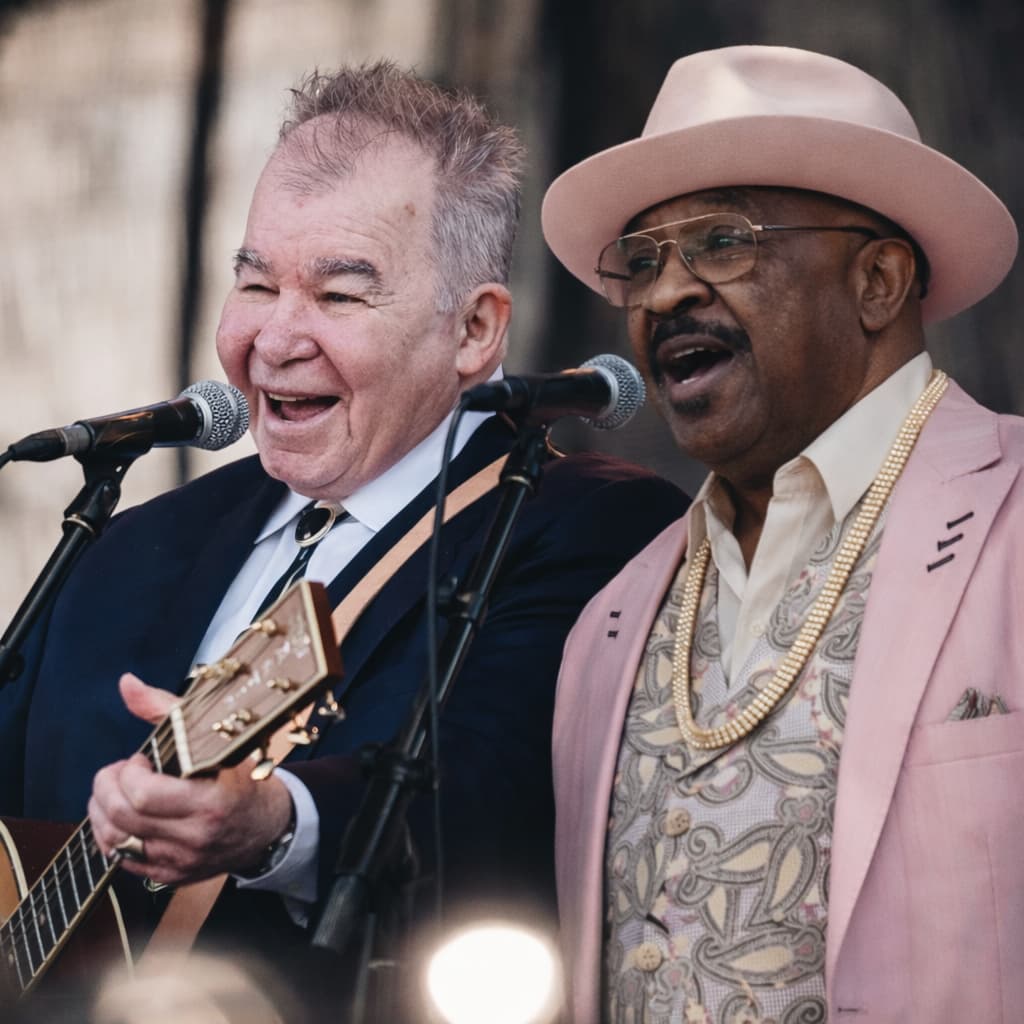
Among those who admired the song deeply was Swamp Dogg, the soul musician born Jerry Williams Jr. Known for blending Southern soul, R&B, and social commentary, Swamp Dogg recognized immediately that John Prine’s songwriting carried a kind of emotional truth that transcended musical genres.
Years later, Swamp Dogg recorded his own version of “Sam Stone.” His interpretation leaned into the gospel-soul tradition, adding emotional depth through layered vocals and a slightly heavier groove. Where Prine’s version felt like a solitary reflection, Swamp Dogg’s rendition sounded almost like a communal lament — as if the story of Sam Stone belonged not just to one man, but to an entire generation.
The connection between John Prine and Swamp Dogg was rooted in mutual respect. Though they came from different musical backgrounds — Prine from the Chicago folk scene and Swamp Dogg from the Southern soul tradition — both were artists unafraid to address uncomfortable truths about American life.
And “Sam Stone” was exactly that: uncomfortable truth.
At the time of its release in 1971, mainstream radio was filled with bright pop melodies and polished rock productions. Yet here was John Prine, a former mailman from Illinois, quietly singing about addiction, broken families, and forgotten veterans.
The song did not dominate the charts.
But it dominated the hearts of those who heard it.
Over the years, “Sam Stone” has been covered by numerous artists and frequently cited by critics as one of the greatest songs ever written about the aftermath of war. Publications like Rolling Stone and Paste Magazine have praised John Prine’s ability to compress entire lifetimes of pain into a few simple verses.
Listening to “Sam Stone” today feels almost like opening an old photograph album. The music carries a softness that belongs to another era, yet the story remains painfully relevant.
War changes people.
Silence hides suffering.
And sometimes the most powerful songs are the quietest ones.
That is why “Sam Stone” still lingers in the mind long after the final note fades. Not because it shouts, but because it whispers a truth that many would rather not hear.
And in that whisper, John Prine gave a voice to countless forgotten stories.