
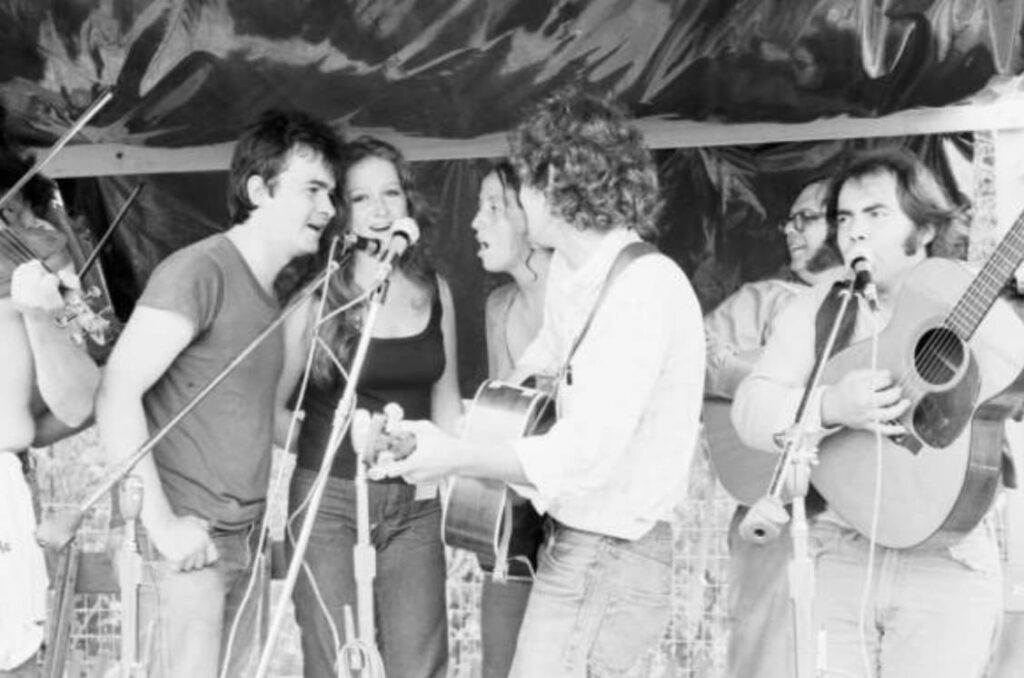
A quiet voice, a wooden stage, and the enduring truth of songs that outlive their moment
On August 25, 1974, at the Philadelphia Folk Festival, John Prine stood before an audience that didn’t yet fully grasp how rare a storyteller they were about to witness. There were no grand theatrics, no elaborate arrangements—just a man, a guitar, and a voice that carried the weight of ordinary lives with extraordinary grace. By that time, Prine had already released his self-titled debut album, John Prine (1971), a record that had quietly climbed to No. 174 on the Billboard 200, a modest chart position that hardly reflected its eventual influence. Yet numbers, as it often happens in folk music, told only a fraction of the story.
The Philadelphia Folk Festival itself was never about charts or commercial triumph. It was a gathering rooted in authenticity, a place where songs mattered more than sales, and where voices like Prine’s could find their true audience. His performance that evening has since taken on a near-mythical status among devotees—not because it was polished, but because it was profoundly human. In a time when popular music was increasingly shaped by spectacle, Prine offered something disarmingly simple: truth.
What made John Prine so compelling during that period was his uncanny ability to write songs that felt both deeply personal and universally recognizable. By 1974, he was already known for compositions like “Sam Stone”, “Hello in There”, and “Paradise”—songs that explored themes of war, aging, loss, and memory with a clarity that avoided sentimentality. These weren’t just songs; they were portraits of lives often overlooked. At the festival, stripped of studio polish, those stories seemed to breathe even more freely.
There’s a quiet anecdote often shared among those who attended similar performances in the early 1970s: Prine would sometimes introduce his songs with a dry, almost self-effacing humor, as if gently reminding listeners not to take him too seriously—only to follow it with a line that would land like a quiet revelation. That balance between wit and sorrow became his signature. It’s likely that in Philadelphia, on that late summer day, the audience experienced that same emotional whiplash—laughter dissolving into reflection, reflection settling into something deeper.
The meaning behind Prine’s work during this era is inseparable from the world he observed. America in the early 1970s was still reckoning with the aftermath of the Vietnam War, grappling with shifting cultural identities and a growing sense of disillusionment. Prine didn’t address these issues with slogans or protest chants. Instead, he wrote about individuals—the veteran struggling with addiction, the elderly couple fading into invisibility, the small-town memories eroded by progress. In doing so, he gave those broader social themes a human face.
What makes the 1974 Philadelphia performance particularly significant is how it captures Prine at a crossroads—no longer an unknown songwriter, but not yet the revered elder statesman he would become. There’s an immediacy in performances from this period, a sense that each song is still discovering itself in real time. You can almost imagine the warm August air, the attentive silence between verses, the subtle murmur of recognition as listeners realized they were hearing something that would stay with them long after the festival ended.
Unlike chart-topping hits that rise and fall with the seasons, John Prine’s songs have endured because they were never chasing trends to begin with. They belonged to a different timeline—one measured not in weeks on a chart, but in years of quiet resonance. The Philadelphia Folk Festival performance stands as a reminder of that enduring quality. It wasn’t about being the biggest voice in the room; it was about being the most honest.
And perhaps that is the lasting meaning of that day: in a world increasingly drawn to noise, John Prine proved that a soft voice, telling the truth, could echo the longest.