
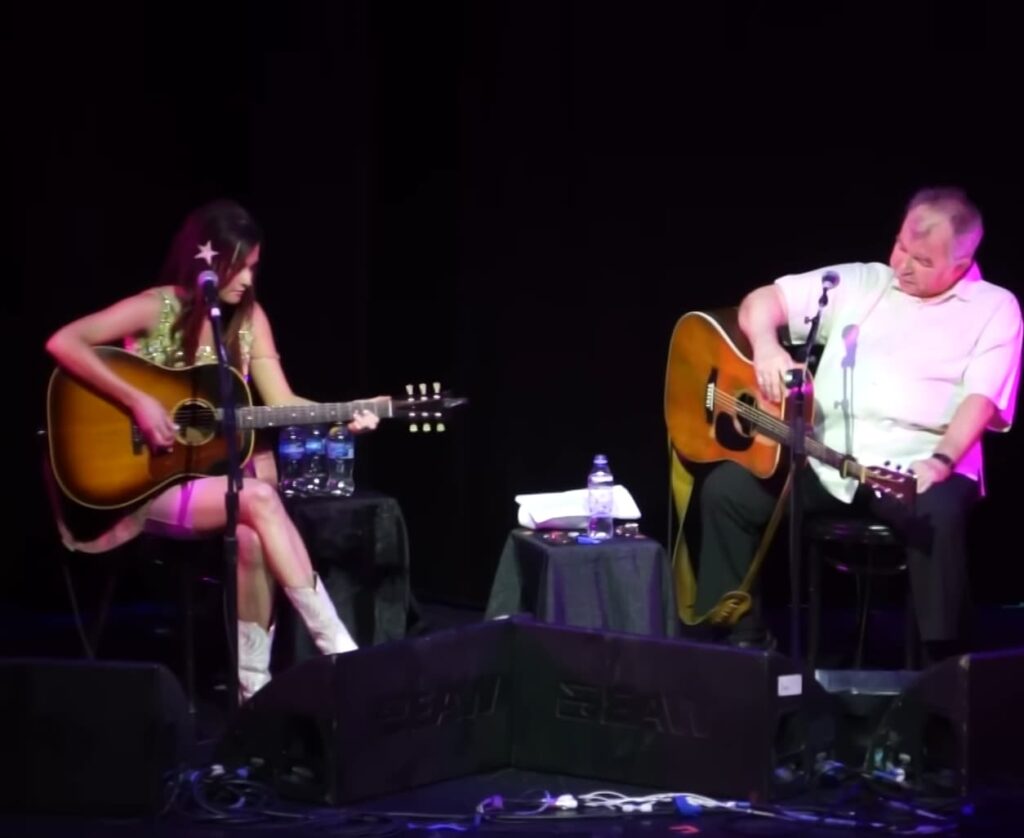
A Gentle Song of Gratitude: When “Burn One with John Prine” Became a Musical Thank-You to a Songwriting Legend
In the long conversation of American songwriting, there are moments when one generation quietly tips its hat to another. Burn One with John Prine, performed by Kacey Musgraves in honor of John Prine, is one of those rare moments—simple, sincere, and filled with affection for a man widely regarded as one of the greatest storytellers in modern folk and country music.
Released as a standalone digital single in 2016, “Burn One with John Prine” was not designed as a commercial chart climber. In fact, the song did not enter the Billboard Hot 100 or major mainstream charts upon release. But that was never its purpose. Instead, it circulated warmly through Americana radio, streaming platforms, and among fans who recognized the gentle wink in its title. It was less a pop single and more a musical letter of admiration, written by a younger artist to one of her heroes.
And perhaps that is why the song has aged so gracefully.
At its heart, “Burn One with John Prine” is a playful yet deeply respectful tribute. The title itself refers to the laid-back, countercultural image that surrounded John Prine, whose wit and storytelling made him a cult hero among musicians. Musgraves sings about the dream of simply sitting down with Prine, sharing a smoke, and absorbing his wisdom—the kind of quiet fantasy many songwriters have surely imagined.
To understand the emotional weight behind the song, one must remember who John Prine was to the musical community. Emerging in the early 1970s with his self-titled debut album John Prine (1971), he quickly became known for songs like “Angel from Montgomery,” “Sam Stone,” and “Hello in There.” These were not flashy hits chasing radio trends. They were portraits of ordinary lives, painted with humor, empathy, and devastating honesty.
Though Prine’s music rarely dominated the pop charts, his influence spread quietly but profoundly. Generations of songwriters—from folk singers to country artists—studied his work like sacred texts. Kacey Musgraves was one of them.
By the time Musgraves wrote “Burn One with John Prine,” she had already begun establishing herself as a thoughtful voice in modern country music. Her early success with songs like “Merry Go ’Round” had earned her recognition for lyrics that balanced humor with social observation—qualities long associated with Prine’s writing.
The tribute therefore felt natural.
Musgraves has spoken openly about her admiration for Prine, describing him as one of the greatest lyricists America ever produced. When she wrote the song, she wasn’t trying to imitate him. Instead, she approached the idea with a gentle smile—imagining what it might be like to spend a relaxed evening with the man whose songs had shaped her musical outlook.
The lyrics reflect that warmth. Rather than grand declarations, the song offers small images: conversation, laughter, the quiet passing of time. It captures the informal magic of musicians sitting together, where stories and melodies flow freely.
That sense of closeness became even more meaningful after John Prine passed away in April 2020, following complications from COVID-19. In the days that followed, artists across the musical spectrum shared tributes, covers, and memories. Among them, Kacey Musgraves’ performance of “Burn One with John Prine” resonated strongly with listeners.
What once felt like a playful tribute suddenly sounded like a farewell wrapped in gratitude.
When Musgraves sang the song in tribute performances and online memorials, the tone shifted subtly. The lyrics remained light, but the emotion behind them deepened. It was no longer just about dreaming of meeting a hero—it was about remembering one.
And that is the quiet beauty of the song.
Unlike many tributes that rely on sweeping orchestration or dramatic language, “Burn One with John Prine” stays humble. Its melody drifts gently, almost like a porch conversation at sunset. That simplicity mirrors the spirit of Prine himself, whose greatest songs often felt like stories told over coffee rather than performances delivered from a stage.
In the end, the song stands as a small but heartfelt chapter in the long story of American songwriting. It reminds listeners that music is not only about charts, awards, or commercial success. Sometimes it is simply about respect—one artist recognizing the path another has cleared before them.
And somewhere in that imagined scene—guitars leaning against a chair, laughter floating through the air—you can almost hear the conversation continuing.
Exactly the kind of moment John Prine spent a lifetime writing about.