
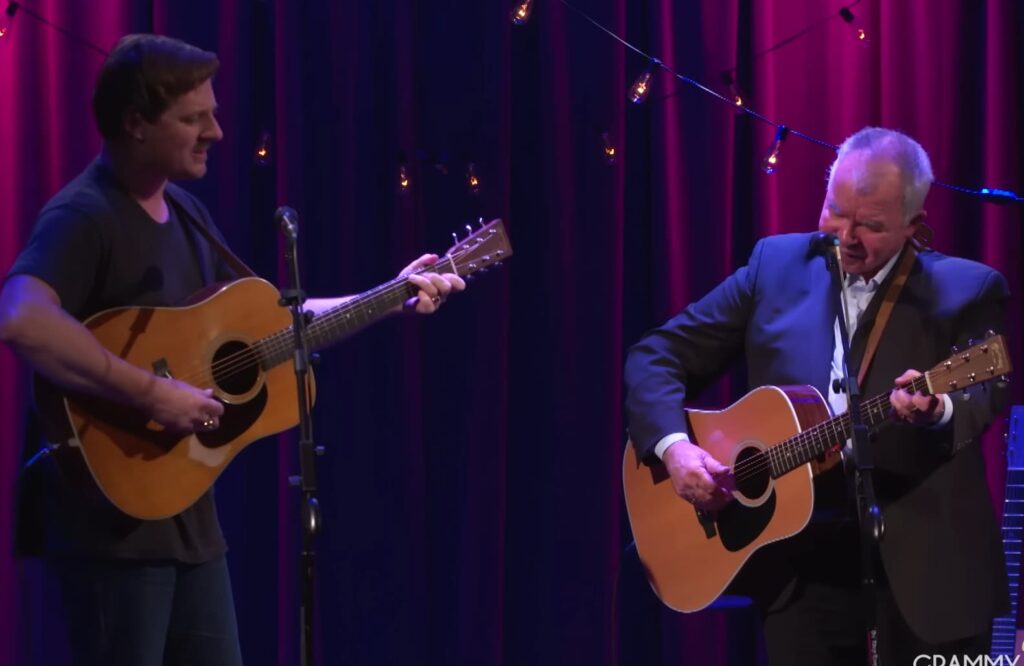
A Quiet Passing of the Torch: When Two Generations Meet in Song
In the intimate setting of GRAMMY Pro Up Close & Personal, the evening that brought together John Prine and Sturgill Simpson was never meant to be a chart-topping spectacle—yet its significance runs deeper than any number on a Billboard listing. This was not about commercial ranking, but about legacy, continuity, and the quiet power of storytelling in American songwriting. Still, it is worth remembering that John Prine, over the course of his career, earned multiple entries on the Billboard 200, with albums like “The Tree of Forgiveness” (2018) reaching No. 5—his highest-charting release—while Sturgill Simpson’s “A Sailor’s Guide to Earth” (2016) debuted at No. 3 and went on to win the Grammy Award for Best Country Album. These milestones frame the weight of what unfolded on that modest stage: two voices, each shaped by different eras, yet bound by a shared reverence for honest songwriting.
The GRAMMY Pro Up Close & Personal series is designed for conversation as much as performance, and on that night, the dialogue between John Prine and Sturgill Simpson felt almost sacred. Prine, already a revered figure by then, carried with him decades of songs that had quietly shaped the American musical landscape. His compositions—whether “Angel from Montgomery” or “Sam Stone”—were never written to chase charts, yet they endured because they spoke plainly, truthfully, and with compassion. Simpson, by contrast, represented a newer voice—restless, genre-defying, unwilling to be confined by Nashville’s expectations. And yet, sitting beside Prine, one could sense a deep humility, almost a student in the presence of a master.
There is no single “song” that defines this performance; rather, it is the interplay between their repertoires that becomes the story. When Sturgill Simpson joins in on Prine’s material, there is a subtle shift—his voice, weathered yet younger, wraps itself around lyrics written decades earlier, giving them a second life. And when Simpson performs his own songs in that setting, one can hear the unmistakable imprint of Prine’s influence: the unvarnished honesty, the refusal to romanticize hardship, the quiet humor that softens even the hardest truths.
The story behind this collaboration is not one of coincidence, but of admiration that had long been expressed. Sturgill Simpson has often cited John Prine as a guiding light—an artist who proved that one could remain authentic in an industry that often rewards conformity. By the time of this performance, Prine himself had already endured significant health challenges, including his battle with cancer, which altered his voice but never diminished his spirit. That added a layer of poignancy to the evening; every note he sang carried not just melody, but survival.
What makes this moment particularly meaningful is its reflection of continuity in American roots music. John Prine emerged in the early 1970s, a time when songwriting was undergoing a transformation—moving away from polished pop structures toward something more introspective and personal. Decades later, Sturgill Simpson would challenge a different kind of orthodoxy, pushing against the boundaries of modern country music. Their meeting, then, becomes symbolic: a bridge between two periods of resistance, two artists who refused to compromise their artistic voices.
The emotional core of this performance lies in its simplicity. There are no elaborate arrangements, no grand gestures—just songs, stories, and the kind of quiet understanding that can only exist between artists who recognize something of themselves in each other. For listeners, especially those who have followed the arc of John Prine’s career, it feels like witnessing a gentle passing of wisdom. Not an ending, but a continuation.
In the years since, this moment has taken on even greater resonance. With John Prine’s passing in 2020, performances like this stand as reminders of what he gave to music—not just songs, but a way of seeing the world. And in Sturgill Simpson, one hears the echo of that vision, carried forward into a new era.
It is, in the end, not about rankings or awards, though both men have earned their share. It is about something quieter, more enduring: the belief that a well-written song, sung with sincerity, can outlast trends, outlast time itself. And on that evening, in a room designed for listening, that belief felt not only alive—but everlasting.