
A Song of Quiet Longing and Unspoken Lives, Where Time Stands Still in the Heart of an Ordinary Woman
Few songs in American roots music carry the quiet weight of lived-in truth quite like “Angel From Montgomery”—a composition by John Prine that has, over the years, transcended its modest beginnings to become something close to sacred. First released in 1971 on John Prine’s self-titled debut album, the song was never a chart-topping single in the traditional sense. It did not storm the rankings of the Billboard Hot 100, nor was it designed to. Instead, it settled into the consciousness of listeners slowly, like a story told late at night—one that lingers long after the final note fades.
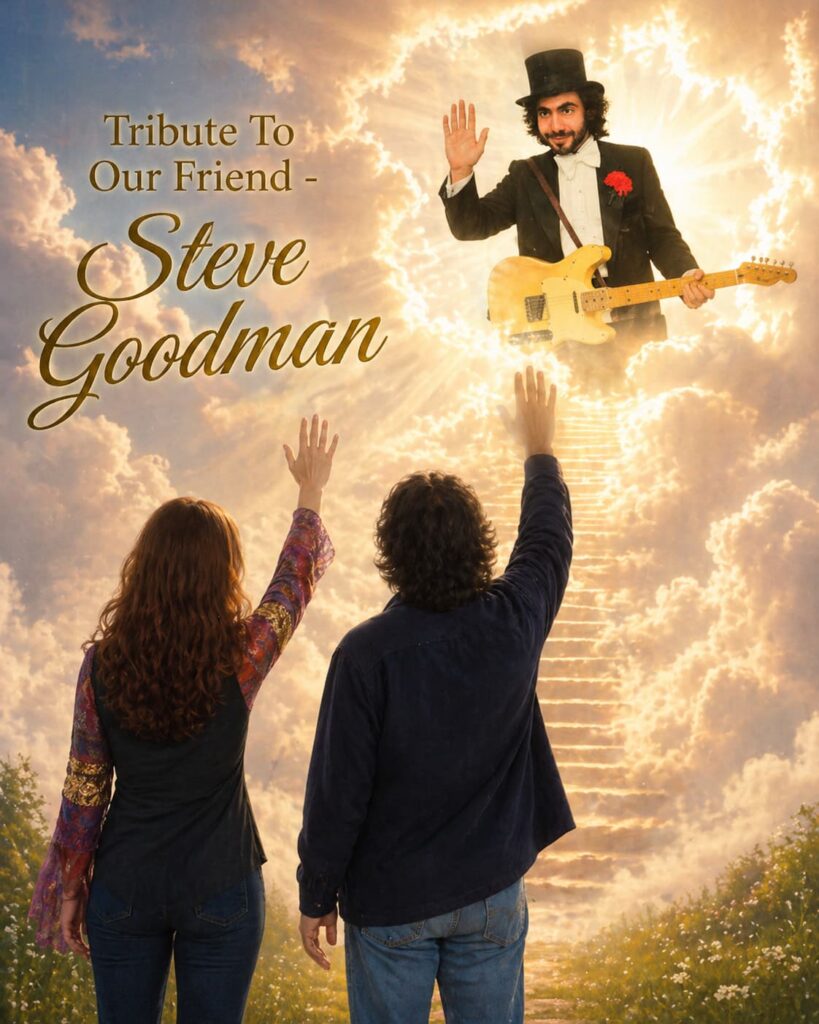
By 1985, when Bonnie Raitt and John Prine performed this piece live as part of a tribute to Steve Goodman, the song had already taken on a second life. That performance—intimate, unadorned, and profoundly human—was not about commercial success or chart positions. It was about reverence: for a friend, for a fellow songwriter, and for the enduring power of a song that speaks softly yet cuts deeply.
The origins of “Angel From Montgomery” are as unassuming as its melody. John Prine, known for his gift of inhabiting characters far removed from himself, wrote the song from the perspective of a middle-aged woman in Montgomery, Alabama. A woman whose life has become a quiet routine, whose dreams have faded into the background noise of everyday survival. It is remarkable, even now, how convincingly Prine captures her voice—not with dramatics, but with restraint. Lines unfold with a simplicity that feels almost conversational, yet each carries the weight of years unspoken.
What makes the 1985 live rendition so special is the presence of Bonnie Raitt, whose voice brings a weathered tenderness to the narrative. Where Prine’s delivery is grounded and observational, Raitt’s interpretation feels deeply personal, as though she is not merely telling the story, but remembering it. Their voices intertwine not in harmony alone, but in understanding—two artists meeting at the crossroads of empathy and experience.
The tribute itself, dedicated to Steve Goodman, adds another layer of poignancy. Goodman, a beloved figure in the folk community and a close friend of Prine, was known for his own storytelling brilliance. His passing left a quiet void, and this performance becomes, in many ways, a conversation between those who remain—an acknowledgment of shared histories, of songs that outlive their creators, and of friendships etched into melody.
The meaning of “Angel From Montgomery” lies not in grand statements, but in its subtle honesty. It speaks of longing—not the dramatic kind, but the slow, persistent ache of a life that feels smaller than it once promised to be. The “angel” in the song is never clearly defined. Is it salvation? Escape? Or simply the memory of who one used to be? That ambiguity is its strength. It allows each listener to find their own reflection within the lyrics.
And perhaps that is why the song has endured. It does not demand attention; it invites recognition. It reminds us that behind every ordinary life lies a story of quiet endurance, of compromises made, and of dreams that never quite disappeared—only softened with time.
In the end, the 1985 live performance by Bonnie Raitt and John Prine is more than a tribute. It is a moment suspended in time, where music becomes memory, and memory becomes something almost sacred. No chart position could ever measure its value. Some songs are not meant to climb—they are meant to stay, gently, in the places where we keep the parts of ourselves we rarely speak of.