
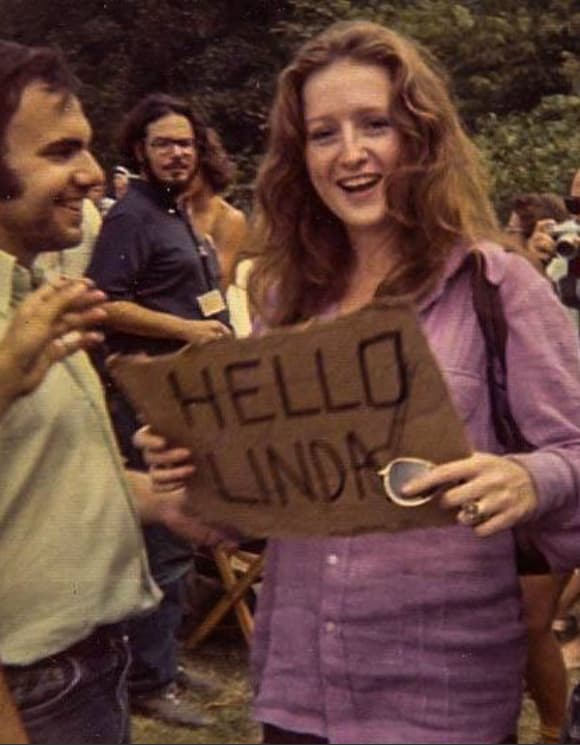
A raw, intimate declaration of longing that defined Bonnie Raitt’s early folk-blues identity
In “Love Me Like a Man,” Bonnie Raitt transforms desire into something unvarnished and deeply human—where vulnerability is not weakness, but truth spoken plainly in the language of blues and folk tradition.
When Bonnie Raitt stepped onto the stage in Philadelphia during the vibrant era of the early Philadelphia Folk Festival circuit, she was not yet the household name she would later become. But even then, there was already something unmistakable in her presence: a young artist carrying an old soul’s understanding of heartbreak, longing, and emotional honesty. Her performance of “Love Me Like a Man” became one of those quietly defining moments—less about spectacle, more about connection. The kind of performance that lingers in memory long after the last note fades.
The song itself was originally written by Chris Smither, a folk-blues songwriter whose work often explored emotional restraint and philosophical reflection. Raitt’s interpretation, however, reshaped it into something more direct, more embodied. Released on her 1972 album Give It Up, her version did not arrive as a chart-dominating single. In fact, it never held a significant position on mainstream singles charts upon release. And yet, in a different sense of the word “success,” it quietly achieved something far more enduring: it became a cornerstone of her early artistic identity and a favorite among listeners who valued authenticity over commercial polish.
What makes “Love Me Like a Man” so striking is its refusal to disguise emotional need. The lyrics do not plead in fragile tones; instead, they speak with a grounded, adult clarity. It is a song about wanting to be loved without hesitation, without games, without the softened edges society often expects in expressions of desire. In Raitt’s hands, the song becomes less about romantic idealism and more about emotional truth—messy, honest, and recognizably human.
At the time of its release, Give It Up marked a transitional moment for Bonnie Raitt. She was still building her audience, still carving out her place in a musical landscape dominated by both traditional folk revivalists and emerging singer-songwriters. The album itself did not produce major charting hits, but it earned respect within musical circles for its sincerity and stylistic confidence. Critics and folk audiences recognized something rare: an artist who could inhabit blues tradition without imitation, and folk storytelling without detachment.
Her live performances during this period, particularly at gatherings like the Philadelphia Folk Festival, amplified that impression. Stripped of studio polish, the song gained a different kind of power on stage. Her voice—warm, slightly rough at the edges, unmistakably lived-in—carried the weight of someone speaking not just for herself, but for anyone who had ever felt the quiet urgency of wanting to be seen fully by another person.
There is also a subtle cultural significance in how “Love Me Like a Man” was received in those years. At a time when female expression in rock and folk music was still often filtered through expectation or constraint, Raitt’s delivery felt unusually unguarded. She did not soften the sentiment, nor did she exaggerate it. Instead, she stood firmly within it, as though emotional honesty itself were a form of musicianship.
Looking back now, decades later, the song remains less a product of its chart history—which was modest—and more a document of artistic courage. It captures a young Bonnie Raitt at a moment when she was still forming the voice that would later define her career: rooted in blues tradition, but unafraid of emotional clarity.
And perhaps that is why “Love Me Like a Man” continues to resonate. Not because it once climbed the charts, but because it never needed to. It belongs to a different kind of musical legacy—one measured not in rankings, but in the quiet permanence of feeling understood.