
A Song About Letting Go, Long After the Heart Refuses To
When Nanci Griffith sang a forgotten Rolling Stones ballad on Austin City Limits in 1991, she did not simply perform a cover — she quietly reopened an old emotional wound that many listeners thought music had already healed.
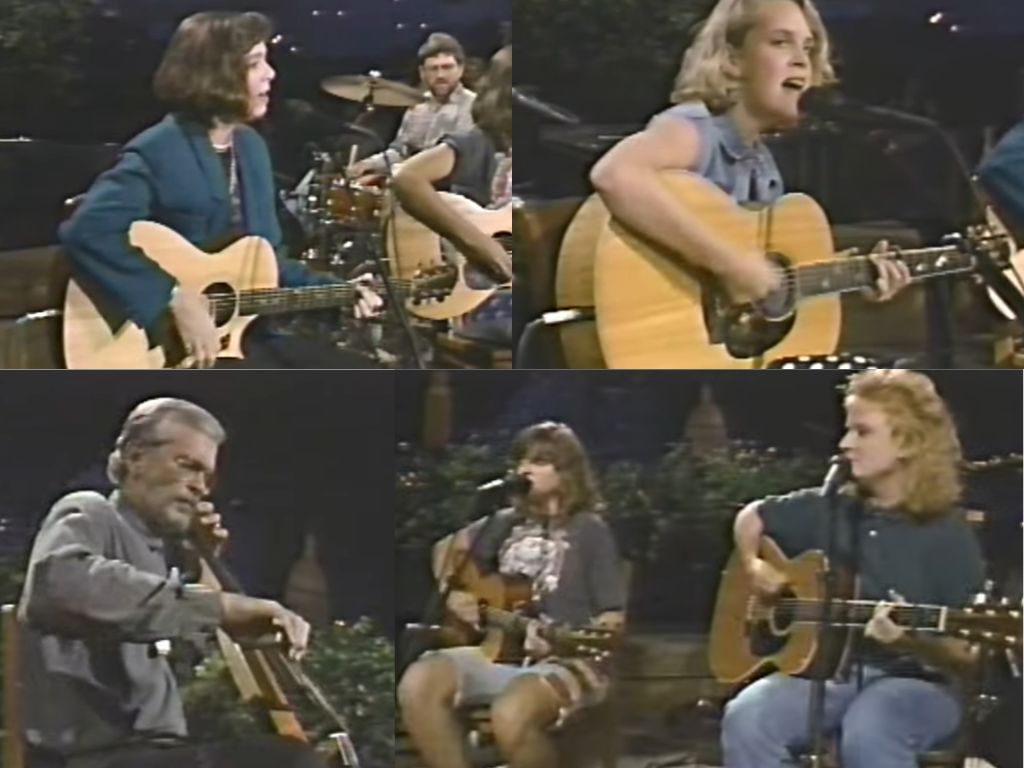
There are performances that feel polished, rehearsed, and designed for applause. And then there are moments like this one — fragile, human, almost accidental in their honesty. Nanci Griffith’s rendition of “No Expectations” during the 1991 episode of Austin City Limits, alongside Indigo Girls, Mary Chapin Carpenter, and Julie Gold, belongs to that second category. It feels less like a television performance and more like a late-night confession shared between old friends after the world has gone quiet.
Originally written and recorded by The Rolling Stones for their landmark 1968 album Beggars Banquet, “No Expectations” was never one of the band’s biggest chart hits. In fact, it was not released as a major standalone single in the way songs like “Jumpin’ Jack Flash” or “Honky Tonk Women” were. Yet among devoted listeners, it became something deeper — one of the most sorrowful and emotionally naked songs Mick Jagger and Keith Richards ever created.
And perhaps that is why it fit Nanci Griffith so perfectly.
By the early 1990s, Griffith had already established herself as one of the finest storytellers in American folk and country music. Albums like Storms (1989) and Late Night Grande Hotel (1991) had solidified her reputation as an artist who could turn quiet sadness into poetry. She never needed grand gestures. Her voice carried emotion the way old photographs carry memory — softly faded, but impossible to forget.
When she sang “No Expectations”, she approached it differently from the Stones’ weary blues version. The original recording, shaped by the haunting slide guitar of Brian Jones, sounded like the end of a long road traveled alone. It carried the dust of broken dreams and emotional exhaustion. Many critics have since described it as one of Jones’ finest musical moments before his tragic death in 1969. In hindsight, the song now feels almost prophetic, as though the band unknowingly captured the sound of someone slipping away from the world.
The original version appeared on Beggars Banquet, released in December 1968, an album now universally regarded as one of the greatest records in rock history. While it did not top the American charts, it reached No. 5 on the UK Albums Chart and No. 5 on the Billboard 200 in the United States, helping restore The Rolling Stones after the psychedelic experimentation of the previous era. More importantly, the album marked a return to roots music — blues, folk, country, and gospel influences woven into rock and roll with remarkable maturity.
Listening carefully to “No Expectations,” one can hear traces of old country heartbreak songs hidden beneath the British blues surface. That emotional DNA made Griffith’s interpretation feel almost inevitable.
In the Austin City Limits performance, she stripped the song of its rock mystique and revealed its loneliness more clearly than ever. Her phrasing was gentle, almost hesitant, as though she understood that true heartbreak rarely arrives dramatically. It arrives quietly — in empty rooms, fading memories, and the slow realization that someone you once loved has already become part of another lifetime.
What made the performance especially moving was the atmosphere surrounding it. This was not an arena concert. There were no giant lights or theatrical effects. It was simply musicians respecting a song enough to leave space around it. And in that space, listeners could place their own memories.
That is the strange power of songs like “No Expectations.” They grow older with us.
A young listener may hear a breakup song. But over time, the meaning changes. The song begins to speak about lost years, vanished friendships, roads not taken, and the quiet acceptance that life rarely unfolds the way we imagined it would. Griffith understood that emotional evolution better than most songwriters of her generation.
Interestingly, her version never appeared on one of her official studio albums, which has only added to its mystique among longtime fans. The VHS recordings traded between collectors throughout the 1990s helped preserve the performance almost like a hidden treasure from another era of television — back when music programs still valued intimacy over spectacle.
And perhaps that rarity is fitting.
Some songs are not meant to dominate radio charts or streaming playlists. Some are meant to find people privately, during reflective evenings when nostalgia feels heavier than usual. Griffith’s performance belongs to that world.
If you have never heard the original Rolling Stones version from Beggars Banquet, it is essential listening. Not only for “No Expectations,” but for the entire album itself. Records like Beggars Banquet remind us that rock music once carried danger, poetry, vulnerability, and deep musical roots all at once. It was an album made before perfection became the industry’s obsession — and perhaps because of that, it still feels alive today.
And when Nanci Griffith revisited that song decades later, she did something beautiful: she reminded listeners that great music never truly belongs to one generation. It simply waits patiently for another voice, another moment, another heart ready to understand it differently.