
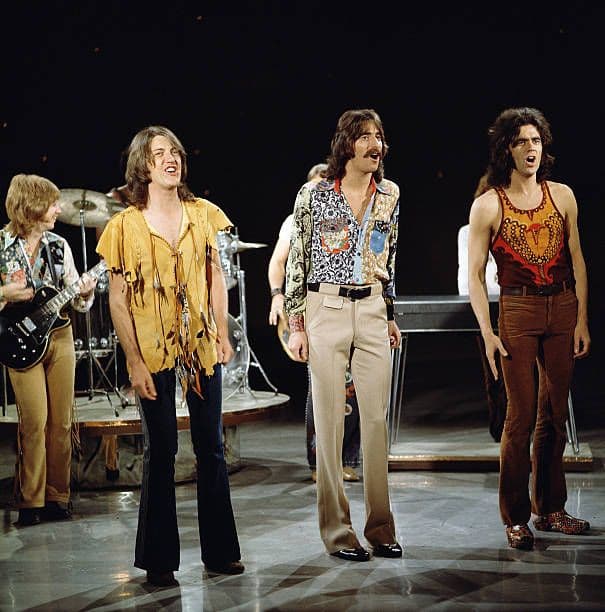
A gentle reminder that sincerity never goes out of style, “An Old Fashioned Love Song” celebrates love stripped of trends, ego, and noise—just melody, memory, and feeling.
When Three Dog Night released “An Old Fashioned Love Song” in the autumn of 1971, it arrived quietly, without gimmicks or grand statements—yet it quickly became one of the most enduring songs of their career. The single climbed to No. 4 on the Billboard Hot 100, a remarkable achievement during a fiercely competitive era dominated by hard rock, soul powerhouses, and the expanding ambitions of album-oriented rock. It also reached No. 2 on the U.S. Adult Contemporary chart, confirming its deep emotional connection with listeners who valued melody, clarity, and emotional honesty over spectacle.
The song appeared on Three Dog Night’s album Harmony (1971), an album that, true to its title, emphasized balance—between voices, between pop accessibility and thoughtful songwriting, and between the past and the present. At the heart of this balance was “An Old Fashioned Love Song”, written not by a member of the band, but by Paul Williams, one of the era’s most perceptive and quietly influential songwriters.
The story behind the song is almost as modest as the song itself. Paul Williams once explained that he wrote it as a kind of self-reflection—almost a confession. The opening line, “Just an old fashioned love song, playing on the radio,” was not ironic. It was Williams acknowledging that, in a time obsessed with innovation and cleverness, there was still room for something simple and emotionally direct. He even doubted whether the song was “good enough” by contemporary standards. Ironically, that doubt became the song’s greatest strength.
Three Dog Night understood this instinctively. Known for their democratic vocal approach—rotating lead singers rather than spotlighting a single frontman—the band gave the song a warm, communal feel. Danny Hutton’s lead vocal is unforced and conversational, as if he is speaking directly to the listener rather than performing at them. The harmonies that follow do not overwhelm; they support, echo, and gently lift the sentiment. This restraint is precisely why the song still resonates decades later.
Musically, “An Old Fashioned Love Song” avoids dramatic crescendos or instrumental bravado. The arrangement is clean and unpretentious: acoustic guitar, subtle rhythm, and carefully placed harmonies. There is no attempt to dazzle. Instead, the song invites the listener to slow down—to remember what it felt like when love songs were less about performance and more about presence.
The meaning of the song lies not in a narrative, but in an attitude. It is about rediscovering sincerity in a world that often moves too fast. The lyric “Coming from me to you” feels almost handwritten, like a personal note rather than a mass-produced message. It suggests that love, at its best, does not need reinvention—only attention.
Within Three Dog Night’s broader legacy, the song holds a special place. While the band is often associated with energetic hits like “Joy to the World” or “Mama Told Me (Not to Come)”, “An Old Fashioned Love Song” reveals their reflective side. It shows a band mature enough to step back and let the song speak for itself. In hindsight, it also marked a moment when popular music briefly paused to honor its own emotional roots.
Over fifty years later, the song remains a familiar companion on oldies radio and personal playlists—not because it demands to be remembered, but because it never stopped being relevant. For listeners who have lived long enough to see musical trends rise and fall, “An Old Fashioned Love Song” feels less like nostalgia and more like recognition. It reminds us that beneath all the changes, the human need for connection stays remarkably the same.