
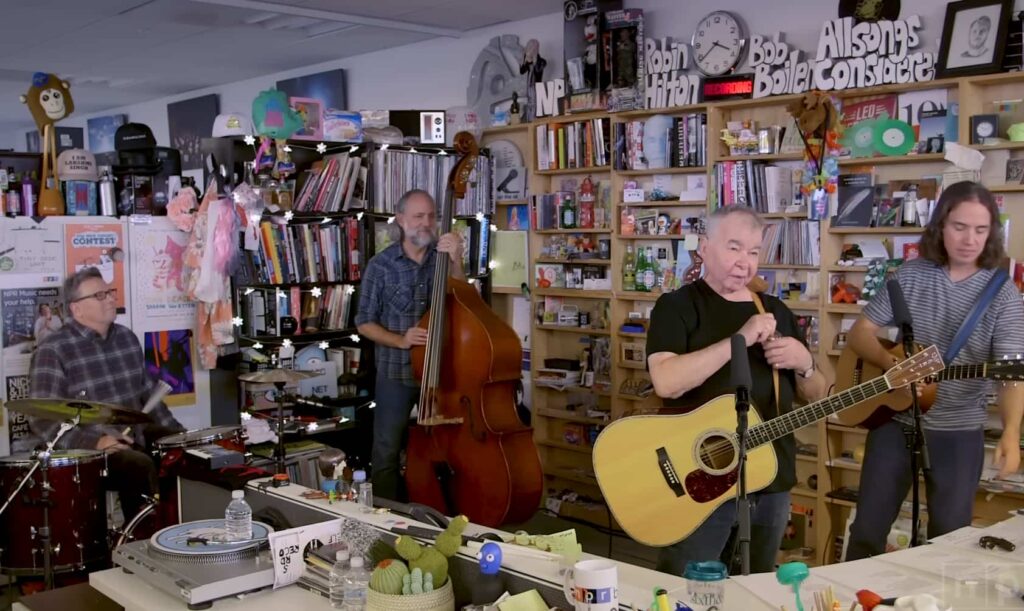
A Quiet Room, A Gentle Voice: When John Prine Turned a Tiny Desk Into a Lifetime of Stories
In 2018, when John Prine walked into the small office space that hosts the celebrated NPR Music Tiny Desk Concert, it felt less like a performance and more like an old friend pulling up a chair to tell a few stories. By then, Prine was already regarded as one of the most beloved songwriters in American folk and country music—an artist whose words carried the wit of a humorist and the heart of a poet. His appearance on NPR Music’s Tiny Desk Concert series became one of those rare moments where music history, memory, and quiet honesty met in a room no bigger than a living room.
The performance was released in June 2018, during the same year Prine issued his long-awaited album The Tree of Forgiveness. That record marked his first album of new original material in 13 years, and it debuted at No. 5 on the Billboard 200, the highest chart position of his entire career. For an artist who began writing songs in the late 1960s while working as a mailman in Chicago, that achievement carried the weight of time—proof that authentic songwriting never truly fades.
During the Tiny Desk Concert, Prine performed a short but deeply meaningful set that included songs like “Summer’s End”, “Souvenirs,” and “Hello in There.” These were not flashy performances. There were no elaborate arrangements, no dramatic lighting, and certainly no spectacle. Just a man, his guitar, a few longtime collaborators, and decades of life folded into every lyric.
One of the most moving moments came with “Hello in There,” originally released on his landmark debut album John Prine (1971). When that album first appeared, it reached No. 171 on the Billboard 200, modest by commercial standards but monumental in influence. The record introduced listeners to a songwriter who could see the invisible people of America—lonely seniors, factory workers, forgotten veterans—and give them dignity through song.
By the time Prine sang “Hello in There” at the Tiny Desk, the meaning of the song had deepened with age. Written when Prine was only in his twenties, the song tells the story of an elderly couple living quietly after their children have moved away. The lyrics speak gently but directly about loneliness and the human need for connection. Hearing Prine perform it decades later felt almost surreal. The young songwriter who imagined old age had now lived long enough to understand it.
Another highlight of the session was “Summer’s End,” one of the standout tracks from The Tree of Forgiveness. The song itself carries a message that feels almost like a whispered reassurance: “Come on home.” In interviews, Prine explained that the song was about compassion—about telling someone who has struggled or lost their way that they are still welcome. In a world that often seems quick to judge, the quiet generosity of that message struck listeners deeply.
The Tiny Desk Concert format suited Prine perfectly. Unlike arena stages or television productions, the setting emphasized what always mattered most in his music: storytelling. Every pause between verses, every half-smile after a clever line, reminded listeners that Prine’s true instrument was language.
His influence on other musicians is enormous. Artists such as Bonnie Raitt, Emmylou Harris, Kris Kristofferson, and Brandi Carlile have all spoken about how Prine’s songs shaped their understanding of songwriting. Even Bob Dylan once remarked that Prine’s work contained “pure Proustian existentialism,” a surprisingly literary compliment for songs that often sounded as plainspoken as a conversation on a front porch.
Watching the John Prine Tiny Desk Concert today carries an additional layer of emotion. After Prine’s passing in 2020, the performance feels almost like a farewell letter written in music. Yet it is not sad in the traditional sense. Instead, it feels warm, grateful, and deeply human.
That was always the magic of John Prine. His songs did not shout. They simply told the truth—about love, aging, memory, and the strange beauty of ordinary lives.
And in that small office at NPR, with shelves of books behind him and barely enough room for the band, John Prine proved once again that the quietest stages sometimes hold the biggest stories.