
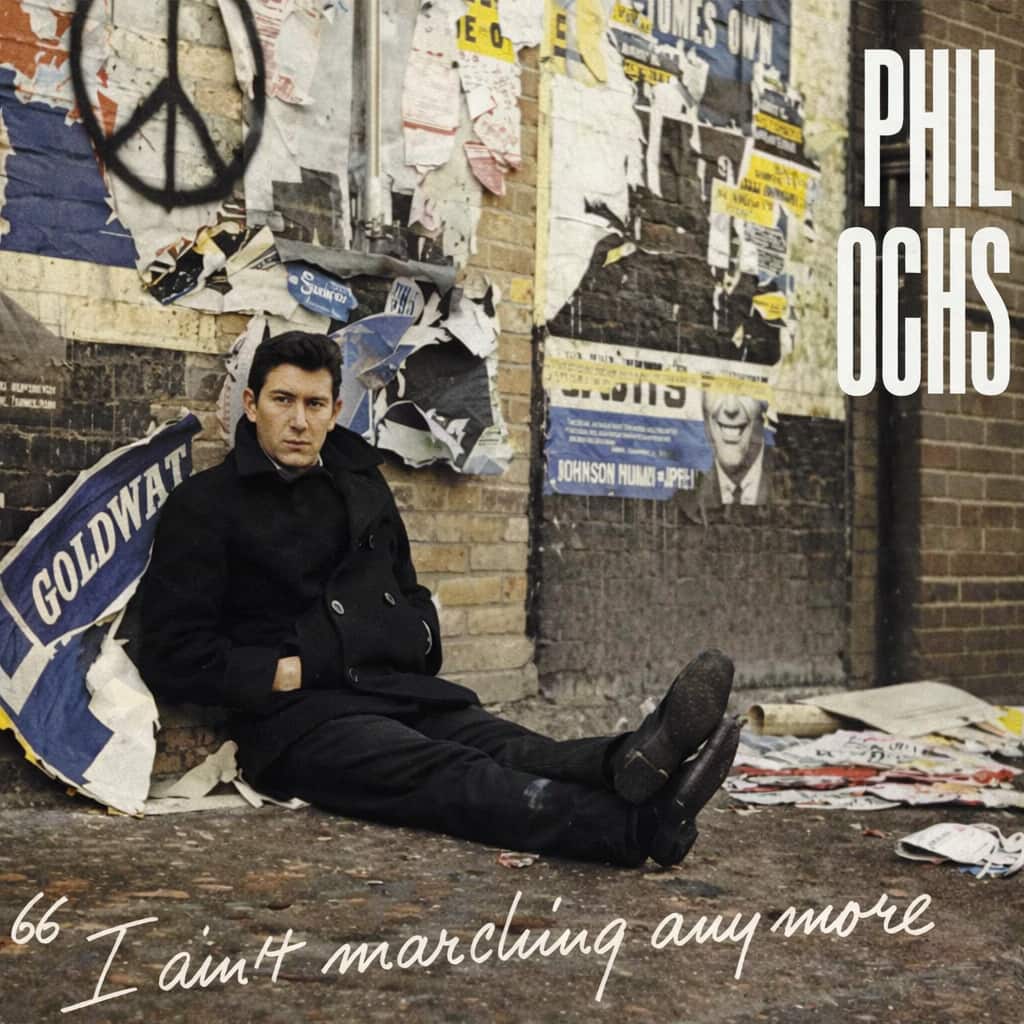
A Quiet Refusal, A Moral Stand: The Timeless Echo of Conscience in “I Ain’t Marching Anymore”
When one speaks of protest music in the turbulent 1960s, few voices resonate with the same clarity and conviction as Phil Ochs. His defining composition, “I Ain’t Marching Anymore”, released in 1965 as the title track of the album “I Ain’t Marching Anymore”, stands as one of the most poignant anti-war anthems of its era. While it did not achieve major commercial chart success in the way pop singles did—failing to enter the Billboard Hot 100—its cultural and political impact far outweighed any numerical ranking. This was a song meant not for entertainment, but for awakening.
At its core, “I Ain’t Marching Anymore” is a stark, unflinching narrative told from the perspective of a soldier reflecting on centuries of war. Ochs traces a lineage of conflict—from the War of 1812 to the Civil War, and ultimately to the then-escalating Vietnam War—placing the listener inside the weary soul of someone who has seen too much. The refrain, simple yet devastating, becomes a declaration of moral exhaustion: a refusal to continue participating in the machinery of war.
The mid-1960s in America was a period marked by unrest, questioning, and generational awakening. As the Vietnam War intensified, young Americans began to challenge the narratives they had inherited. It was within this climate that Phil Ochs, often compared to contemporaries like Bob Dylan, carved out his own distinct voice—less abstract, more direct, and unapologetically political. Where Dylan often cloaked his messages in poetic ambiguity, Ochs delivered his with journalistic precision.
The song gained particular prominence during live performances, most notably at the Newport Folk Festival 1965, where Ochs performed it before an audience already grappling with the changing face of both music and society. In that setting, the song felt less like a performance and more like a public statement—one that resonated deeply with those beginning to question authority and tradition.
Musically, the arrangement is deliberately sparse. A steady, marching rhythm underpins the melody, almost mimicking the very act the song condemns. This contrast—between form and message—creates a haunting tension. Ochs’ voice, clear and unwavering, carries no trace of theatricality; instead, it conveys sincerity, even vulnerability. It is as though he is not merely singing, but bearing witness.
Behind the song lies Ochs’ own deep frustration with American foreign policy and his growing disillusionment with the idea of patriotic duty. Unlike many artists who flirted with protest themes, Ochs lived them. He performed at rallies, wrote extensively about injustice, and used his platform not for fame, but for advocacy. “I Ain’t Marching Anymore” became, in many ways, his personal manifesto.
Yet what gives the song its enduring power is not its historical specificity, but its universal message. It speaks to the individual conscience—the moment when one must decide whether to follow orders or to follow one’s moral compass. That quiet, resolute “no” at the heart of the song continues to echo across generations.
Listening to “I Ain’t Marching Anymore” today is like opening a time capsule, but one that feels unsettlingly relevant. The names of the wars may change, the faces of the leaders may differ, but the questions remain the same. What is duty? What is sacrifice? And at what point does obedience become complicity?
In the vast landscape of folk music, many songs have faded into nostalgia. But this one endures—not because it comforts, but because it challenges. It asks us to remember, to reflect, and perhaps, to reconsider. And in that quiet space between memory and conscience, the voice of Phil Ochs still sings, unwavering and true.