
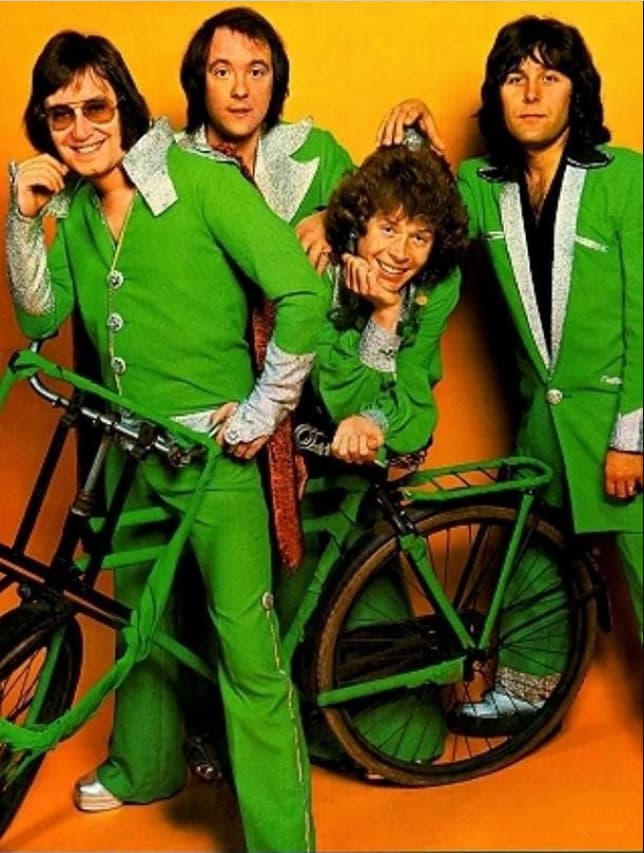
“Crazy” – The Song That Opened the Door for Mud’s Glam-Rock Rise in 1973
When “Crazy” by Mud arrived in early 1973, it did more than simply climb the charts—it marked the moment when a struggling British band finally stepped into the spotlight after years of uncertainty. Released on RAK Records and written by the celebrated songwriting partnership Nicky Chinn and Mike Chapman, the single reached No. 12 on the UK Singles Chart, entering the chart on March 10, 1973 and remaining there for twelve weeks.
That chart position may seem modest compared with the group’s later No. 1 triumphs, but historically it was pivotal. “Crazy” was the very first charting single for Mud, effectively launching the run of hits that would define the band’s golden years throughout the mid-1970s.
In the early 1970s, the four young musicians of Mud—Les Gray (vocals), Rob Davis (guitar), Ray Stiles (bass), and Dave Mount (drums)—had already spent years touring clubs across Britain without a major breakthrough. Formed in the mid-1960s, they were seasoned performers but still searching for the one record that could change everything. That turning point arrived when the powerhouse producer-songwriter duo Chinn and Chapman, already famous for their work with The Sweet, decided to take Mud under their wing.
The partnership came with a fresh musical direction, a new image, and most importantly—a new song. That song was “Crazy.”
Interestingly, the recording itself carried a small secret of the studio world. According to later interviews, the band members primarily contributed the vocals on the early singles, while session musicians performed much of the instrumental backing during the recording process.
It was not uncommon in the pop industry of that era, especially when producers were striving for a polished radio sound.
Musically, “Crazy” stood out even within the flamboyant landscape of early-1970s glam rock. Instead of relying purely on pounding rock rhythms, the song introduced a subtle tango-inspired beat, giving it a slightly theatrical and mysterious flavor.
This unusual rhythmic foundation, combined with Les Gray’s sly vocal delivery, created a track that felt both playful and slightly seductive—a perfect reflection of the glam era’s flair for drama.
But beneath its catchy chorus and danceable rhythm, “Crazy” carries a simple and universal theme: the bewildering, almost irrational power of attraction. The lyrics describe a person who knows they are losing control under the spell of love, yet cannot resist the pull. There is a gentle humor in the way the story unfolds—as if the singer is half-embarrassed, half-delighted by his own emotional confusion.
It is the kind of song that does not try to be philosophical, yet quietly mirrors a truth many listeners recognize: that love, especially in youth, often feels wonderfully irrational.
Listening to “Crazy” today is like opening a small musical time capsule from 1973. The guitars sparkle with the bright, confident tone of early glam rock, the rhythm moves with a theatrical swagger, and Les Gray’s voice carries the charm of a frontman who understood exactly how to make a pop record feel alive.
And perhaps that is why the song still resonates decades later. It captures the moment just before success arrives—the instant when a band on the verge of obscurity suddenly finds the door opening.
After “Crazy,” the road ahead for Mud changed dramatically. Within a year they would release “Dyna-mite,” a Top-5 hit, followed by the smash “Tiger Feet,” which became one of the biggest British singles of 1974.
But those triumphs all trace back to this first breakthrough.
So when we revisit “Crazy,” we are not simply hearing an early glam-rock single. We are witnessing the very moment a band’s long journey finally began to pay off—the sound of persistence rewarded, and of a new chapter opening in British pop history.
And in that sense, the title could not have been more fitting.
Because sometimes, the path to success really does begin with a little bit of crazy.